Progress behind closed doors
pp. 25-26 · Read in the full issue
Guam
By David North
UAM’S political leadership and
■ high federal officials talked behind closed doors in Washington for two days late in February about the island’s relations to the Mainland, and all concerned said afterwards that progress had been made.
“We were able to turn things around .
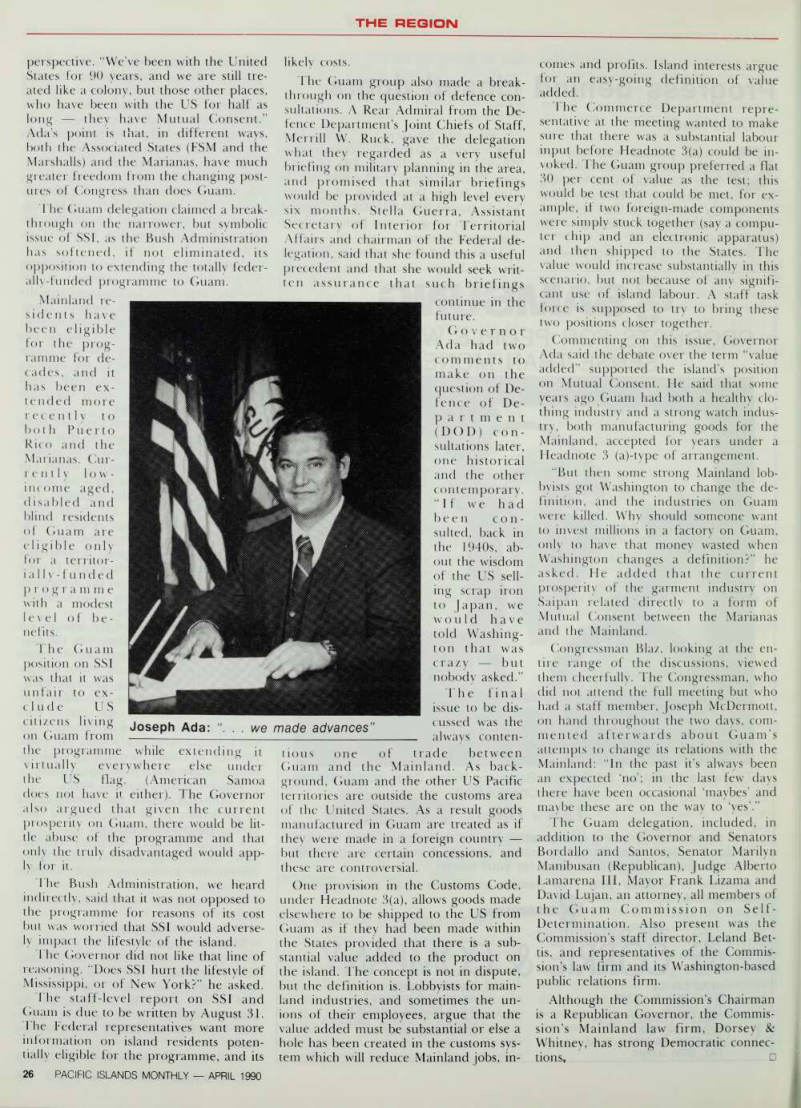
. . we made advances . . . some hard lines were softened,” according to Guam’s Governor Joseph Ada (Republi
can). Larry Morgan, spokesman for the
United States Department of Interior, which hosted the discussions, agreed, saying that progress was being made on four specific issues.
The tone for the meeting in Washing
ton was in sharp contrast to that of De cember’s stormy Congressional hearing in Honolulu which took place in front of hundreds of Guamanians and an array of television cameras and radio mic rophones. The subject of both meetings was the draft Guam Commonwealth Act, written on the island, and later submit ted to the House of Representatives by Guam’s Congressman, Ben Blaz (Repub lican). The proposed bill would fun
damentally change the relationship be
tween the island and the Federal Gov ernment.
Congressman Ron de Lugo (Democrat Virgin Islands), who presided at the hearing, urged the Guamanians and the Federal officials to seek areas of agree ment. He said that without some narrow ing of differences that the Congress was unlikely to do anything with the Guam bill, particularly in light on the ongoing debate on the status of a much larger territory, Puerto Rico (which has more than 3.2 million people).
February’s meeting was designed to be
constructive, by all hands, so that prog ress made was no accident. The sessions were closed, so that neither island nor federal officials felt any need for grand
standing. Similarly the meeting took
place in Washington, far from island activists. Further, it was agreed by the
bi-partisan Guam delegation that only
the Governor would speak to press after the meeting. (Two Democratic Territo rial Senators were part of the delegation: ex-Governor Bordallo’s widow, Made line, and Frank Santos).
The specific output of the sessions was aimed at narrowing differences, the non dramatic stuff of the incremental process of reaching agreements. Four specific issues were raised, by pre-agreement, and after thrashing out both sides’ posi tions it was agreed, in each case, to work toward further areas of agreement at the staff level. Another round of talks,
perhaps in Guam, perhaps in Washing
ton, will take place probably in June.
The four issues covered were: • Mutual Consent, the island’s desire to participate in all Congressional deci sions related to the island;
• Supplemental Security Income
(SSI), the federally-funded welfare prog ramme for low-income aged, disabled and blind; • Consultations on defence matters; and • Trade arrangements.
Mutual Consent is a proposed arrangement which bothers many Main land policymakers who see it as a techni que for giving the island a veto over any and all bills passed by the Congress. No state has this power. In fact, the Amer ican Civil War was fought over a related issue.
Governor Ada sees it from a different
perspective. “We’ve been with the United States for 90 years, and we are still tre ated like a colony, but those other places, who have been with the US for half as long they have Mutual Consent.”
Ada’s point is that, in different ways, both the Associated States (FSM and the Marshalls) and the Marianas, have much greater freedom from the changing post ures of Congress than does Guam.
The Guam delegation claimed a break through on the narrower, but symbolic issue of SSL as the Bush Administration has softened, if not eliminated, its opposition to extending the totally feder ally-funded programme to Guam.
Mainland re sidents have
been eligible
for the prog ramme for de cades, and it has been ex tended more
recently to
both Puerto Rico and the Marianas. Cur
rently low
income aged,
disabled and blind residents of Guam are
eligible only
for a territor
ially-funded
programme with a modest level of be nefits.
The Guam position on SSI was that it was unfair to ex clude US
citizens living
on Guam from
the programme while extending it
virtually everywhere else under
the US flag. (American Samoa does not have it either). The Governor also argued that given the current prosperity on Guam, there would be lit tle abuse of the programme and that
only the truly disadvantaged would app
ly for it.
The Bush Administration, we heard indirectly, said that it was not opposed to the programme for reasons of its cost but was worried that SSI would adverse ly impact the lifestyle of the island.
The Governor did not like that line of reasoning. “Does SSI hurt the lifestyle of Mississippi, or of New York?” he asked.
The staff-level report on SSI and Guam is due to be written by August 31.
The Federal representatives want more information on island residents poten tially eligible for the programme, and its
likely costs.
The Guam group also made a break through on the question of defence con sultations. A Rear Admiral from the De fence Department’s Joint Chiefs of Staff, Merrill W. Ruck, gave the delegation what they regarded as a very useful briefing on military planning in the area, and promised that similar briefings would be provided at a high level every six months. Stella Guerra, Assistant Secretary of Interior for Territorial Affairs and chairman of the Federal de legation, said that she found this a useful precedent and that she would seek writ ten assurance that such briefings
continue m the future.
Governor Ada had two comments to make on the question of De fence of De part m e n t (DOD) con sultations later, one historical and the other contemporary.
“If we had been con sulted, back in the 19405, ab out the wisdom of the US sell ing scrap iron to Japan, we would have
told Washing
ton that was crazy but
nobody asked.”
The final issue to be dis cussed was the always conten
tious one of trade between Guam and the Mainland. As back ground, Guam and the other US Pacific territories are outside the customs area of the United States. As a result goods manufactured in Guam are treated as if they were made in a foreign country but there are certain concessions, and these are controversial.
One provision in the Customs Code, under Headnote 3(a), allows goods made elsewhere to be shipped to the US from Guam as if they had been made within the States provided that there is a sub stantial value added to the product on the island. The concept is not in dispute, but the definition is. Lobbyists for main land industries, and sometimes the un ions of their employees, argue that the value added must be substantial or else a hole has been created in the customs sys tem which will reduce Mainland jobs, in
comes and profits. Island interests argue for an easy-going definition of value added.
The Commerce Department repre sentative at the meeting wanted to make sure that there was a substantial labour input before Headnote 3(a) could be in voked. The Guam group preferred a flat 30 per cent of value as the test; this would be test that could be met, for ex ample, if two foreign-made components were simply stuck together (say a compu ter chip and an electronic apparatus) and then shipped to the States. The value would increase substantially in this scenario, but not because of any signifi cant use of island labour. A staff task force is supposed to try to bring these
two positions closer together.
Commenting on this issue, Governor Ada said the debate over the term “value added” supported the island’s position on Mutual Consent. He said that some years ago Guam had both a healthy clo thing industry and a strong watch indus try, both manufacturing goods for the Mainland, accepted for years under a Headnote 3 (a)-type of arrangement.
“But then some strong Mainland lob byists got Washington to change the de finition, and the industries on Guam were killed. Why should someone want to invest millions in a factory on Guam, only to have that money wasted when Washington changes a definition?” he asked. He added that the current prosperity of the garment industry on Saipan related directly to a form of Mutual Consent between the Marianas and the Mainland.
Congressman Blaz, looking at the en tire range of the discussions, viewed them cheerfully. The Congressman, who did not attend the full meeting but who had a staff member, Joseph McDermott, on hand throughout the two days, com mented afterwards about Guam’s attempts to change its relations with the Mainland: “In the past it’s always been an expected ‘no’; in the last few days there have been occasional ‘maybes’ and maybe these are on the way to ‘yes’.”
The Guam delegation, included, in addition to the Governor and Senators Bordallo and Santos, Senator Marilyn
Manibusan (Republican), Judge Alberto
Lamarena HI, Mayor Frank Lizama and David Lujan, an attorney, all members of the Guam Commission on Self- Determination. Also present was the Commission’s staff director, Leland Bet tis, and representatives of the Commis sion’s law firm and its Washington-based public relations firm.
Although the Commission’s Chairman is a Republican Governor, the Commis sion’s Mainland law firm, Dorsey & Whitney, has strong Democratic connec tions, □
Joseph Ada: "... we made advances”