150 years under the Treaty
p. 20 · Read in the full issue
Maori
By Karen Mangnall
ON February 6 about 30,000 New Zealanders sesqui-ed up to Waitangi in the Bay of Islands for a birthday party. The occasion was the 150th anniversary of the signing of the Treaty of Waitangi, a contract be tween the Crown and chiefs of the va rious Maori tribes, the founding charter of modern New Zealand. The day’s dis cord revealed that 150 years in the life of a nation is only a short leap into adolescence, not the considered stroll of adulthood.
In the past 20 years, Waitangi Day has evolved from the carelessly smug beach barbecue-celebration of immigrant domi nance to a focus for Maori protest. The 50 or so heckling protesters scattered through the viewing stands with their “Honour the Treaty” banners, were stunned first into silence and then cheers by the Bishop of Aotearoa, the Most Rev Whakahuihui Vercoe. Taking his sermon text from Psalm 137, the Anglican Bishop said he had come to the waters of Waitangi “to weep for what could have been a unique document in the his tory of the world of the indigenous peo ple” and their colonisers.
Since the Treaty was signed, Maori had been “marginalised”. Bishop Vercoe said. “The language of this land is yours, the custom is yours, the media by which we tell the world who we are is yours.”
And using the Waitangi national marae protocol, Bishop Vercoe laid down a clear challenge to the Government, as Treaty partner: “You have not honoured the treaty.”
Perhaps in 1984, Geoffrey Palmer architect of the new Labour Govern
ment’s policy on redressing Maori grie
vances might have agreed. But he’s now Prime Minister, behind in the polls, and with race relations looming as a ma jor worry for Pakeha (non-Maori) in the elections later this year. Palmer ignored the Bishop’s verbal challenge reinforc ing in Maori minds how little he under stands their true feelings and attacked the protesters.
New Zealanders, Palmer thundered, wanted to get on with the task of nation building “and they don’t want to have their right to listen to me interfered with by those who would have no-one listen at all”. This right to protest under the ‘rule of law” was what the Treaty of Waitangi had brought to New Zealand, Palmer proclaimed, in one of those glorious in versions of history possible only for for mer constitutional law professors. The
irony cannot have been lost on those in the audience who’d earlier witnessed a re-enactment of the
Treaty signing, when
without the benefits of law and order Maori chiefs had
protested stridently
in accordance with their own protocol while Imperial troops silenced the settler rabble.
It was a singularly
graceless speech,
lacking any vision or
subtlety, bludgeoning
the increasingly un comfortable audience with Palmer’s loud insistence that injus tices weren’t being
ignored, grievances
were being resolved.
Later, the Prime Minister seemed to continue his retreat from electorally un palatable implications
of his own Maori policies by dismissing Bishop Vercoe’s “marginalised” claims as having “not much substance”. c . . upporte by his church superiors, Bishop Vercoe refused to back down; he pointed to the Maori rates of unemployment and imprisonment, much higher in all age groups than Pakeha. Bishop Vercoe also pointed out recent progress in settling Maori grievances through the courts had come despite strong Govern-
ment opposition.
So the grace and appropriate ritual for such a birthday was left to the Maori hosts, the five tribes of Tai Tokerau, and Her Majesty. Queen Elizabeth. Describing herself as a direct descendant of one party to the Treaty, the Queen noted the document had been a “triumph of patience and good intentions”, undermined by differences in language and perception. “Today we are strong enough and honest enough to learn the lessons of the last 150 years and to admit that the treaty has been imperfectly observed.”
But the real stars of Waitangi Day were the 22 magnificent waka taua (Maori war canoes) from tribes all around the country, led by Ngatokimatawhaorua from Tai Tokerau, which escorted the Royal barge across the bay to Waitangi. The foreshore became a tent city as the thousands of paddlers
and their supporters joined as many more Maori taking part in the annual cultural competitions. It was a party within the birthday party, as Maori cele brated the renaissance of an important t of their culture in the face O F f over . whe lmiag odds, But there was also a girding of the loins, a chance to really protest Geof frey Palmer wouldn’t have appreciated the messages from many of the haka (war dances) during the competitions and exchange strategies for the times a ,cacl A j °“ P rotest leader P oln ‘ ed out afterwards, Maori opposition to the sys tem has s .P read d< ; e P er and " lder ,! han annual m P s to Waitangi. While Maori y°" th can celebrate the pr.de of the ™ aka taua renaissance, most of the pad d ers would return home to the unem - P ovme,u c l ueue - So far, New Zealand’s official celebra tions have hooned around like a party of teenagers in Dad’s car, high on the euphoria of the Commonwealth Games and fuelled by the rhetoric of a new dawn in nationhood. But on the road
are signs of growing Maori impatience
over backlogged land and resource claims. The driver ignored Bishop Ver coe’s warning flags and there’s a lamp post up ahead. The party’s over, wel come to the real 1990. □
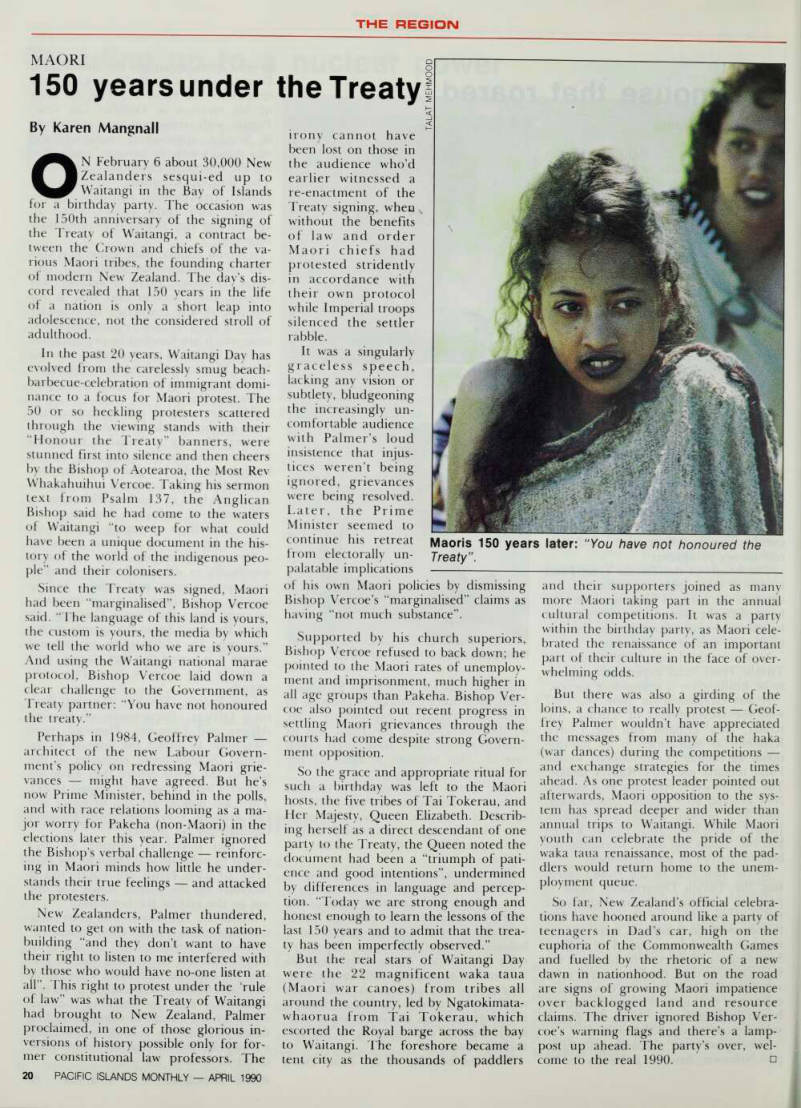
Maoris 150 years later: “You have not honoured the Treaty”.