Diana Mcmanus
p. 19 · Read in the full issue
Tuvalu
The mouse that roared
By Diana McManus
TINY Tuvalu can almost be seen as the mouse that roared. As one of the world’s smallest sovereign na tions it is propped up largely with aid from friendly donor countries. However, it is determined to become economically self-reliant despite formidable difficul ties. This determination has given rise to an aid experiment which is the world’s first in design concept, and Tuvalu is possibly still the only developing nation to be benefitting from such a scheme.
The scheme is, of course, the Tuvalu Trust Fund.
Normally economic aid comes in pack age form funded by one or more donors. There is usually a specific pro ject in mind and once that project has been completed the maintenance and running costs fall upon the shoulders of the recipient. Whilst these sorts of pack ages are gratefully received and often add vital infrastructural plant and ser vices to Tuvalu, they do not necessarily create a developing situation for Tuvalu.
Health services, sea walls, education, the Public Services, are not short term in
come-generating propositions and they
cost money to upkeep.
The beauty of the Tuvalu Trust Fund is that it does generate immediate in come in the form of interest which may be used by the Government, after capital maintenance and administration charges, to finance recurrent expenditure.
Now in its third year of operations the Tuvalu Trust Fund experiment appears to be heading for a resounding success.
It was established on June 16, 1987 with the Governments of Tuvalu, Au stralia, New Zealand and the United Kingdom as signatories to an interna tional agreement. Contributions to the Fund totalled just over A 527.4 million.
The donors were: Australia $B.O million, New Zealand $8.3 million, United King dom $8.5 million, Tuvalu $1.6 million, Japan $700,000 and South Korea $30,000. Japan and South Korea did not become parties to the Agreement.
In the first year of the Fund’s incep tion the Tuvalu Government chose to pace its withdrawals because the stock market wobble in October 1987 threatened to jeopardise its future. Over night the Fund lost about $l.B million.
Spending on Government business was very cautious until the Fund’s real value was re-established. Now the Government expects to call upon the interest annual ly. At September 30, 1989 the Fund’s value stood at over $33.7 million.
“The good news”, according to Pana pasi Nelesone, Assistant Secretary for Fi-
nance, “is that for 1990 about $1 million from the Fund’s earnings is available to assist with recurrent expenditure after all the real value of the Fund and its administration costs have been taken care of. That amounts to about 25 per cent of the total Budget.”
The money is managed by Westpac
Investment Management Proprietary Li
mited, of Australia. Its goal is to mini mise risk through a diversified invest ment portfolio within Australia and overseas.
The islanders do not want to live on hand-outs. The Trust Fund is seen as a very real way of overcoming some of the country’s economic short-comings. Tuva lu does try very hard to operate on a
balanced budget. However, departure
taxes and customs duties, improvements in taxation, accounting and management systems are not enough to make ends meet; not even with the limited foreign exchange earnings derived from its Phi latelic Bureau and licensing of foreign fishing vessels.
With the benefits of the Trust Fund
project quite apparent, the new Paeniu Government is actively seeking new donors for the Fund. Hard on the heels of his election in October last year, Paeniu, with senior members of his Pub lic Service, approached traditional and new donors with the proposal while visit ing the European Economic Community.
The United Kingdom, (traditional), France, (traditional), Germany, (tradi tional), and Italy, (new), were all approached and Tuvalu is awaiting their response.
It would appear, once again, that spe cific aid policies may inhibit the out come. However, there is another way around the problem and that is for possible donor countries to consider allowing some of their regional aid dona tions which are handled by organisations such as UNDP to be channelled into the Fund. This is one of the most appropri ate and pressing aid requirements per ceived by Tuvalu.
The Trust Fund will be one of the items on the agenda for discussion at the Donors’ Meeting in Funafuti scheduled for next month. The meeting was to have been held last July but was post poned due to the pressures of the gener al election held in October. This meeting will consist of traditional donors.
The UNDP is arranging a follow-up round table meeting of donor countries at Geneva in November. The meeting is specifically to discuss Tuvalu’s develop ment programmes and policies and to identify areas where the donor commun ity could best assist Tuvalu. Certainly the Trust Fund will be on the agenda at that meeting. In addition to traditional donors it is hoped that new donors, par ticularly the Nordic countries, will attend.
Seve Paeniu, Tuvalu’s Assistant Plan ning Officer, Department of Foreign Affairs and Economic Planning, says: “We hope to attract the interest of the Nordic (Scandinavian) countries to this part of the world where they have not formerly been involved in respect to aid.
Their aid policies are less stringent and this ties in very well with Tuvalu’s rationale on aid projects.”
In fact UNDP is assisting Tuvalu’s efforts to publicise and promote the con cept of the Fund by financing a brochure on the subject which was due out by the end of the last month.
Optimism, enthusiasm and determina tion abound in Tuvalu Government cir cles when it comes to the Tuvalu Trust Fund. There is no denying that at pre sent the experimental Trust Fund, in its extreme infancy, represents a success which may have far reaching consequ ences for the future of other struggling developing nations. It could well become a blueprint for survival for other small countries around the world. □
Diana Mcmanus
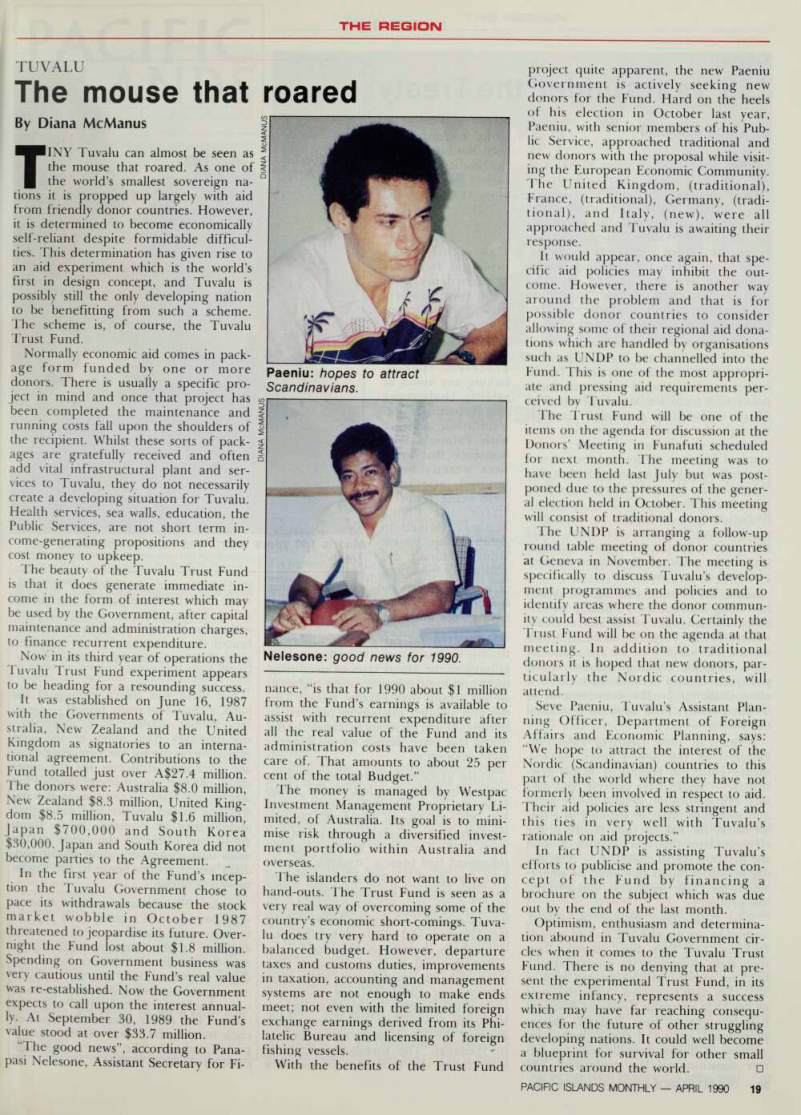
Paeniu: hopes to attract Scandinavians.
Nelesone: good news for 1990.