Namaliu vs Tohian: what really happened?
pp. 16-17 · Read in the full issue
By Frank Senge
WAS there an attempted coup in Papua New Guinea or not?
That is the grand question that a high level police investigation will un cover soon.
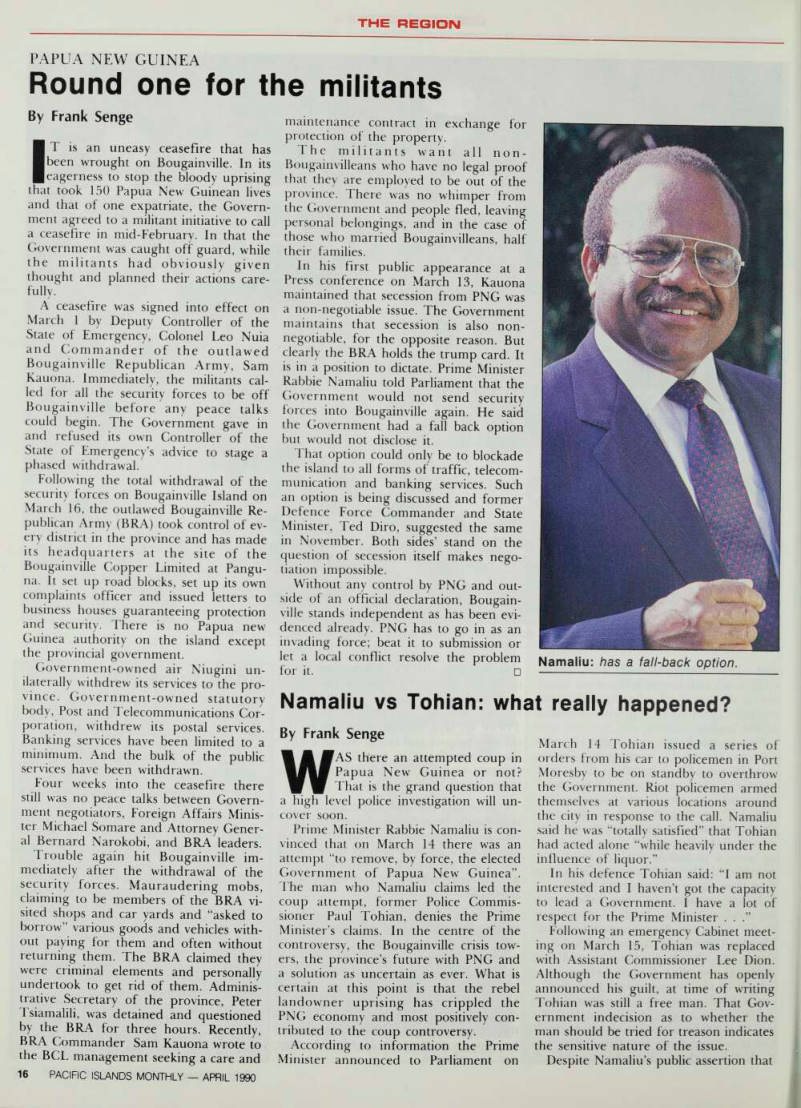
Prime Minister Rabbie Namaliu is con vinced that on March 14 there was an attempt “to remove, by force, the elected Government of Papua New Guinea”.
The man who Namaliu claims led the coup attempt, former Police Commis sioner Paul Tohian, denies the Prime Minister’s claims. In the centre of the controversy, the Bougainville crisis tow ers, the province’s future with PNG and a solution as uncertain as ever. What is certain at this point is that the rebel landowner uprising has crippled the PNG economy and most positively con tributed to the coup controversy.
According to information the Prime Minister announced to Parliament on
March 14 Tohian issued a series of orders from his car to policemen in Port Moresby to be on standby to overthrow the Government. Riot policemen armed themselves at various locations around the city in response to the call. Namaliu said he was “totally satisfied” that Tohian had acted alone “while heavily under the influence of liquor.”
In his defence Tohian said: “I am not interested and I haven’t got the capacity to lead a Government. I have a lot of respect for the Prime Minister . .
Following an emergency Cabinet meet ing on March 15, Tohian was replaced with Assistant Commissioner Lee Dion.
Although the Government has openly announced his guilt, at time of writing Tohian was still a free man. That Gov ernment indecision as to whether the man should be tried for treason indicates the sensitive nature of the issue.
Despite Namaliu’s public assertion that
Tohian acted alone and offered congra tulatory remarks to the “loyalty and dis cipline” of the police and defence forces, there is a very real underlying fear that Tohian was not alone.
It is a fear that is confirmed by a senior officer of the Defence Force. “Mr Tohian did not coordinate it properly,” he said. “There are a lot of discontented soldiers in the defence force. They would have supported him.” Tohian said he was “fed up with the system,” adding: “In a way it (the coup attempt or pro test) -has to do too with frustration I faced on Bougainville and the interfer ence I had to face from the Govern ment. There was too much political in terference.”
Paul Tarcissius Tohian, 41, was, until his sacking, the only man in the nation to ever have under his command mem bers of the defence, police and correc tional institution forces in PNG.
He was the controller of the State of Emergency on Bougainville island where he commanded 600 joint security forces, “very successfully” according to his men
and not quite successfully according to
the Government. A respected banker and a personal friend of the Prime Minister said: “It (the coup attempt) is an outward manifestation of a deeper feeling,”
The police and defence forces have often before threatened to go on strike out of frustration at Government failing to improve conditions for members. The soldiers riot in 1987 was one outward expression of that frustration. The frus tration was compounded and pressured to combustion point in the recent Bougainville exercise. □
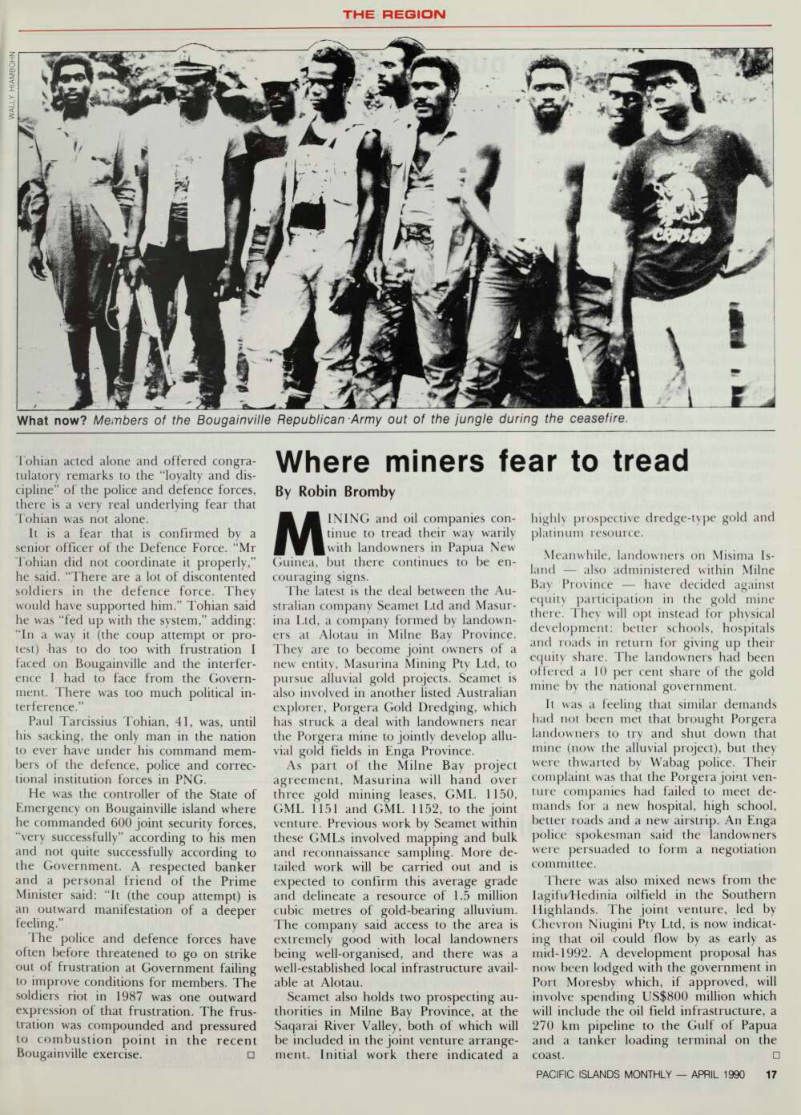
What now? Members of the Bougainville Republican Army out of the jungle during the ceasefire.