Round one for the militants
p. 16 · Read in the full issue
Papua New Guinea
By Frank Senge
IT is an uneasy ceasefire that has been wrought on Bougainville. In its eagerness to stop the bloody uprising that took 150 Papua New Guinean lives and that of one expatriate, the Govern ment agreed to a militant initiative to call a ceasefire in mid-February. In that the Government was caught off guard, while the militants had obviously given thought and planned their actions care
fully.
A ceasefire was signed into effect on March 1 by Deputy Controller of the State of Emergency, Colonel Leo Nuia and Commander of the outlawed
Bougainville Republican Army, Sam
Kauona. Immediately, the militants cal led for all the security forces to be off Bougainville before any peace talks could begin. The Government gave in and refused its own Controller of the State of Emergency’s advice to stage a phased withdrawal.
Following the total withdrawal of the security forces on Bougainville Island on March 16, the outlawed Bougainville Re publican Army (BRA) took control of ev ery district in the province and has made its headquarters at the site of the Bougainville Copper Limited at Pangu na. It set up road blocks, set up its own complaints officer and issued letters to business houses guaranteeing protection and security. There is no Papua new Guinea authority on the island except the provincial government.
Government-owned air Niugini un ilaterally withdrew its services to the pro vince. Government-owned statutory body, Post and Telecommunications Cor poration, withdrew its postal services.
Banking services have been limited to a minimum. And the bulk of the public services have been withdrawn.
Four weeks into the ceasefire there still was no peace talks between Govern ment negotiators, Foreign Affairs Minis ter Michael Somare and Attorney Gener al Bernard Narokobi, and BRA leaders.
Trouble again hit Bougainville im mediately after the withdrawal of the
security forces. Mauraudering mobs,
claiming to be members of the BRA vi sited shops and car yards and “asked to borrow” various goods and vehicles with out paying for them and often without returning them. The BRA claimed they were criminal elements and personally undertook to get rid of them. Adminis trative Secretary of the province, Peter Tsiamalili, was detained and questioned by the BRA for three hours. Recently, BRA Commander Sam Kauona wrote to the BCL management seeking a care and
maintenance contract in exchange for protection of the property.
The militants want all non- Bougainvilleans who have no legal proof that they are employed to be out of the province. There was no whimper from the Government and people fled, leaving personal belongings, and in the case of those who married Bougainvilleans, half their families.
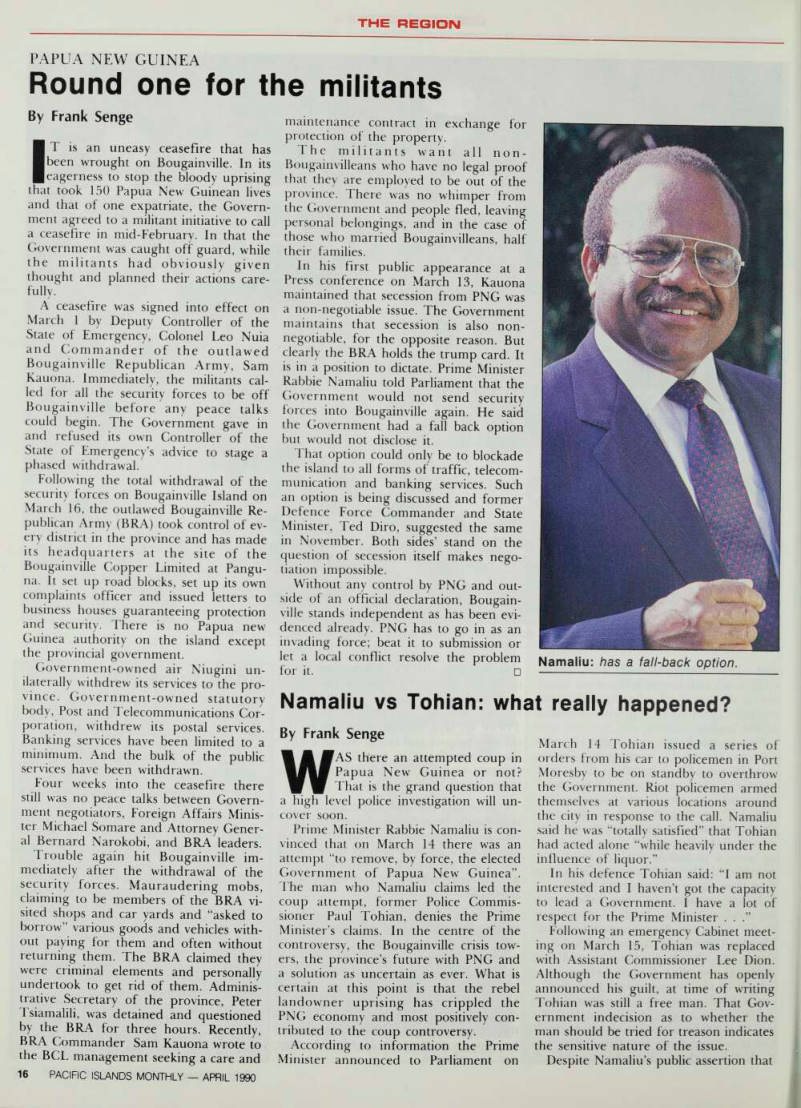
In his first public appearance at a Press conference on March 13, Kauona maintained that secession from PNG was a non-negotiable issue. The Government maintains that secession is also non negotiable, for the opposite reason. But clearly the BRA holds the trump card. It is in a position to dictate. Prime Minister Rabbie Namaliu told Parliament that the Government would not send security forces into Bougainville again. He said the Government had a fall back option but would not disclose it.
That option could only be to blockade the island to all forms of traffic, telecom munication and banking services. Such an option is being discussed and former Defence Force Commander and State Minister, Ted Diro, suggested the same in November. Both sides’ stand on the question of secession itself makes nego
tiation impossible.
Without any control by PNG and out side of an official declaration, Bougain ville stands independent as has been evi denced already. PNG has to go in as an invading force; beat it to submission or let a local conflict resolve the problem for it. □
Namaliu: has a fail-back option.