Then there is light
pp. 23-25 · Read in the full issue
The hope after Bougainville
All is not lost in Papua New Guinea while Bougainville is breaking the back of the economy, new oil strikes promise a good future once peace is found.
By Robin Bromby
FOR the government of Papua New Guinea Prime Minister Rabbie Namaliu, the news did not get any better. The irony is that, while his gov ernment was dragged deeper into the political quicksand over the Bougainville rebellion, the long-term future of the country was given a boost with the news of new oil strikes in Papua, strikes which confirmed the enormous potential of the
nation but one that increasingly looks to be many years away.
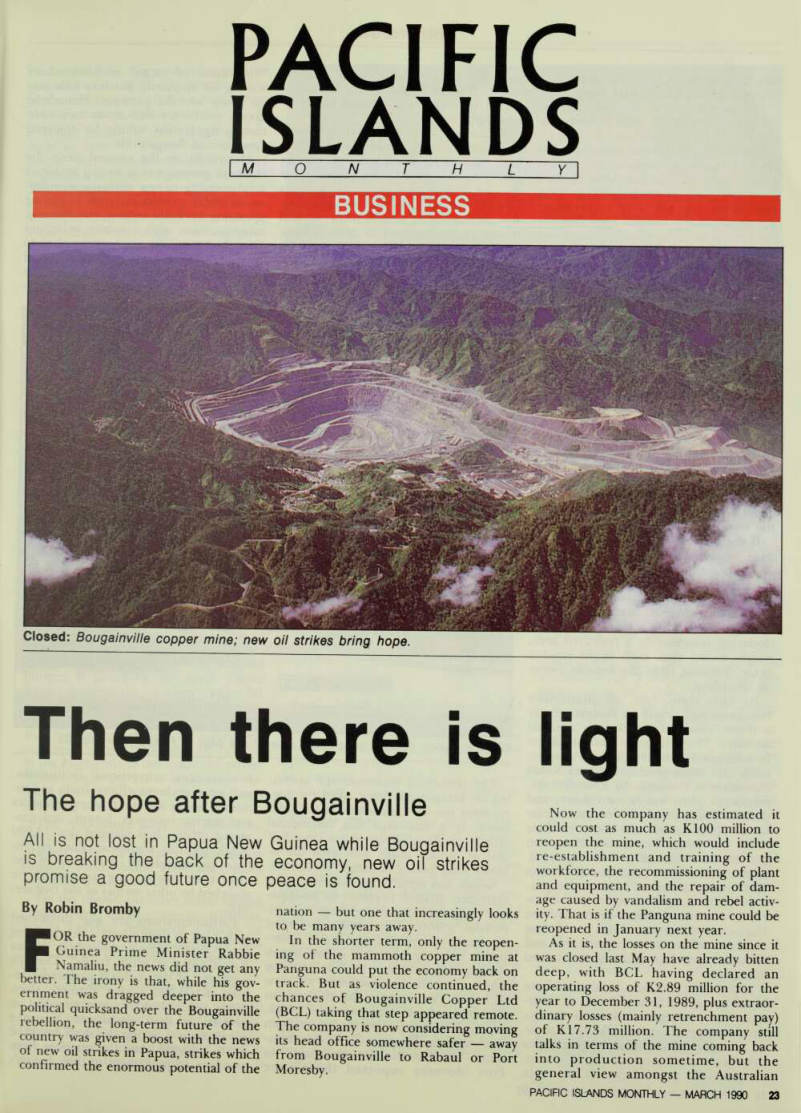
In the shorter term, only the reopen ing of the mammoth copper mine at Panguna could put the economy back on track. But as violence continued, the chances of Bougainville Copper Ltd (BCL) taking that step appeared remote.
The company is now considering moving its head office somewhere safer away from Bougainville to Rabaul or Port Moresby.
Now the company has estimated it could cost as much as KlOO million to reopen the mine, which would include re-establishment and training of the workforce, the recommissioning of plant and equipment, and the repair of dam age caused by vandalism and rebel activ ity. That is if the Panguna mine could be reopened in January next year.
As it is, the losses on the mine since it was closed last May have already bitten deep, with BCL having declared an operating loss of K 2.89 million for the year to December 31, 1989, plus extraor
dinary losses (mainly retrenchment pay)
of K 17.73 million. The company still talks in terms of the mine coming back into production sometime, but the general view amongst the Australian
financial world is that the mine is a write-off for at least several years.
The effects are seeping into all the corners of the Papua New Guinea eco nomy.
The general economic downturns has affected the large regional air service, Talair. Flight services have been reduced by 10 per cent, retrenched staff and has three aircraft for sale all as a result in the plight of the nation. The company has also been affected by government pressure (by means of threatening not to renew work permits) to turn jobs held by expatriates over to nationals, a problem faced by owner Dennis Buchanan last year in Vanuatu when he pulled out of his other airline, Air Melanesie, and sold it to the Port Vila government.
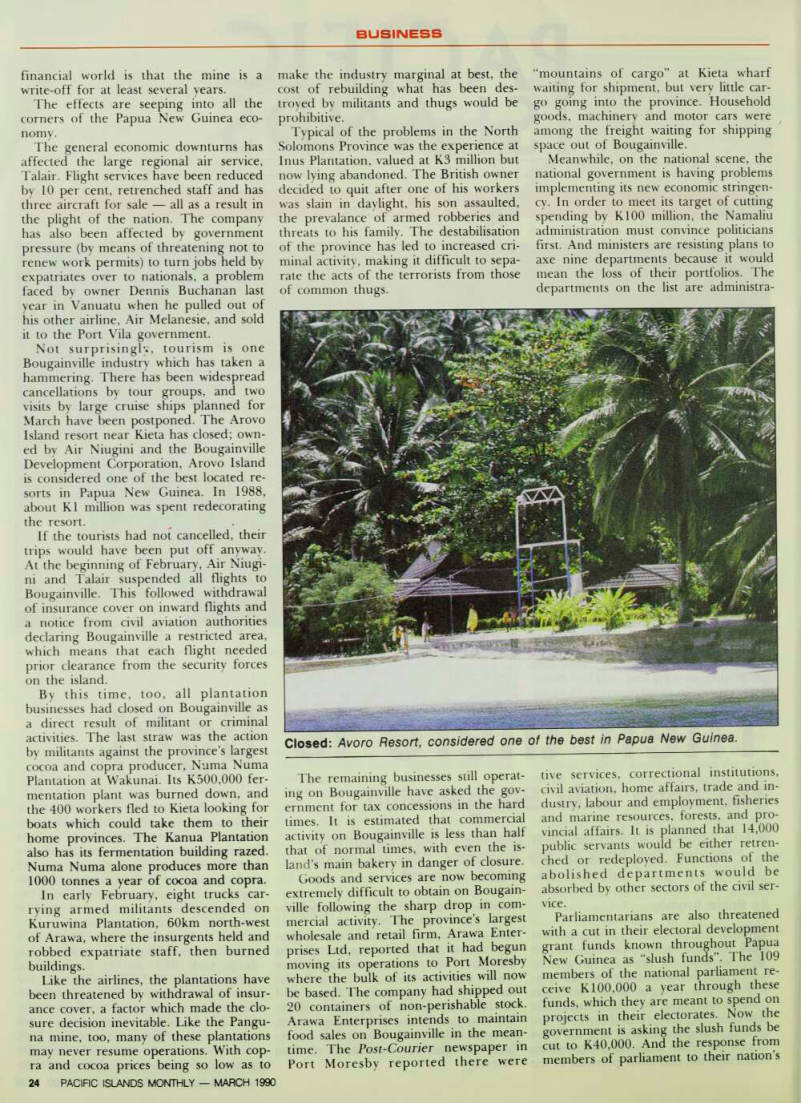
Not surprisingly, tourism is one Bougainville industry which has taken a hammering. There has been widespread cancellations by tour groups, and two visits by large cruise ships planned for March have been postponed. The Arovo Island resort near Kieta has closed; own ed by Air Niugini and the Bougainville
Development Corporation, Arovo Island
is considered one of the best located re sorts in Papua New Guinea. In 1988, about K 1 million was spent redecorating the resort.
If the tourists had not cancelled, their trips would have been put off anyway.
At the beginning of February, Air Niugi ni and Talair suspended all flights to Bougainville. This followed withdrawal of insurance cover on inward flights and a notice from civil aviation authorities declaring Bougainville a restricted area, which means that each flight needed prior clearance from the security forces on the island.
By this time, too, all plantation businesses had closed on Bougainville as a direct result of militant or criminal activities. The last straw was the action
by militants against the province’s largest
cocoa and copra producer, Numa Numa Plantation at Wakunai. Its K 500,000 fer mentation plant was burned down, and the 400 workers fled to Kieta looking for boats which could take them to their home provinces. The Kanua Plantation also has its fermentation building razed.
Numa Numa alone produces more than 1000 tonnes a year of cocoa and copra.
In early February, eight trucks car rying armed militants descended on Kuruwina Plantation, 60km north-west of Arawa, where the insurgents held and robbed expatriate staff, then burned
buildings.
Like the airlines, the plantations have been threatened by withdrawal of insur ance cover, a factor which made the clo sure decision inevitable. Like the Pangu na mine, too, many of these plantations may never resume operations. With cop ra and cocoa prices being so low as to
make the industry marginal at best, the cost of rebuilding what has been des troyed by militants and thugs would be
prohibitive.
Typical of the problems in the North Solomons Province was the experience at Inus Plantation, valued at K 3 million but now lying abandoned. The British owner decided to quit after one of his workers was slain in daylight, his son assaulted, the prevalance of armed robberies and threats to his family. The destabilisation of the province has led to increased cri minal activity, making it difficult to sepa rate the acts of the terrorists from those of common thugs.
The remaining businesses still operat ing on Bougainville have asked the gov ernment for tax concessions in the hard times. It is estimated that commercial activity on Bougainville is less than half that of normal times, with even the is land’s main bakery in danger of closure.
Goods and services are now becoming extremely difficult to obtain on Bougain ville following the sharp drop in com mercial activity. The province’s largest wholesale and retail firm, Arawa Enter prises Ltd, reported that it had begun moving its operations to Port Moresby where the bulk of its activities will now be based. The company had shipped out 20 containers of non-perishable stock.
Arawa Enterprises intends to maintain food sales on Bougainville in the mean time. The Post-Courier newspaper in Port Moresby reported there were
“mountains of cargo” at Kieta wharf waiting for shipment, but very little car go going into the province. Household goods, machinery and motor cars were among the freight waiting for shipping space out of Bougainville.
Meanwhile, on the national scene, the national government is having problems implementing its new economic stringen cy. In order to meet its target of cutting spending by KlOO million, the Namaliu administration must convince politicians first. And ministers are resisting plans to axe nine departments because it would mean the loss of their portfolios. The departments on the list are administra
tive services, correctional institutions, civil aviation, home affairs, trade and in dustry, labour and employment, fisheries and marine resources, forests, and pro vincial affairs. It is planned that 14,000 public servants would be either retren ched or redeployed. Functions of the abolished departments would be absorbed by other sectors of the civil ser vice.
Parliamentarians are also threatened with a cut in their electoral development grant funds known throughout Papua New Guinea as “slush funds”. The 109 members of the national parliament re ceive K 100,000 a year through these funds, which they are meant to spend on projects in their electorates. Now the government is asking the slush funds be cut to K 40,000. And the response from members of parliament to their nation’s
Closed: Avoro Resort, considered one of the best in Papua New Guinea.
economic crisis? They asked for advance payment of the K 100,000, presumably to make sure they get all the money before the government coffers run dry.
It now looks as if the World Bank will have to come to Papua New Guinea’s rescue, and there have been reports in Australian newspapers that the bank will ask Canberra for Asso million as that country’s contribution to the bail-out.
But there is strong opposition to helping Papua New Guinea any further, given that Australia already underpins the national budget with its annual aid pack age. Typical of the thinking was the comment by a former Papua New Guinea University economics professor, Brian Brogan, who said Australia had to take a tough line on aid, that decision makers in Port Moresby should face the reality of their plight, and the Canberra politicians should not encourage any temptation to take the soft options by handing over more money.
Central Bank governor Sir Henry Toßobert said there were no plans for a further devaluation of the kina. The bank was seeking credit lines from the International Monetary Fund and World Bank.
Sir Henry said Papua New Guinea’s foreign exchange reserves, now at K 363 million, would dip by K 215 million to less than Kl5O million at the end of the 1990. The government plans to use the IMF facilities to maintain reserves at K3OO million by the end of the year.
There is no doubt that the closure of the Bougainville mine, and the loss of its making up 40 per cent of the country’s exports and 17 per cent of the national budget, is going to bite deep. Justice Brian Brunto, the resident judge for Eastern Highlands and Chimbu pro vinces, has warned the economic decline and low prices received for coffee will combine to force thousands of families in the Highlands to live below the pover ty line, triggering a rise in domestic vio lence and child abuse, with many fami lies being unable to pay school fees.
The Agriculture Bank has waived in terest payments on all cocoa and coffee projects over 20 hectares which if has funded, which should allow some relief to the agriculture sector.
On the upside, the other major mining projects are working up on schedule, Santos Ltd has announced a major oil strike in Papua and the lagifu partners are expected to announce by April that they plan to proceed developing that oil field and build a pipeline to the coast.
The feelings of observers was summed up by one expatriate in Port Moresby: Papua New Guinea will be a great coun try in 15 years’ time, it’s just not going to much fun in the meantime. □