Compact vote fails again
p. 22 · Read in the full issue
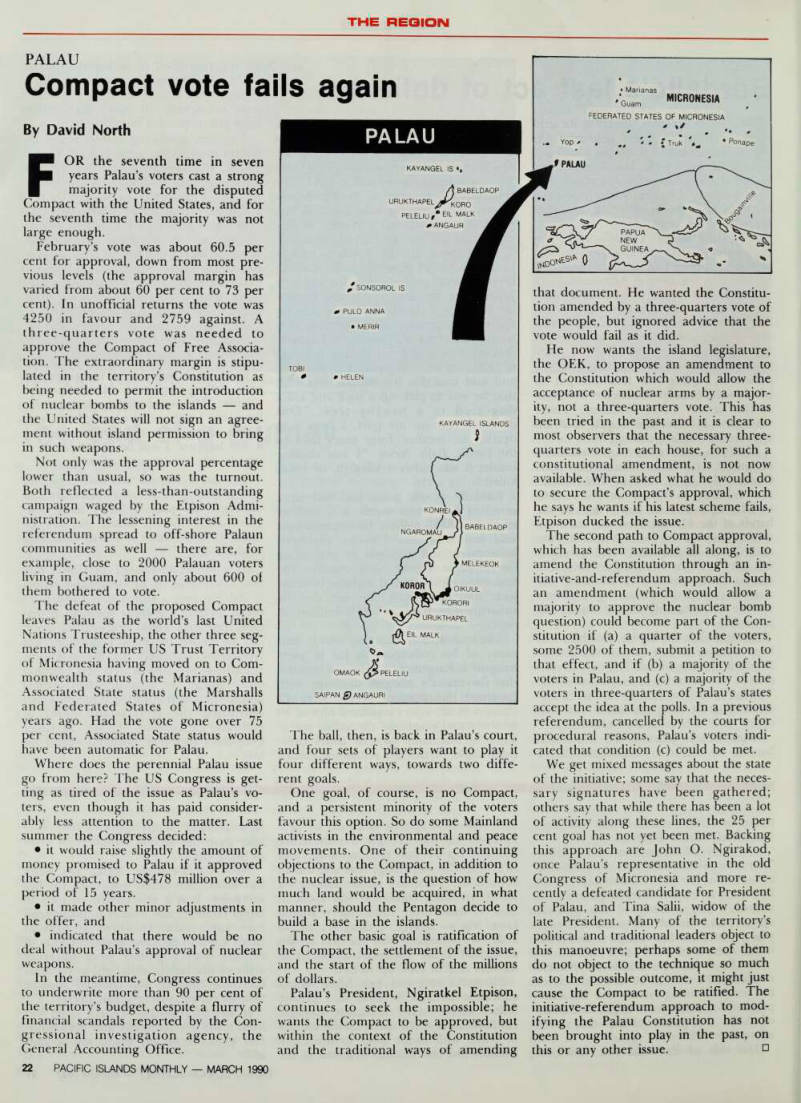
Palau
By David North
FOR the seventh time in seven years Palau’s voters cast a strong majority vote for the disputed Compact with the United States, and for the seventh time the majority was not
large enough.
February’s vote was about 60.5 per cent for approval, down from most pre vious levels (the approval margin has varied from about 60 per cent to 73 per cent). In unofficial returns the vote was 4250 in favour and 2759 against. A three-quarters vote was needed to approve the Compact of Free Associa
tion. The extraordinary margin is stipu
lated in the territory’s Constitution as being needed to permit the introduction of nuclear bombs to the islands and the United States will not sign an agree ment without island permission to bring in such weapons.
Not only was the approval percentage lower than usual, so was the turnout.
Both reflected a less-than-outstanding campaign waged by the Etpison Admi nistration. The lessening interest in the referendum spread to off-shore Palaun communities as well there are, for example, close to 2000 Palauan voters living in Guam, and only about 600 of them bothered to vote.
The defeat of the proposed Compact leaves Palau as the world’s last United Nations Trusteeship, the other three seg ments of the former US Trust Territory of Micronesia having moved on to Com monwealth status (the Marianas) and Associated State status (the Marshalls and Federated States of Micronesia) years ago. Had the vote gone over 75 per cent, Associated State status would have been automatic for Palau.
Where does the perennial Palau issue go from here? The US Congress is get ting as tired of the issue as Palau’s vo ters, even though it has paid consider ably less attention to the matter. Last summer the Congress decided: • it would raise slightly the amount of money promised to Palau if it approved the Compact, to US$47B million over a period of 15 years. • it made other minor adjustments in the offer, and • indicated that there would be no deal without Palau’s approval of nuclear weapons.
In the meantime, Congress continues to underwrite more than 90 per cent of the territory’s budget, despite a flurry of financial scandals reported by the Con gressional investigation agency, the General Accounting Office.
The ball, then, is back in Palau’s court, and four sets of players want to play it four different ways, towards two diffe
rent goals.
One goal, of course, is no Compact, and a persistent minority of the voters favour this option. So do some Mainland activists in the environmental and peace movements. One of their continuing objections to the Compact, in addition to the nuclear issue, is the question of how much land would be acquired, in what manner, should the Pentagon decide to build a base in the islands.
The other basic goal is ratification of the Compact, the settlement of the issue, and the start of the flow of the millions of dollars.
Palau’s President, Ngiratkel Etpison,
continues to seek the impossible; he wants the Compact to be approved, but within the context of the Constitution and the traditional ways of amending
that document. He wanted the Constitu tion amended by a three-quarters vote of the people, but ignored advice that the vote would fail as it did.
He now wants the island legislature, the OEK, to propose an amendment to the Constitution which would allow the acceptance of nuclear arms by a major ity, not a three-quarters vote. This has been tried in the past and it is clear to most observers that the necessary three quarters vote in each house, for such a constitutional amendment, is not now available. When asked what he would do to secure the Compact’s approval, which he says he wants if his latest scheme fails, Etpison ducked the issue.
The second path to Compact approval,
which has been available all along, is to amend the Constitution through an in itiative-and-referendum approach. Such an amendment (which would allow a majority to approve the nuclear bomb question) could become part of the Con stitution if (a) a quarter of the voters, some 2500 of them, submit a petition to that effect, and if (b) a majority of the voters in Palau, and (c) a majority of the voters in three-quarters of Palau’s states accept the idea at the polls. In a previous referendum, cancelled by the courts for procedural reasons, Palau’s voters indi cated that condition (c) could be met.
We get mixed messages about the state of the initiative; some say that the neces sary signatures have been gathered; others say that while there has been a lot of activity along these lines, the 25 per cent goal has not yet been met. Backing this approach are John O. Ngirakod, once Palau’s representative in the old Congress of Micronesia and more re cently a defeated candidate for President of Palau, and Tina Salii, widow of the late President. Many of the territory’s political and traditional leaders object to this manoeuvre; perhaps some of them do not object to the technique so much as to the possible outcome, it might just cause the Compact to be ratified. The initiative-referendum approach to mod ifying the Palau Constitution has not been brought into play in the past, on this or any other issue. D