Operation Evacuation
p. 18 · Read in the full issue
Papua New Guinea
PEOPLE have been evacuated en masse from the troubled island of Bougainville where the gov ernment of Papua New Guinea has de clared war against secessionist rebels.
Hundreds of plantation workers, govern ment workers and expatriates were taken out of the island in an operation begin ning February 9. The mass evacuation started after eight truckloads of Bougainville Republican Army guerillas
attacked plantations.
The national airline, Air Niugini, put in several F2B flights a day and airlifted hundreds of people to the northern port of Rabaul in East New Britain and to the
capital, Port Moresby. Flights continued
under special security arrangements made with the army, allowing the planes to keep flying under special insurance
cover. Nearly all employees of Bougain
ville Copper Limited were evacuated, leaving only a small team of managerial staff.
A report in the Canberra Times on February 12 renewed concern over Au stralia’s involvement in the Bougainville
crisis. The paper reported that Canberra told its Port Moresby High Commission to advise the Papua New Guinea govern ment that “we have committed a batta lion”. But the PNG government did not want the direct involvement of Austra lian troops and the Canberra message was withdrawn without any explanation.
However, the Australian High Com mission in Port Moresby released a
three-paragraph statement urging all
Australian citizens “who do not have essential reasons for staying in Bougain ville ... to leave as soon as practicable”.
What was interesting, however, was the fact that the Australian mention of troops was made after Bougainville Cop per Limited had completed an airport at Panguna in three days. The airport is big enough to take Hercules aircraft which can carry troops and military hardware.
The provincial government of Joseph Kabui is virtually unable to govern Bougainville where the army and pro secessionist guerillas of the Bougainville
Republican Army are fighting a 15-
month bush war. Kabui’s administrative secretary, Peter Tsiamalili, was bashed up by the army on February 7. Kabui himself was the target of army brutality late last year when he had a gun thrust in his face. The national government is
seriously considering the suspension of
the provincial government. That will save administrative costs and allow the army to acquire an extra Kl 7 million, at least, for military operations on the is land.
The current state of emergency on Bougainville ends on March 12 when Parliament will reconvene and govern ment will seek another extension. There is no solution in sight except a military one which the government is pushing.
Government is losing patience. Said Prime Minister Rabbie Namaliu: “The endless hours of negotiations, the dozens of people who have been fruitlessly en gaged in the pursuit of a peaceful solu tion to the crisis all of those have failed to produce the lasting solution we all desire.”
The war on Bougainville is having a disastrous effect on the civilian popula tion. The people of Buin, Siwai and Kongara areas, for example, have run out of basic commodities like soap and kerosene because the army has restricted the flow of supplies into the region to try and cut the guerillas’ supply line.
The army, however, seems to have in creased supplies to include items that can be classified as chemical weapons. A report in the weekly newspaper Times of
Papua New Guinea said army stores in Bougainville contained chemical weapons. The paper said it documented some of the chemicals stored in the security forces’ ammunition dump at Koiari and found that out of 45 items listed, the following were chemical weapons: • 9 class 1363 military chemical agents ESH 36 and 35, • 1 PAM 27 CW ammunition EGH 36, • 5 CW grenades, • 4 inservice bulk CW ammunition, • 5 biological agents.
The revelation of these chemicals fol lows a denial by the state of emergency controller Paul Tohian that government forces sprayed chemicals from helicop ters. Radio North Solomons reported that a woman and two children were tre ated for chemical injuries by a clinic on the island. The report angered the security forces who subsequently ordered the reporter out of Bougainville. □
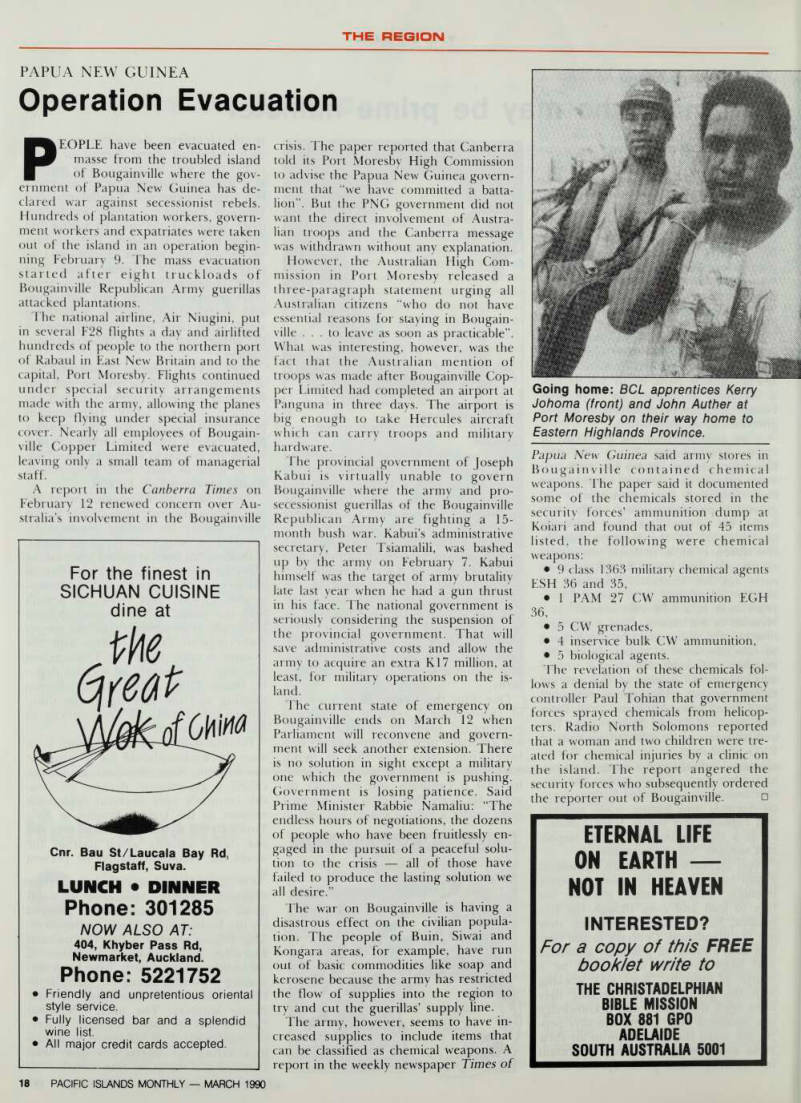
Going home: BCL apprentices Kerry Johoma (front) and John Auther at Port Moresby on their way home to Eastern Highlands Province.