Solomon Star
p. 17 · Read in the full issue
Solomon Islands
The man who may be prime minister
By Dykes Angiki
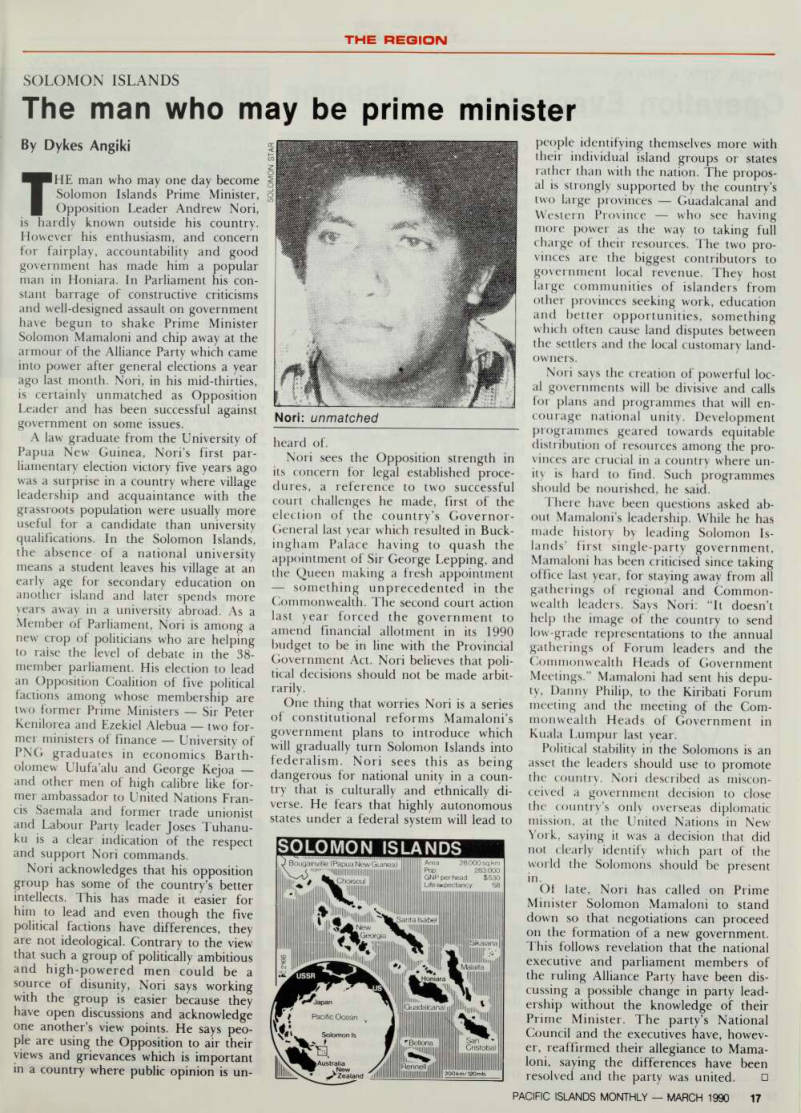
THE man who may one day become Solomon Islands Prime Minister, Opposition Leader Andrew Nori, is hardly known outside his country.
However his enthusiasm, and concern
for fairplay, accountability and good
government has made him a popular man in Honiara. In Parliament his con stant barrage of constructive criticisms and well-designed assault on government have begun to shake Prime Minister Solomon Mamaloni and chip away at the armour of the Alliance Party which came into power after general elections a year ago last month. Nori, in his mid-thirties, is certainly unmatched as Opposition Leader and has been successful against government on some issues.
A law graduate from the University of Papua New Guinea, Nori’s first par liamentary election victory five years ago was a surprise in a country where village leadership and acquaintance with the grassroots population were usually more useful for a candidate than university qualifications. In the Solomon Islands, the absence of a national university means a student leaves his village at an early age for secondary education on another island and later spends more years away in a university abroad. As a Member of Parliament, Nori is among a new crop of politicians who are helping to raise the level of debate in the 38member parliament. His election to lead an Opposition Coalition of five political factions among whose membership are two former Prime Ministers Sir Peter Kenilorea and Ezekiel Alebua two for mer ministers of finance University of PNG graduates in economics Barth olomew Ulufa’alu and George Kejoa and other men of high calibre like for mer ambassador to United Nations Fran cis Saemala and former trade unionist and Labour Party leader Joses Tuhanu ku is a clear indication of the respect and support Nori commands.
Nori acknowledges that his opposition group has some of the country’s better intellects. This has made it easier for him to lead and even though the five political factions have differences, they are not ideological. Contrary to the view that such a group of politically ambitious and high-powered men could be a source of disunity, Nori says working with the group is easier because they have open discussions and acknowledge one another’s view points. He says peo ple are using the Opposition to air their views and grievances which is important in a country where public opinion is un-
heard of.
Nori sees the Opposition strength in its concern for legal established proce dures, a reference to two successful court challenges he made, first of the election of the country’s Governor- General last year which resulted in Buck
ingham Palace having to quash the
appointment of Sir George Lepping, and the Queen making a fresh appointment something unprecedented in the Commonwealth. The second court action last year forced the government to amend financial allotment in its 1990 budget to be in line with the Provincial Government Act. Nori believes that poli tical decisions should not be made arbit
rarily.
One thing that worries Nori is a series of constitutional reforms Mamaloni’s government plans to introduce which will gradually turn Solomon Islands into federalism. Nori sees this as being dangerous for national unity in a coun try that is culturally and ethnically di verse. He fears that highly autonomous states under a federal system will lead to
people identifying themselves more with their individual island groups or states rather than with the nation. The propos al is strongly supported by the country’s two large provinces Guadalcanal and Western Province who see having more power as the way to taking full charge of their resources. The two pro vinces are the biggest contributors to government local revenue. They host large communities of islanders from other provinces seeking work, education and better opportunities, something which often cause land disputes between the settlers and the local customary land owners.
Nori says the creation of powerful loc al governments will be divisive and calls for plans and programmes that will en
courage national unity. Development
programmes geared towards equitable
distribution of resources among the pro vinces are crucial in a country where un ity is hard to find. Such programmes should be nourished, he said.
There have been questions asked ab out Mamaloni’s leadership. While he has
made history by leading Solomon Is
lands’ first single-party government, Mamaloni has been criticised since taking office last year, for staying away from all gatherings of regional and Common wealth leaders. Says Nori: “It doesn’t help the image of the country to send low-grade representations to the annual gatherings of Forum leaders and the Commonwealth Heads of Government Meetings.” Mamaloni had sent his depu ty, Danny Philip, to the Kiribati Forum meeting and the meeting of the Com monwealth Heads of Government in Kuala Lumpur last year.
Political stability in the Solomons is an asset the leaders should use to promote the country. Nori described as miscon ceived a government decision to close the country’s only overseas diplomatic mission, at the United Nations in New York, saying it was a decision that did not clearly identify which part of the world the Solomons should be present in.
Of late, Non has called on Prime Minister Solomon Mamaloni to stand down so that negotiations can proceed on the formation of a new government.
This follows revelation that the national executive and parliament members of the ruling Alliance Party have been dis cussing a possible change in party lead ership without the knowledge of their Prime Minister. The party’s National Council and the executives have, howev er, reaffirmed their allegiance to Mama loni, saying the differences have been resolved and the party was united. □
Solomon Star
Nori: unmatched