Ofa was one of the worst in 169 years
pp. 12-13 · Read in the full issue
Western Samoa
By Aivao Ulafala
YCLONE Ofa which hit Western B Samoa on February 2-3, is one of
most devastating cyclones to
hit the country since records were kept in 1831. Casualties included seven dead, most of them washed away by waves or
killed by flying debris.
Ofa cost the country WS$3O6 million,
according to a preliminary estimate by
the National Disaster Council, twice this year’s government budget. The council report is going to prospective aid donors.
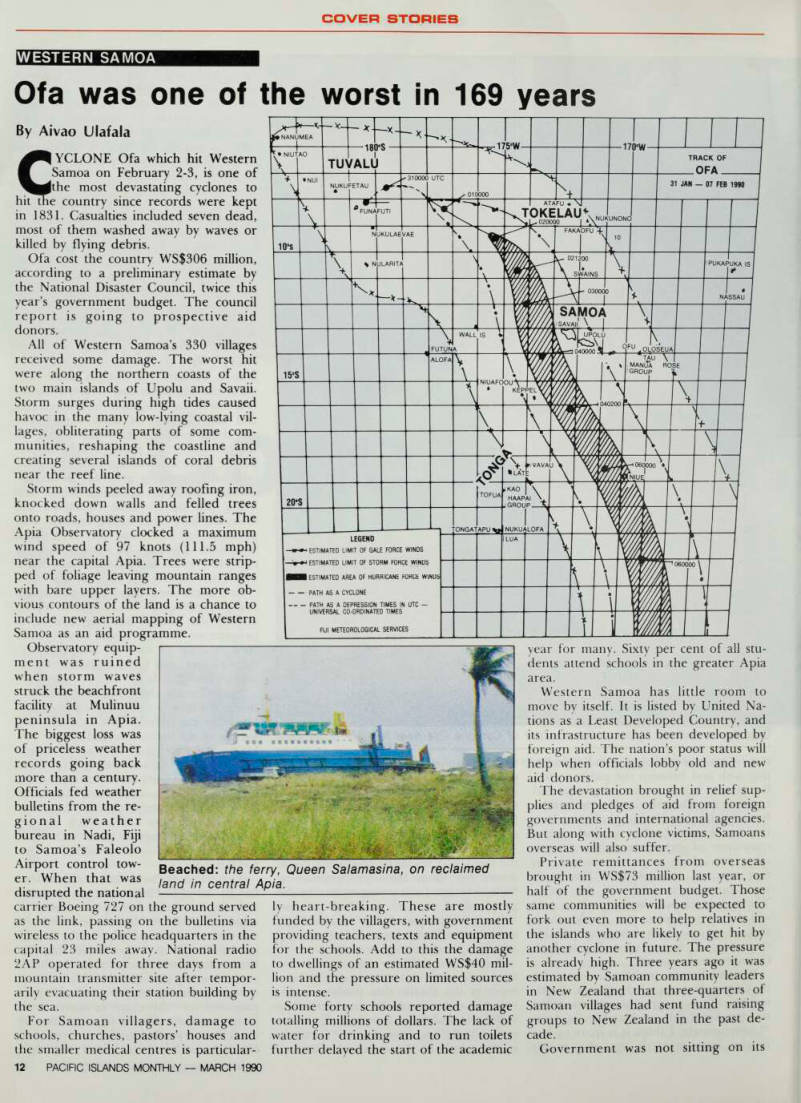
All of Western Samoa’s 330 villages received some damage. The worst hit were along the northern coasts of the two main islands of Upolu and Savaii.
Storm surges during high tides caused havoc in the many low-lying coastal vil lages, obliterating parts of some com munities, reshaping the coastline and creating several islands of coral debris near the reef line.
Storm winds peeled away roofing iron, knocked down walls and felled trees onto roads, houses and power lines. The Apia Observatory clocked a maximum wind speed of 97 knots (111.5 mph) near the capital Apia. Trees were strip
ped of foliage leaving mountain ranges
with bare upper layers. The more ob vious contours of the land is a chance to include new aerial mapping of Western Samoa as an aid programme.
Observatory equip ment was ruined when storm waves struck the beachfront facility at Mulinuu
peninsula in Apia.
The biggest loss was of priceless weather records going back more than a century.
Officials fed weather bulletins from the re
gional weather
bureau in Nadi, Fiji to Samoa’s Faleolo Airport control tow er. When that was disrupted the national
carrier Boeing 727 on the ground served as the link, passing on the bulletins via wireless to the police headquarters in the capital 23 miles away. National radio 2AP operated for three days from a mountain transmitter site after tempor arily evacuating their station building by the sea.
For Samoan villagers, damage to schools, churches, pastors’ houses and the smaller medical centres is particular-
ly heart-breaking. These are mostly funded by the villagers, with government providing teachers, texts and equipment for the schools. Add to this the damage to dwellings of an estimated WS$4O mil lion and the pressure on limited sources is intense.
Some forty schools reported damage totalling millions of dollars. The lack of water for drinking and to run toilets further delayed the start of the academic
year for many. Sixty per cent of all stu dents attend schools in the greater Apia area.
Western Samoa has little room to move by itself. It is listed by United Na tions as a Least Developed Country, and its infrastructure has been developed by foreign aid. The nation’s poor status will help when officials lobby old and new aid donors.
The devastation brought in relief sup plies and pledges of aid from foreign governments and international agencies.
But along with cyclone victims, Samoans overseas will also suffer.
Private remittances from overseas brought in WS$73 million last year, or half of the government budget. Those same communities will be expected to fork out even more to help relatives in the islands who are likely to get hit by another cyclone in future. The pressure is already high. Three years ago it was estimated by Samoan community leaders in New Zealand that three-quarters of Samoan villages had sent fund raising groups to New Zealand in the past de cade.
Government was not sitting on its
Beached: the ferry, Queen Salamasina, on reclaimed land in central Apia.
heels. Taxpayers’ money was used to buy food and materials in Apia (the purchase going into the general relief program me). Workmen toiled around the clock.
Some reconstruction can be absorbed by current programmes. For example, the Post Office is a recipient of a Us|l6 million aid scheme to upgrade telecom munications in Apia and set up more rural telephone exchanges. This work is due for completion in mid 1991.
Despite crop losses, leading to fears of a five-month local food shortage until the next harvest, no one is saying Sa moans will starve. Relief, remittances and replanting are helping to ease that anguish.
Churches offered refuge. The Church of Jesus Christ of Latter Day Saints flew in a DC-8 charter with building tools, food and shelter material. LDS also bought hundreds of sacks of rice, given out by branches in Savaii “to those in need”, including to non LDS members.
Health officials are worried about mal nutrition especially among young chil dren. Food aid tends to be items such as flour, rice and canned food. Refined Western food is not the flavour of the month with dieticians.
Western Samoa’s Central Bank drop ped lending rates and made other con cessions to help reconstruction. The maximum lending rate fell from 17 per cent per annum down to 12 per cent.
The measures are temporary. This month the Central Bank is setting up an Export Finance Facility to boost exports to offset increased imports. That is ex pected to have an impact on a trade de ficit reaching WS$Bl million in 1986, the latest year for complete figures.
The monetary measures were wel
corned by traders and homeowners who needed all the breaks they could get to
finance rebuilding.
The idea of exports has not been with out hiccups. Foreign relief officials were upset to find hundreds of sacks of taros
awaiting shipment at Faleolo Airport,
while relief aid was being flown in. The argument was, why not give the taro to cyclone victims? High level talks brought a temporary halt, but a week later, taro was on a Boeing 727 charter flight arranged to pick up aid from New Zea land. More taro followed as farmers tried to move crops before they rotted in the ground. Farmers also needed money to meet their own needs plus obligations to church and community projects.
Ofa cannot be blamed for all the damages. Looters hit homes abandoned by expatriates. Other targets included makeshift stores in Apia and part of the main wharf where a few containers were thrown about by storm waves. One businessman arrived with a truck to re move the stock from his small roofless store, only to find not a can of food in sight.
On the bright side, people were quick to come to the aid of those who had lost their homes. Some shops caught by pow er shutdowns gave away freezer goods (with the Health Department issuing a caveat emptor). Not so charitable were traders who lifted prices for certain goods. Western Samoa’s Commerce Board warned traders to stick to official prices, and invited aggrieved buyers to report cases of overcharging.
Samoa’s recovery plans will be guided by reports collected by the National Dis aster Council. Cost estimates were some times downgraded by more accurate fi
gures. Certainly there was widespread destruction, but National Disaster Coun cil (NDC) officials frowned on claims of, for instance, 100 per cent losses for breadfruit and bananas, or 90 per cent losses for taro and root crops. Early re ports of near total destruction of isolated villages were revised by field teams.
Even casualty figures changed. The
death toll reported to police reached eleven, but dropped to eight in the second week with police saying the others were not cyclone-related. The eighth victim was killed in a road acci dent seven days after Ofa passed Samoa.
The death was still listed in Ofa’s toll as the man was in a repair team transport ing a generator when their truck went out of control down a hill.
Confusion over the words “damaged” and “destroyed” is understandable in the heat of the moment. It may take weeks for final figures to be confirmed. Unoffi cial estimates were that between one per cent and five per cent of buildings were destroyed, and a fifth of all buildings had moderate to severe damage that could be repaired.
No amount of revising can remove the fact that losses are high. In shipping alone, passengers were left with only one of four vessels in working order.
The main ferry link with American Samoa, Queen Salamasina 11, is high and dry on a 20-acre reclaimed area in the centre of Apia. The replacement value is WS$l2 million. A smaller transport (WS$3.5 million) disappeared after breaking mooring lines at a domestic wharf. However, the largest vessel in the fleet, Lady Samoa 11, can be repaird.
All the inter-island ferries were pro vided through aid. □
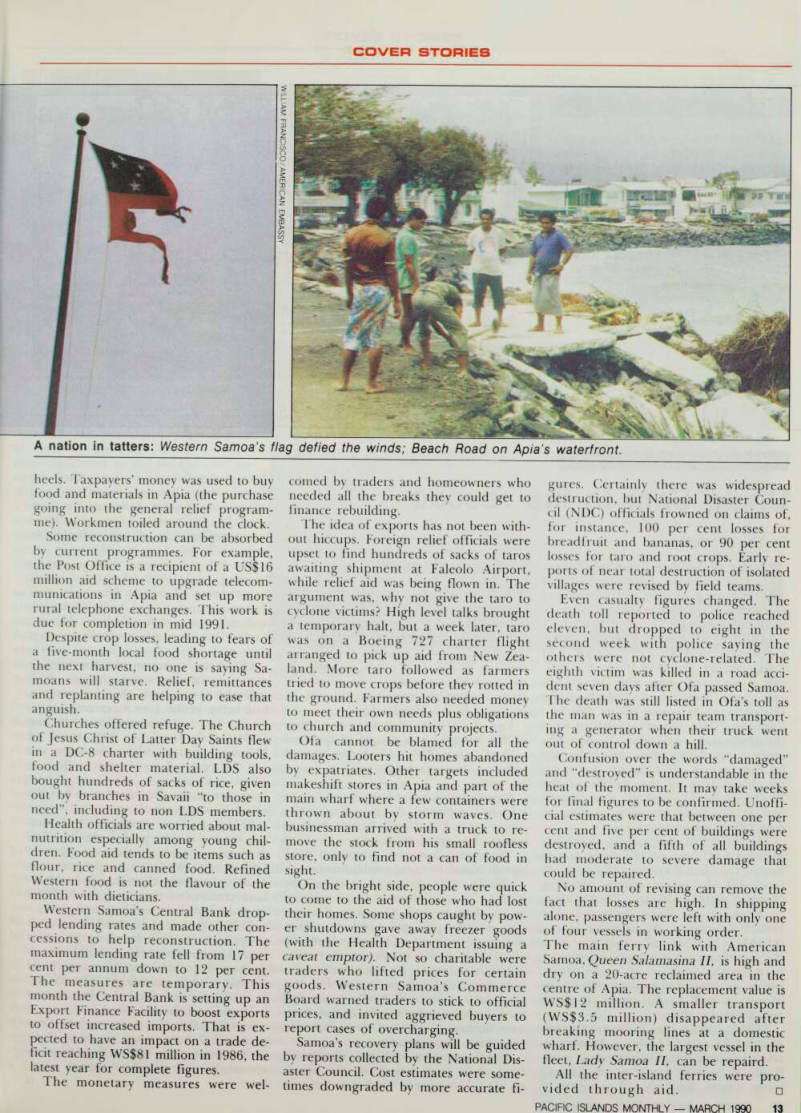
William Francisco/American Embassy
A nation in tatters: Western Samoa's flag defied the winds; Beach Road on Apia's waterfront.