A Code
pp. 10-11 · Read in the full issue
Cover Stories
A Code for Survival
After the fury of killer Cyclone Ofa, an expert in Suva hurries to complete a programme that will save houses in future.
By Jope Balawanilotu
THE international community has
responded with compassion to cyc lone-stricken Polynesia, tattered and shattered by Ofa when it killed, rav aged homes and destroyed crops through Tokelau, Western Samoa, part of Tonga and Niue last month. Aid in dollars and in kind rolled in. More is expected. Exactly how much is required to help mend the tatters has not been accurately determined, yet.
In any event it is irrelevant when “no thing, no amount of aid, can compensate the suffering, the death, the destruction and trauma of no longer feeling safe in your own homes”, says Kris Ayyar, the
engineer drawing up building codes to ensure that the modern homes and buildings of the Pacific islands nations are reasonably cyclone-secure within their respective means.
Ayyar is the Kerala-born, Suva-based Australian project manager of Pacific Building Standards, a regional program me funded close to A|l million by the Australian International Development Assistance Bureau (AIDAB) from March 1988 to September 1990. By the Septem ber deadline Ayyar will have delivered what could be considered a new lifeline to Ofa victims apart from other prog ramme participants the Cooks, Fiji, Vanuatu, the Solomons and, hopefully, Papua New Guinea.
Each of the seven countries will re ceive a building code with commentaries to accommodate modifications in the fu ture, an illustrated manual so that you do not have to be a construction expert to make the necessary adjustments to ex isting homes, and a compendium of proprietory products to ensure that the islands nations do not continue to be a dumping ground for sub-standard com mercial building materials or fall victim of mediocrity from within.
Ayyar says the decision to legislate the codes will be left to the government of each country, which he feels will not be a
problem. His work on Fiji’s building
code, for example, has involved a pain-
Eddie Rasmussen /Apia Photo Centre
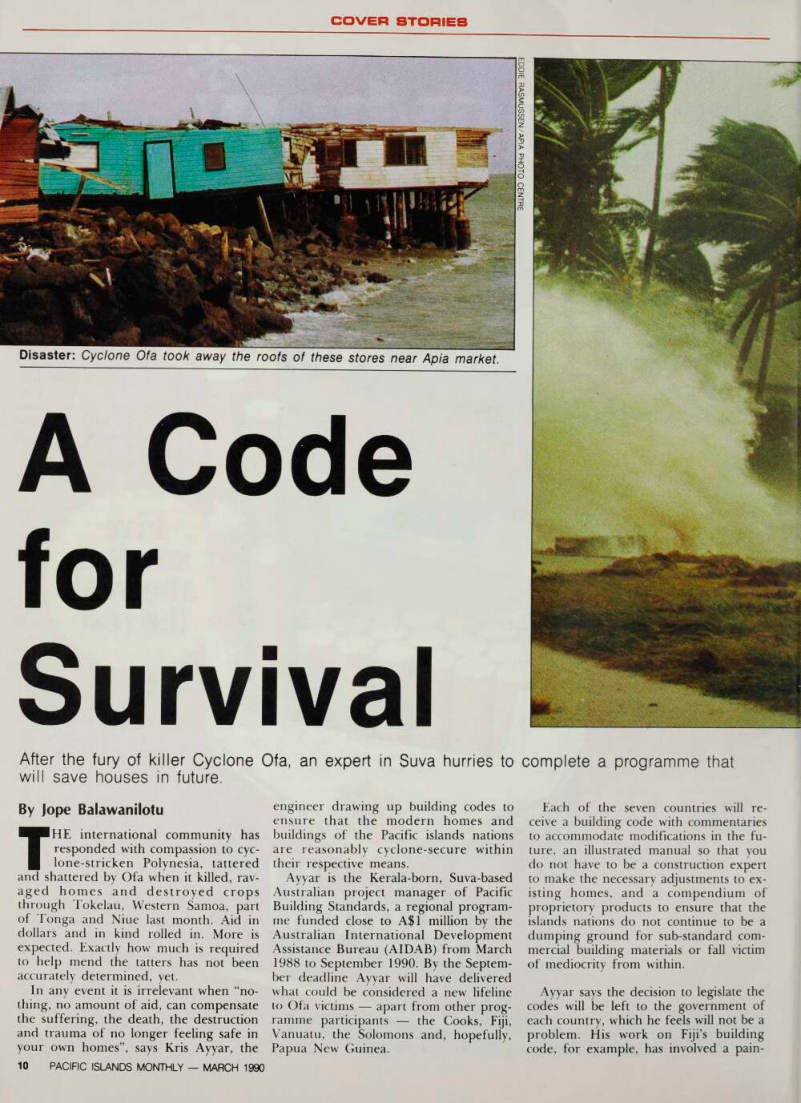
Disaster: Cyclone Ofa took away the roofs of these stores near Apia market.
staking process of dialogue and consulta tion with and between the public sector, the private sector, interested groups and consumers. This level of consultation, however, has been lacking in Papua New Guinea because he has to deal with a committee of expatriate public servants who “don’t have a permanent stake in that country”, says Ayyar. “The locals were born there and will die there.
Their children will be born there and will die there. Unless you involve those sort of people how honestly will this document turn out what Papua New Guineans really want?”
Western Samoa, perhaps the worst hit by Ofa, pulled out of the Pacific Build ing Standards programme after it failed to have Ayyar relocate his office in Apia.
Unfortunately, I think it is more or less in the Samoan spirit that they won’t
tolerate something from outside,” ex plains Ayyar. “They felt that it would be much more appropriate to produce a building code for them by actually being facilitated in Western Samoa and con sulting the people of Western Samoa.
They were not quite prepared to accept the fact that I would be producing docu ments for them from my location in Suva although I was trying to involve the people there as much as I had been in
volving the people of Fiji.” Additionally
the Western Samoa government equated a building code to higher costs.
Ayyar says that the equation is not necessarily true and there seems to be a myth in the Pacific that modern mate rials like concrete blocks, tin sheets, nuts and bolts and nails automatically mean
secure buildings. Says Ayyar: “Certainly
in the minds of the many who are not
5 educated in engineering or building sci i ence, and even in the minds of the well \ educated, such myths do exist. It’s party : true, of course, that we should have ; strong materials to withstand strong . forces. But ... in many instances you ; can compensate for the lack of strength i of the materials by a suitable arrange - ment of the materials how they’re i connected together.”
Ayyar says the Polynesian-type fales adapted by the Fijian province of Lau compare favourably with the more mod ern homes of the Pacific. The aerodyna mic, oval-shaped houses of timber with strategically placed joints bound with coir have withstood many cyclones and hurricanes over the past 150 years. Yet,
similar shaped buildings constructed
with sturdier, modern materials have not withstood winds up to only 30 to 40 knots. Says Ayyar: “This is where I believe, in terms of cost, in many inst ances the additional cost involved is sole ly a cost of ensuring that the connections and the locations of these connections are done properly and thoroughly. If that is done the actual materials that people (have been using) would be quite
adequate. Speaking generally about the
middle-class type buildings which are being put up in these countries, the materials have been strong enough. The problem has been how they have been connected together. So what a building code has to do is to ensure that these important aspects are kept in view.”
In Tonga, these important aspects are
being questioned. The kingdom opted
out of the Pacific Building Standards programme because it got money from New Zealand to fund its own building code project, and hired a private consul tant to do the job.
Niue, Tuvalu, the Cooks and the Solo mons will have a code which will ensure buildings can safely resist cyclone wind speeds of 49 metres/second (about 100 knots). A swift change of heart by Tonga and Western Samoa will group them under this category but their codes will lack the level of consultations the others have enjoyed, says Ayyar. Fiji and Vanuatu will have codes which will en able their buildings to cope with wind speeds up to 57 metres/second (about 115 knots).
The choices have been dependent largely on affordability and acceptability with the basic engineering parametres in mind. The choices have accommodated the desires of the peoples of the islands in the Pacific to forge ahead into the future and its associated uncertainties and leave the past behind with its time tested traditions. Ayyar was not quite prepared for “this craze in many, many people of these islands (who) think that it’s a status symbol to have a concrete block house with tin sheet roofing.’n
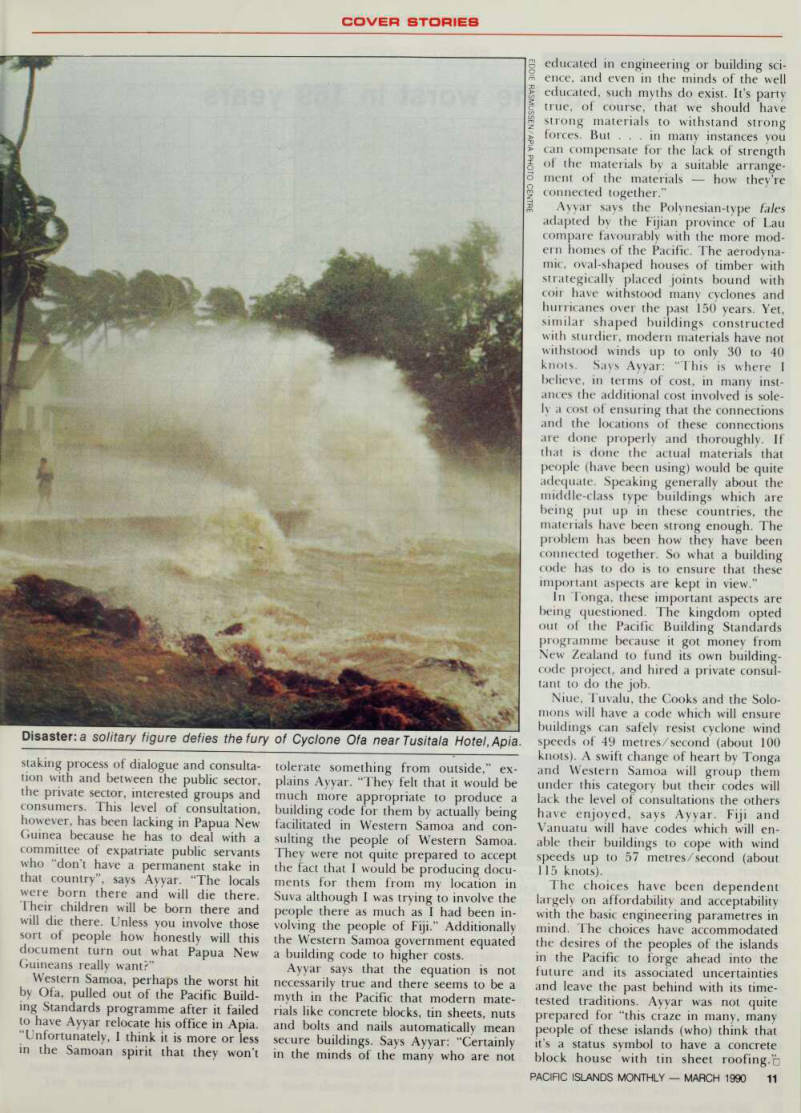
Disaster: a solitary figure defies the fury of Cyclone Ofa near Tusitala Hotel, Apia.