international attention
pp. 28-32 · Read in the full issue

Fiji Pine attracts more international attention
Fiji’s pine industry is under close scrutiny internationally as a potential model for landowner development. It is a unique form of joint venture development where Government provided loan finance and the landowners provided the land.
By Penny Gibson
FIJI’S pine industry will churn ab out F 526.5 million into the coun try’s economy this year, directly benefiting the native landowners with land rental, royalties and lucrative forest related contracts. The grand vision of politicians and developers in the 1960 s to give landowners a financial stake in
their country through forestry planta
tions is finally beginning to pay off, with the implementing company, Fiji Pine Commission, and its commercial subsidi ary, Tropik Wood Industries, turning their first profits on trading last year.
The vision has turned unproductive land to profit, provided valuable income, employment and business opportunities to landowners and others, provided fore
ign earning and import substitution and
made remote villages accessible with forest roads.
However, it’s not all roses. The Fiji
Pine Commission has a massive, virtually unserviceable debt to the Fiji Govern ment, the forests are continually threatened by cyclone and fire and there is doubt if there is enough pine in the
country to keep Tropik’s enormous, high
technology mill viable. Although Tropik is currently servicing its Fs3s million debt, its sawmilling equipment is work ing at only half capacity because of li mited wood supply.
The Fiji Pine Commission has an accumulated debt of Fs9o million, the result of the 18-year lead time between
planting and harvesting the pine trees,
Pinus caribaea. Major financial setbacks included three major cyclones and the post-coup fires of 1987 which decimated the larger forests. To overcome this bur den, with its crippling annual interest re payment, the Fiji Pine Commission is negotiating with the Government to con
vert its debt into equity through the cor poratisation of the Commission.
By exchanging government debt for government shares in a private company, Fiji Pine should be self-financing within 10 years, according to General Manager Konisi Yabaki. This will coincide with the completion of harvesting of the first rotation of planted trees. By then, the Fiji Pine Commission should be sup plying Tropik with 500,000 cubic metres a year, more than double its current
supply. For Tropik’s General Manager,
Mark Sanderson, this can’t happen soon enough; “In the next five years there will just not be the resource (to meet our
capacity).”
To boost current production, this year Tropik will ship 42,000 cubic metres of
sawlogs from Forestry Department
plantations on Vanua Levu at consider able expense, and buy another 2000 cubic metres of logs from private planta tions around Fiji. Although the pine in dustry in Fiji is largely the Fiji Pine Commission, which has 43,000 hectares on the two larger islands and plans to increase to 62,000 hectares in the next ten years, the Forestry Department also has 4000 hectares, and provides manage ment advice for another 10,000 hectares
of smallscale private plantations through
its extension division.
The private plantations will not be ma ture enough for sawmilling for at least another five years, but are a source of
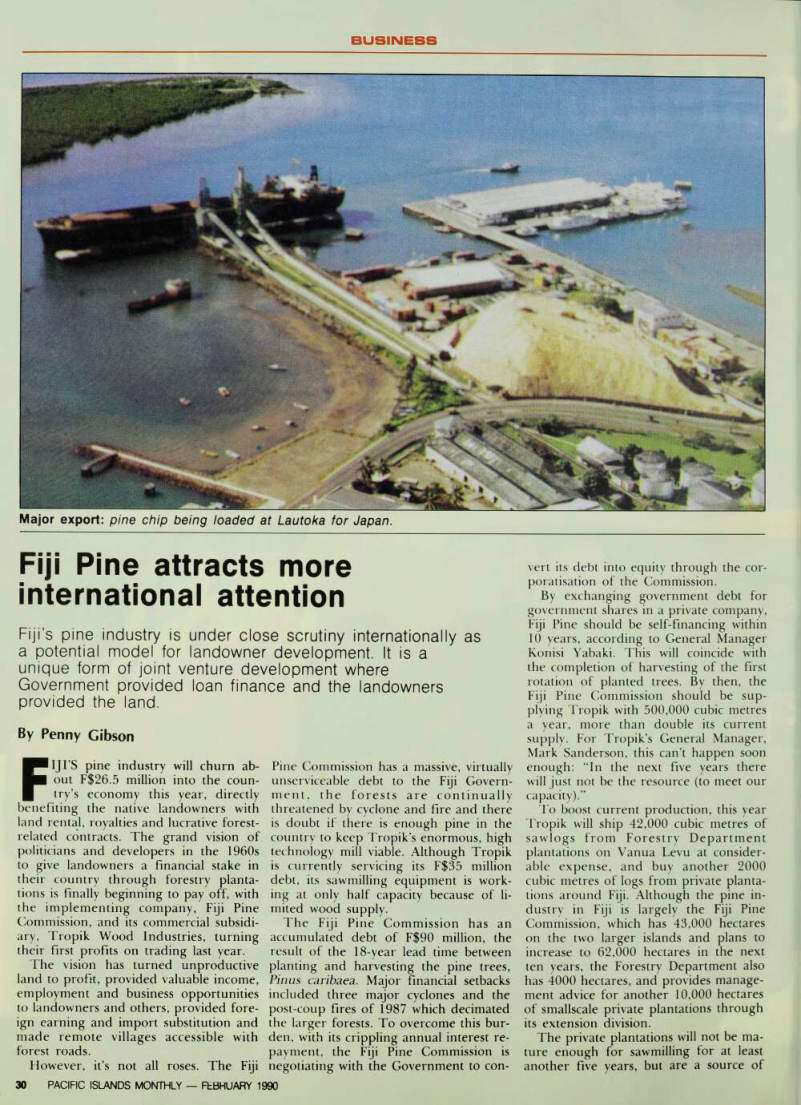
Major export: pine chip being loaded at Lautoka for Japan.
timber for posts, poles and woodchips.
The quality of the logs has been a prob lem due to cyclone and fire damage and
plantation neglect, but is improving fol
lowing the recent introduction of de
tailed management plans by the Fiji-
German Forestry Extension Project. The Dawasamu plantation on Viti Levu has established its own small sawmill which is doing well for the Fijian landowner operators.
Under Fiji Pine’s corporatisation deal, it is rumoured the Government will insist all pine plantations be brought under the auspices of the Fiji Pine company, with private plantation owners being offered shares in the new company. Fiji Pine will then have, with its subsidiary Tropik, an effective monopoly on the
country’s pine industry.
Tropik is the biggest processor of tim ber in Fiji, producing more than the rest of the country put together. With 51 per cent ownership by Fiji Pine Commission, it has an interesting relationship with its major supplier one of cordiality and mutual understanding, although it main tains a very separate identity and is
fiercely competitive.
Sanderson is disappointed by the qual
ity of the logs supplied by the Commis sion. His profits are made on sawn tim ber, but poor quality logs twisted, stunted or bent must be put through the less profitable chipping process. Tro
pik originally planned on receiving over
50 per cent of its long supply as sawlogs, but is currently getting only 30 per cent.
The Fiji Pine Commission has laun ched a major research and forest man agement campaign to ensure future logs will be straight and tall. It’s to their own advantage; they are paid $l6 / m 3 royalty for sawlogs and only $2.72 for pulplogs, a total of $1,616,000 in 1989. The land owners received 3 per cent of this, or $48,480.
Tropik will export 25,000 m 3 of sawn timber this year, worth over $8 million and comprising 55-60 per cent of total sawn timber exports from Fiji. Australia is the major export destination (90 per cent), with the balance going to New Zealand, New Caledonia and other mar kets. Tropik recently entered the Taiwanese market and introduced Pinus caribaea to Japan last year.
The timber is popular on the interna tional market. It is denser, stronger and has a better knot structure than Pinus
radiata grown in Australia, New Zealand and Chile and is price competitive with timber imports from other countries such as the United States and Canada.
Competitiveness is enhanced by Fiji Gov
ernment tax and duty concessions similar to those for the recently established tax free zones.
Tropik also expects to earn about Fsl6 million for exporting nearly 200,000 tonnes of chips this year.
Although woodchip prices are currently
the highest ever, Sanderson is wary of Tropik’s vulnerability to price fluctua tions given a high 70 per cent of mill output is chips. Fortunately, the risk is minimised by a five-year chip contract with C. Itoh, of Japan, while Tropik tries to increase its proportion of sawn tim ber; “There is more stability in sawn tim ber, more added value, and it gives a
much higher price and profit margin.”
Locally, Sanderson said people had converted to pine for construction in quite a big way. In two years Tropik has cornered 66 per cent of the Fiji market for framing timber and plans to further increase sales from the current annual 9000 m 3 sawn timber and 5000 m 3 poles, worth $3.3 million.
Tropik’s major local marketing
strategy is price combined with good
quality, dry timber that is preservative
treated services sawmillers in the in digenous industry have yet to come to effective grips with.
Pine has taken the pressure off the indigenous rainforest timbers for hous
ing and non-specialised uses, allowing
the beautiful hardwoods to realise their true value on the export market as spe cialist timber for furniture, wall cladding, etc. It has enabled the country to conserve some of its natural forests and to slow the rate of harvesting, being mindful of environmental considerations and the conservation of rainforests.
Yabaki, a former head of the Ministry of Forests, has been involved in the pine industry from its inception, and said it was achieving its major aims to create an industry for the landowners that meets local needs and conserve the rainforests.
I he industry has converted non productive grasslands, burnt out by years of slash-and-burn agriculture, into pine forests which are generating income and employment for the local population.
Landowners directly benefit from land rental ($130,000 last year) and the royal
ties from logged trees and gravel taken from plantations for reading. Forestry reading has opened access to 29 villages, allowing easier access to markets and
non-village employment.
The Fiji Pine Commission has a $6.5 million budget, employs 193 staff and pays over $607,000 to contract labourers, often landowners groups, during the
four-month planting and weeding
season.
Yabaki said the Fiji Pine Commission’s
original mandate was to eventually priva
tise with the landowners controlling the company. Thus, landowners from each of the five forests are represented on the Board.
To assist landowners gain the neces sary business and management skills to run the eventual company, the Commis sin has a landowner affairs division
which helps identify projects, form com
panies and provides support through the training, accountancy services and tech nical advice. It invests $50,000 a year in training landowners as foresters, admi nistrators and business people.
At present there are 12 landowner companies, nine directly assisted by the Fiji Pine Commission. With capital in vestment of over $1.3 million, they are expected to gross over $l7 million in the next five years. Although most have con tracts with the Fiji Pine Commission and
Tropik, including silvicultural, logging,
catering, transport and site maintenance, some also run non-forestry operations, such as beche-de-mer business.
Since 1978, the Commission has run a trust fund based on deducting 5 per cent of landowner forest contract earnings, which is then loaned to assist business
development through purchase of capital
equipment and provision of working
capital.
Sanderson said Tropik had a policy of using landowner companies and had
provided extensive training, particularly
in logging, and financed the supply of equipment on a lease arrangement: “There are positive signs that these small
companies will develop into profitable
and efficient enterprises.”
With an operating budget of $2O mil
lion, Tropik employs 320 people directly
and another 300 indirectly on contract.
Both Tropik and the Fiji Pine Commis sion create flow-on employment in the
commercial sector, including engineer
ing, services and transport. □
Solomons opens coconut mill SOLOMON Islands’ first coconut crushing mill has been opened by Prime Minister Solomon Mamaloni. The mill, located at Yandina in the Russell Islands, was built at a cost of Ssl.s million, with machinery being made in Taiwan. It is expected to process copra from the Lev
ers Pacific Plantations Ltd estate on the island, and will export 6200 tonnes of coconut oil and 3300 tonnes of coconut cake a year. 1 s man 9° ban NEW ZEALAND has lifted a ban on
mangoes and other product exported from Fiji. The ban was introduced when the fruit was found to contain Fruit Fly larvae. It is thought the pests managed to live through fumigation, but now New Zealand agriculture authorities say they are satisfied with improved procedures introduced at Nadi Airport.
Tonga gets new factory A JOINT Australian-Tongan venture, to be called Sky High Bags Company Ltd, is to begin manufacturing ladies’ hand bags at a new factory at Nukualofa with in the next few months. About 300 local people will be employed, and the factory is scheduled to produce 200,000 bags a year for export, worth about US$l.2 mil lion.
Cooks land directive COOK Islands Prime Minister Geoffrey Henry has told lawyers that any land deal must include a proportion of local ownership. The directive is to close off a loophole whereby land is leased from a local person, then sub-leased at a much higher value to a third party. Henry said all sub-leases should include payment to the original owners.
Marshalls expands fishery AN experimental fisheries project will be expanded this year as the next step in developing a tuna and reef fish export industries in the Marshall Islands. A Japanese agency has financed a study around Arno atoll, and Resources and Development chief Benson Wise says docks and related facilities will now be developed. The initial aim is to market the fish in Majuro, the capital, and at the United States base on Kwajalein.
Experts for Fiji TWO United Nations agencies, the UN Development Programme and the UN Industrial Organisation will pay for six business experts to be attached to the Fiji Trade and Investment Board. They will help advise local industries and assess new projects. Priority will be given to helping businesses which needed tech nology and expertise to get them off the
ground.
Chevron gets extension THE consortium developing the lagifu oilfield in Papua New Guinea, led by Chevron Niugini Pty Ltd, has been given an extention of time in which to make application for a development licence.
The original deadline was November 28, but the government has now allowed the consortium until March 1. The delay was sought because Chevron said it had not concluded proving its reserves.
Air service delayed A PROPOSED air freight service to link American Samoa with the West Coast of the United States has been delayed by problems in obtaining clearance from the United States Federal Aviation Au thority. Inland Freight Forwarder Ser vice, of Hawaii, now expects to be oper ating by March and then hopes to ex tend the flights to include Western Samoa.
Placer stays on AUSTRALIAN mining company Placer Pacific Ltd has put on hold plans to quit its exploration work in Fiji after a last minute find which it considers worth further investigation. The company has been exploring for gold in the country for five years, with disappointing results.
However, just recently it reported find
ing an intersection near Macuata, on Vanua Levu, but it has no indications whether this is a gold outcrop or a size
able deposit.
Kiribati fish warning THE Kiribati fisheries authorities is alarmed by the large number of lobsters being caught at a rate which could wipe out the population in local waters. The authorities have issued a warning that they will prosecute fishermen, hotel and
restaurant owners catching protected
species or young fish.
Marshalls unveils income plans THE Marshalls Islands government has announced several major construction projects as well as plans for new income generating activities. In addition to the already announced US$9 million Capitol building, the government now plans a new government house for the President together with guest homes for visiting heads of state, as well as new docks and causeways.
The administration is looking at a range of income-producing schemes in cluding a breadfruit chip plant, new pro
duce marketing projects and a pcultry
farm.
Fines at Hawaii airport ON-THE-SPOT fines up to US$5O will be imposed on all travellers bound for the United States mainland or Alaska who fail to declare agricultural items at any Hawaiian airport.
Tinian factories opposed MAYOR Ignacio K Quichocho, of the Northern Mariana island of Tinian, has
come out against proposed law changes
that will allow more than five garment factories to be built there. Five factories were enough on the island, he said, and Tinian should be looking at establishing a casino to further the tourist industry and economic development.
TV future secure PAPUA New Guinea’s commercial televi sion company, EM-TV, has assured view ers its future is secure despite being owned by the troubled Australian pa rent, Bond Corporation and Bond Media Ltd. Bond Media managing direc tor Gary Rice told a Port Moresby press conference the Papua New Guinea op eration was now strong and well estab lished and there were plans to use satel lite transmission to reach areas of the country which now did not receive the
EM-TV signal.
767 flies to Honiara A BOEING 767 airliner was used on holiday traffic to the Solomon Islands in December and January, the first time such a large aircraft has used at Hender son Airport in Honiara. The aircraft,
supplied by Qantas, was operated jointly
on the Brisbane-Honiara service, and was introduced to cope with heavy book ings over the Christmas holidays.
Bank runs out of cash THE Bank of Tonga was caught short of cash in December, and limited cash with drawals to Ts3o a time. A bank spokes man said the government had given no warning that it was going to issue vouchers for civil service pay arrears, and this complicated matters on top of the usual heavy Christmas withdrawals
by local and visiting Tongans.
Vanuatu bank gets help U 55493,000 is to be provided under the
United Nations Development Program
me for helping the Development Bank of Vanuatu to train staff, improve man agement techniques and upgrade lend
ing policies and operational procedures.
The programme will help the bank im prove its role as an instrument of nation
al development.
Kiribati needs training MONEY spent sending students abroad for technical and professional training would be better spent establishing a Kiri bati institute for higher education, said the Director of the University of the South Pacific Centre in Kiribati, Roniti Teiwaki. Overseas training was costing Asl million a year, and the idea of*a local institute had already attracted con siderable donor interest, he said.
Air Tungaru criticised KIRIBATI’S national airline, Air Tun garu, has been severely criticised by the country’s Director of Audit for the state of its accounting, with the recommenda tion that the financial control system and entire operations needed an overhaul.
The report said the airline’s accounts were drawn up with a pre-determined profit figure in mind, that management was confused, senior accountants incom petent and non-professional, and that the board gave no clear policy direction.
Wood company for sale WESTERN Samoa’s government has de cided to sell by tender the Coconut Wood Products Ltd after carrying its los ses for several years. The alternative of attempting to restructure the company was discussed, but then discarded. The company was out of action for three years in the early 1980 s.
ANA operates to Saipan NEW airline services in Micronesia are now a common occurrence as the tourist industry in the region booms. Now All Nippon Airways (ANA) has begun a Norita-Saipan service on a twice-weekly basis. ANA will be using a LlOll Tristar with a capacity for 256 passengers.
Cooks tax increases A TWO per cent increase in income tax has been introduced by the Cook Islands government to help pay for the new state television service and the plan to set up a culture history. The tax hike is ex pected to add NZ5730,000 to govern ment revenues.
Niue airport lights up NIUE is to get night lighting at its air port, a project to cost an estimated NZ5602,000. This will allow the landing strip to be used 24 hours a day, which is aimed at making the island a more attractive calling place for international carriers. The government, since Air Nauru withdrew its flights, has been hoping that it can persuade an airline flying in the region to include a stop at Niue.
Kiribati upgrades telecom KIRIBATI is to have a satellite-based telecommunications system to link all the outer islands. The five-year, As2l mil lion scheme will be developed as a joint venture between the government and Australia’s OTC International. The country will be integrated into the Pacific Area Co-operative Telecommunications network. □
Skin Diver eyes Bikini A WRITER for the American magazine Skin Diver said the Bikini Atoll in the Marshall Islands could become a major attraction for skin divers. The lagoon is strewn with the sunken wrecks of United States and Japanese warships which were used as target practice during the Ato mic bomb tests more than 35 years ago.
So far, few divers had been to the atoll.
Kiribati draws from reserves KIRIBATI has withdrawn US$lO mil lion from its reserve fund in the last two years to balance the country’s budget.
The fund was set up from proceeds of phosphate mining on Ocean Island (also known as Banaba) which finished in 1979. But finance minister Teatoa Tean naki said the fund still stood at more than US$l5O million.
Vanuatu to make beer VANUATU’S parliament has passed leg islation allowing the government to set up a brewing company in which it will be the major shareholder. The bill was pas sed in the face of strong opposition from church and other groups. The govern ment argues that the production of the Vanuatu Beer brand will enable it to control alcohol content and reduce beer
imports.
Airport plan for Aitutaki SURVEY work on a new international airport for the Cook Islands will begin on Aitutaki in April. The island is consi dered to have considerable potential for tourism due to its natural beauty. Its present airstrip was built by United States forces in World War II and the island was once a stopover for Tasman Empire Airways Ltd (TEAL) flying boats. The current proposal is to build an international airport on compressed coral. Initial survey work will cost more than NZ$2O,OOO. The airport upgrading will take three years to complete. The government believes the Aitutaki strip will give tourists another point of entry to the country, and the landing strip will provide an alternative to Rarotonga, 225 kilometre south, in the case of bad weather.