Tagging
p. 27 · Read in the full issue
the tuna
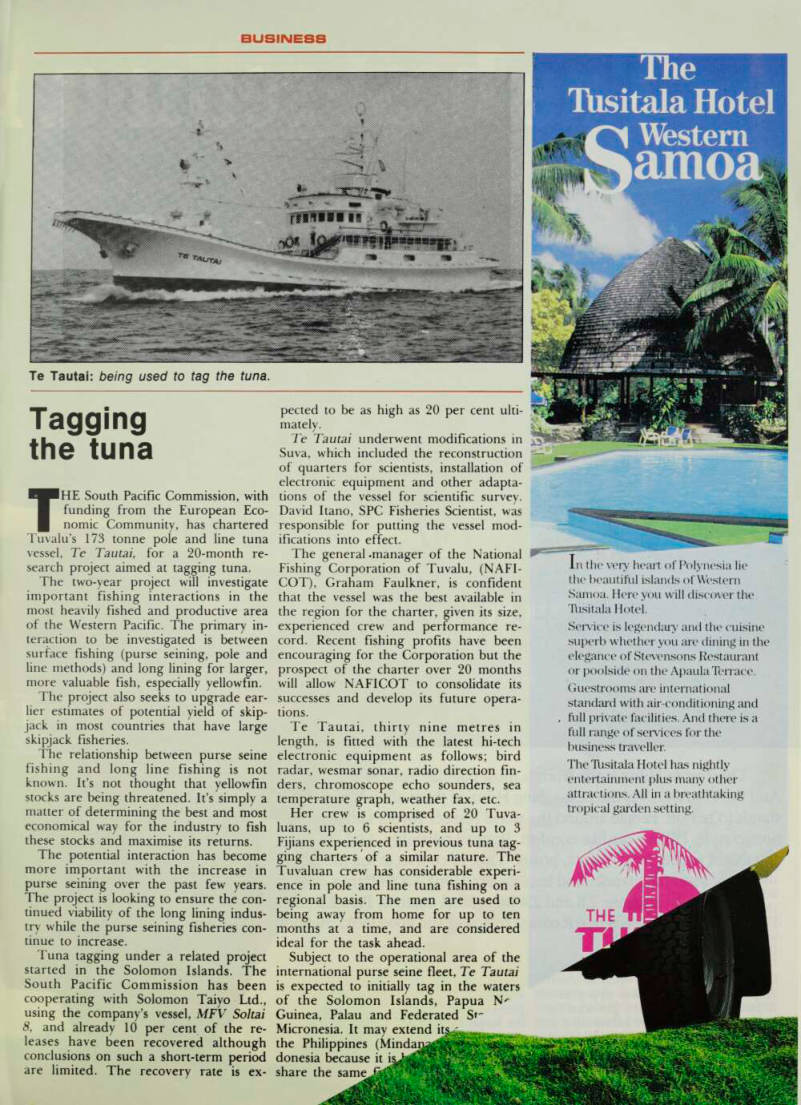
THE South Pacific Commission, with funding from the European Eco nomic Community, has chartered Tuvalu’s 173 tonne pole and line tuna vessel, Te Tautai, for a 20-month re search project aimed at tagging tuna.
The two-year project will investigate important fishing interactions in the most heavily fished and productive area of the Western Pacific. The primary in teraction to be investigated is between
surface fishing (purse seining, pole and
line methods) and long lining for larger, more valuable fish, especially yellowfin.
The project also seeks to upgrade ear lier estimates of potential yield of skip jack in most countries that have large
skipjack fisheries.
The relationship between purse seine fishing and long line fishing is not known. It’s not thought that yellowfin stocks are being threatened. It’s simply a matter of determining the best and most economical way for the industry to fish these stocks and maximise its returns.
The potential interaction has become more important with the increase in purse seining over the past few years.
The project is looking to ensure the con tinued viability of the long lining indus try while the purse seining fisheries con tinue to increase.
Tuna tagging under a related project started in the Solomon Islands. The South Pacific Commission has been cooperating with Solomon Taiyo Ltd., using the company’s vessel, MTV Soltai 8, and already 10 per cent of the re leases have been recovered although conclusions on such a short-term period are limited. The recovery rate is ex
pected to be as high as 20 per cent ulti
mately.
Te Tautai underwent modifications in Suva, which included the reconstruction of quarters for scientists, installation of electronic equipment and other adapta tions of the vessel for scientific survey.
David Itano, SPC Fisheries Scientist, was responsible for putting the vessel mod ifications into effect.
The general -manager of the National Fishing Corporation of Tuvalu, (NAFI COT), Graham Faulkner, is confident that the vessel was the best available in the region for the charter, given its size, experienced crew and performance re cord. Recent fishing profits have been encouraging for the Corporation but the prospect of the charter over 20 months will allow NAFICOT to consolidate its successes and develop its future opera tions.
Te Tautai, thirty nine metres in length, is fitted with the latest hi-tech electronic equipment as follows; bird radar, wesmar sonar, radio direction fin ders, chromoscope echo sounders, sea temperature graph, weather fax, etc.
Her crew is comprised of 20 Tuva luans, up to 6 scientists, and up to 3 Fijians experienced in previous tuna tag ging charters of a similar nature. The Tuvaluan crew has considerable experi ence in pole and line tuna fishing on a regional basis. The men are used to being away from home for up to ten months at a time, and are considered ideal for the task ahead.
Subject to the operational area of the international purse seine fleet, Te Tautai is expected to initially tag in the waters of the Solomon Islands, Papua N** Guinea, Palau and Federated St~ Micronesia. It may extend
the Philippines
donesia because it share the same^%l&
Te Tautai: being used to tag the tuna.