Why the young are dying
p. 10 · Read in the full issue
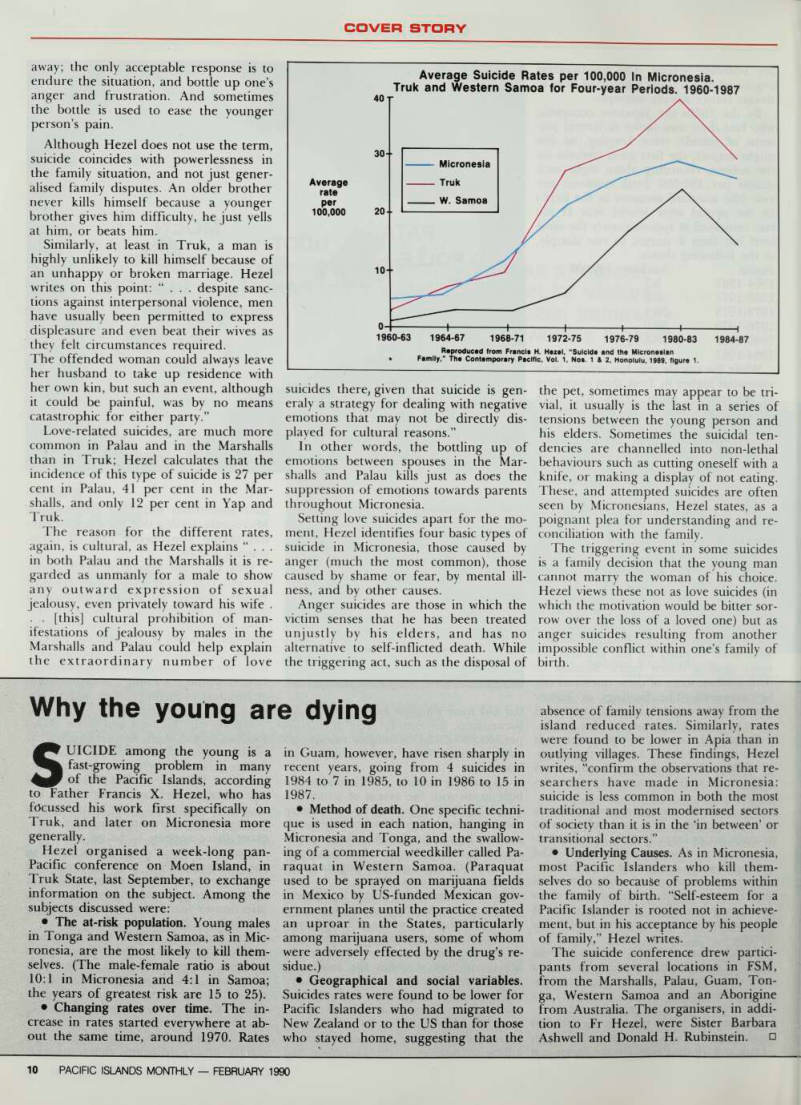
SUICIDE among the young is a fast-growing problem in many of the Pacific Islands, according to Father Francis X. Hezel, who has focussed his work first specifically on Truk, and later on Micronesia more
generally.
Hezel organised a week-long pan- Pacific conference on Moen Island, in Truk State, last September, to exchange information on the subject. Among the subjects discussed were: • The at-risk population. Young males in Tonga and Western Samoa, as in Mic ronesia, are the most likely to kill them selves. (The male-female ratio is about 10:1 in Micronesia and 4:1 in Samoa; the years of greatest risk are 15 to 25). • Changing rates over time. The in crease in rates started everywhere at ab out the same time, around 1970. Rates
in Guam, however, have risen sharply in recent years, going from 4 suicides in 1984 to 7 in 1985, to 10 in 1986 to 15 in 1987. • Method of death. One specific techni que is used in each nation, hanging in Micronesia and Tonga, and the swallow ing of a commercial weedkiller called Pa raquat in Western Samoa. (Paraquat used to be sprayed on marijuana fields in Mexico by US-funded Mexican gov ernment planes until the practice created an uproar in the States, particularly among marijuana users, some of whom were adversely effected by the drug’s re sidue.) • Geographical and social variables.
Suicides rates were found to be lower for Pacific Islanders who had migrated to New Zealand or to the US than for those who stayed home, suggesting that the
absence of family tensions away from the island reduced rates. Similarly, rates were found to be lower in Apia than in
outlying villages. These findings, Hezel
writes, “confirm the observations that re searchers have made in Micronesia: suicide is less common in both the most traditional and most modernised sectors of society than it is in the ‘in between’ or transitional sectors.” • Underlying Causes. As in Micronesia, most Pacific Islanders who kill them selves do so because of problems within the family of birth. “Self-esteem for a Pacific Islander is rooted not in achieve ment, but in his acceptance by his people of family,” Hezel writes.
The suicide conference drew partici pants from several locations in FSM, from the Marshalls, Palau, Guam, Ton ga, Western Samoa and an Aborigine from Australia. The organisers, in addi tion to Fr Hezel, were Sister Barbara Ash well and Donald H. Rubinstein. □