killing
pp. 8-11 · Read in the full issue
Cover Story
The killing field
Al Jesuit priest tries to solve the puzzle of suicide in paradise
The tourist brochures describe Truk as a “natural paradise (that) holds a deep fascination for visitors”.
What it doesn’t say is that within the social framework of this Micronesian state is one of the world’s highest rates of suicide.
By David North
THE young man’s mother gave away his pet dog, so he killed himself.
Another feared that he would be beaten after coming home from watch ing video, so he hung himself. Another suicide occurred after a young man hurt his brother in a fight, and was severely chastised by his parents.
These are not isolated instances, they are a part of a widespread pattern in Truk, in the Federated States of Mic ronesia, which may well be the suicide capital of the Pacific, four times that of Guam, and seven times that of American Samoa. In fact there are only a few places in the world with suicide rates higher than that of Truk. Looking at another way, suicide has become the
leading cause of death of males aged 15-30 in Truk.
The form of suicide favoured in Truk is a particularly grim one no instant death with a bullet in the head, or the drowsy departure caused by an overdose of sleeping pills. About 80 per cent of those killing themselves in Truk do so by hanging; they often tie a rope to a tree, loop it around their neck, and then lean against it from a standing or sitting position until they strangle themselves.
There are variations; women sometimes prefer drug overdoses, and men some times consume a toxic substance, like Clorox or another poison, or use guns or explosives, but death by hanging is the traditional method.
Suicide is not new to the Central Paci fic. United States Navy Commander Charles Wilkes, while exploring the Gil berts around 1840, wrote this still perti
nent description:
“ . . [Gilbertese] are said to be subject to despondency and sullen ness, that sometimes causes them to commit suicide ... To termin ate their lives they always resort to hanging on a tree. The motive of this act is generally the treatment they have received, or offence taken at the conduct of some per son, whom affection or fear ren ders them unwilling to injure; the
mortification and grief produced
thereby leads them at last to suicide, which is considered by them as a remedy for their evils, as well as a severe revenge upon those who had ill-treated them...”
The missionaries noticed these deaths as well. At the turn of the century there were six suicide attempts within two years, two successful, at a Truk mission
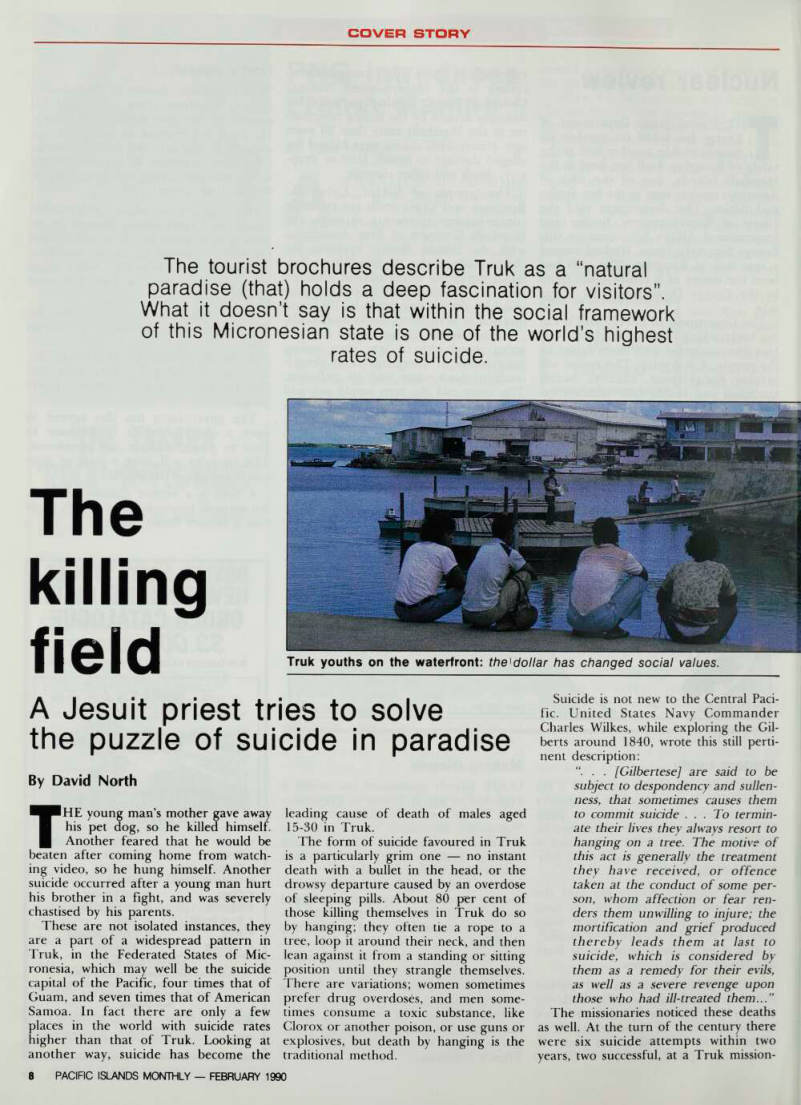
Truk youths on the waterfront: the dollar has changed social values.
ary boarding school. The headmistress organised and trained a group of boys to thwart future suicide attempts.
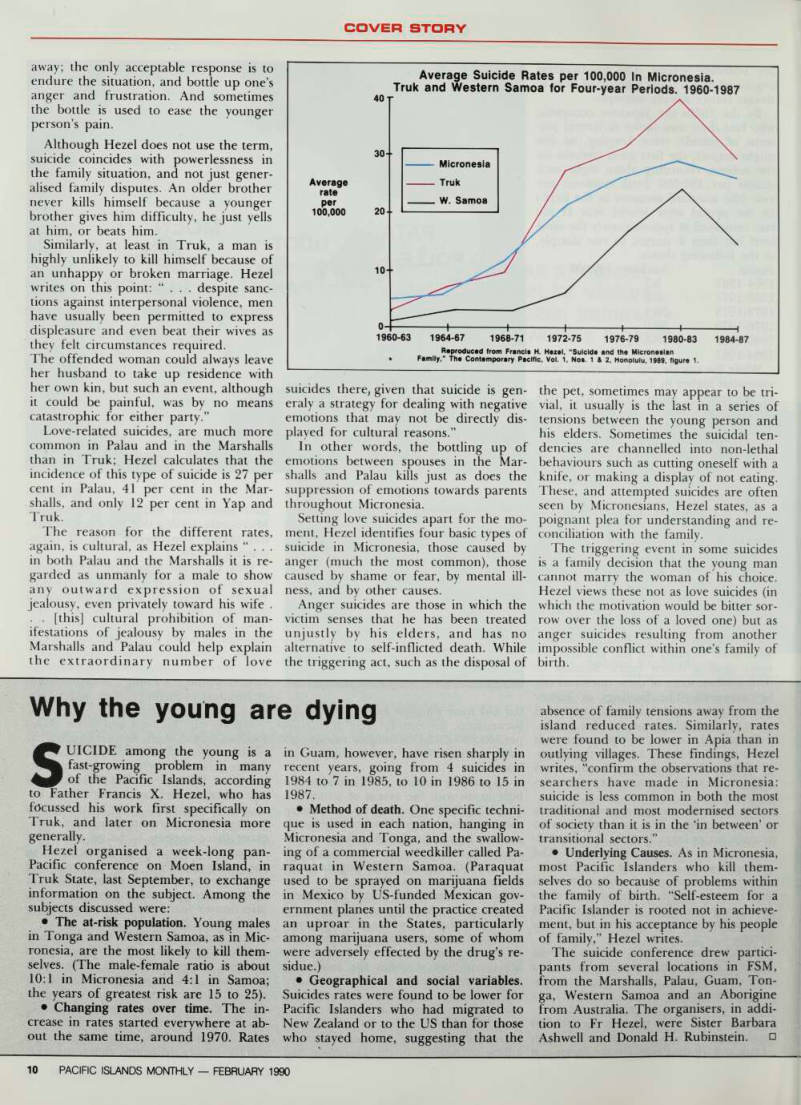
By the 1920 s the Japanese occupiers, who had their own (quite different) pat terns of suicide, were keeping, as one might suspect, the first good statistics on the subject, recording about eight such deaths per 100,000 Truk residents per year (the standard measure in the field.) In the period after World War II the rate remained at approximately the same level but then it started to rise sharply, as the following shows:
While the suicide rate has usually been somewhat higher in Truk than elsewhere in Micronesia, other areas, too, have seen the number of suicides increase.
The peaks for Micronesia as a whole were 40 suicides in 1980 and 43 in 1987. (The latter was the year in which 20 suicides were recorded in the Marshalls, twice the highest level reported pre
viously.)
Who is dying? Why are they killing themselves? And why have the rates in creased so much in recent years?
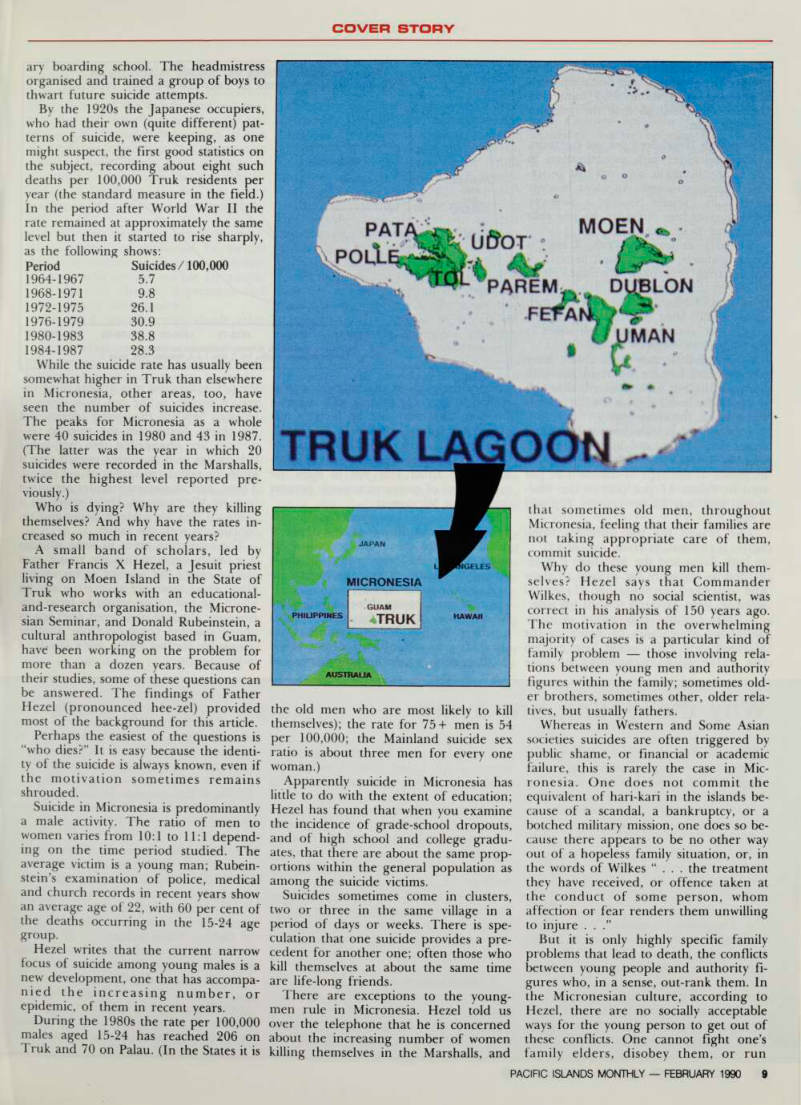
A small band of scholars, led by Father Francis X Bezel, a Jesuit priest living on Moen Island in the State of Truk who works with an educational and-research organisation, the Microne sian Seminar, and Donald Rubeinstein, a cultural anthropologist based in Guam, have been working on the problem for more than a dozen years. Because of their studies, some of these questions can be answered. The findings of Father Bezel (pronounced hee-zel) provided most of the background for this article.
Perhaps the easiest of the questions is “who dies?” It is easy because the identi ty of the suicide is always known, even if the motivation sometimes remains shrouded.
Suicide in Micronesia is predominantly a male activity. The ratio of men to women varies from 10:1 to 11:1 depend ing on the time period studied. The average victim is a young man; Rubein stein’s examination of police, medical and church records in recent years show an average age of 22, with 60 per cent of the deaths occurring in the 15-24 age group.
Bezel writes that the current narrow focus of suicide among young males is a new development, one that has accompa nied the increasing number, or epidemic, of them in recent years.
During the 1980 s the rate per 100,000 males aged 15-24 has reached 206 on Truk and 70 on Palau. (In the States it is
the old men who are most likely to kill themselves); the rate for 75+ men is 54 per 100,000; the Mainland suicide sex ratio is about three men for every one woman.) Apparently suicide in Micronesia has little to do with the extent of education; Bezel has found that when you examine the incidence of grade-school dropouts, and of high school and college gradu ates, that there are about the same prop ortions within the general population as among the suicide victims.
Suicides sometimes come in clusters, two or three in the same village in a period of days or weeks. There is spe culation that one suicide provides a pre cedent for another one; often those who kill themselves at about the same time are life-long friends.
There are exceptions to the young men rule in Micronesia. Bezel told us over the telephone that he is concerned about the increasing number of women killing themselves in the Marshalls, and
that sometimes old men, throughout Micronesia, feeling that their families are not taking appropriate care of them, commit suicide.
Why do these young men kill them selves? Bezel says that Commander Wilkes, though no social scientist, was correct in his analysis of 150 years ago.
The motivation in the overwhelming majority of cases is a particular kind of
family problem those involving rela
tions between young men and authority figures within the family; sometimes old er brothers, sometimes other, older rela tives, but usually fathers.
Whereas in Western and Some Asian societies suicides are often triggered by public shame, or financial or academic failure, this is rarely the case in Mic ronesia. One does not commit the equivalent of hari-kari in the islands be cause of a scandal, a bankruptcy, or a botched military mission, one does so be cause there appears to be no other way out of a hopeless family situation, or, in the words of Wilkes “ . . . the treatment they have received, or offence taken at the conduct of some person, whom affection or fear renders them unwilling
to injure . .
But it is only highly specific family problems that lead to death, the conflicts between young people and authority fi gures who, in a sense, out-rank them. In the Micronesian culture, according to Bezel, there are no socially acceptable ways for the young person to get out of these conflicts. One cannot fight one’s family elders, disobey them, or run
Period Suicides/100,000 1964-1967 5.7 1968-1971 9.8 1972-1975 26.1 1976-1979 30.9 1980-1983 38.8 1984-1987 28.3
away; the only acceptable response is to endure the situation, and bottle up one’s anger and frustration. And sometimes the bottle is used to ease the younger person’s pain.
Although Hezel does not use the term, suicide coincides with powerlessness in the family situation, and not just gener alised family disputes. An older brother never kills himself because a younger brother gives him difficulty, he just yells at him, or beats him.
Similarly, at least in Truk, a man is highly unlikely to kill himself because of an unhappy or broken marriage. Hezel writes on this point: “ . . . despite sanc tions against interpersonal violence, men have usually been permitted to express displeasure and even beat their wives as
they felt circumstances required.
The offended woman could always leave her husband to take up residence with her own kin, but such an event, although it could be painful, was by no means catastrophic for either party.”
Love-related suicides, are much more common in Palau and in the Marshalls than in Truk; Hezel calculates that the incidence of this type of suicide is 27 per cent in Palau, 41 per cent in the Mar shalls, and only 12 per cent in Yap and Truk.
The reason for the different rates, again, is cultural, as Hezel explains “ . . . in both Palau and the Marshalls it is re garded as unmanly for a male to show any outward expression of sexual jealousy, even privately toward his wife . . . [this] cultural prohibition of man ifestations of jealousy by males in the Marshalls and Palau could help explain the extraordinary number of love
suicides there, given that suicide is generaly a strategy for dealing with negative emotions that may not be directly displayed for cultural reasons.”
In other words, the bottling up of emotions between spouses in the Marshalls and Palau kills just as does the suppression of emotions towards parents
throughout Micronesia.
Setting love suicides apart for the moment, Hezel identifies four basic types of suicide in Micronesia, those caused by anger (much the most common), those caused by shame or fear, by mental illness, and by other causes.
Anger suicides are those in which the victim senses that he has been treated unjustly by his elders, and has no alternative to self-inflicted death. While the triggering act, such as the disposal of
the pet, sometimes may appear to be tri vial, it usually is the last in a series of tensions between the young person and his elders. Sometimes the suicidal ten dencies are channelled into non-lethal behaviours such as cutting oneself with a knife, or making a display of not eating, These, and attempted suicides are often seen by Micronesians, Hezel states, as a poignant plea for understanding and re conciliation with the family, The triggering event in some suicides is a family decision that the young man cannot marry the woman of his choice, Hezel views these not as love suicides (in which the motivation would be bitter sor row over the loss of a loved one) but as anger suicides resulting from another impossible conflict within one’s family of birth.
The shame suicides are, again, family related, with the victim killing himself because he fears that an act of his will bring shame to the family, and will ruin his relations with the family for the rest of his life. Among the examples of this kind of suicide was that of a young man who had been caught making advances to a young woman who was classified by society as his sister. He felt that there was no way out of this, so he hung himself.
A relatively small number of Micronesian suicides are explained by mental illness; in contrast, in Europe and Amertea many who commit suicide are people with cases of chronic depression and other mental disturbances.
Why did suicide rates climb alter 1970?
Bezel advances a two-part theory in this connection: suicide rates increased because of increased tensions, particularly for young men, growing out of the declining strength of the extended family; and the extended family, in turn, lost its former cohesive power because of post-1970 economic trends.
The traditional extended families of Truk, but not all Micronesian islands, revolve around the mother’s relatives; in anthropological lingo this is a matrilineal arrangement. One lives on the land owned by the mother’s family, thus one has a matrilocal home. The oldest or most competent older male is the head of the extended family, and he makes decisions about gathering and preparing food, organising family events (such as marriages and funerals), allocating scarce resources, and mobilising family labour.
While both parents have important roles in the raising and disciplining of
small children, the matter of guiding and disciplining post-adolescent males is a task for the head of the extended family, for the older men in the family generally, typically for one’s mother’s brothers (matrilineal uncles) and for grandparents. The relations between young men and the elders in the family are thus somewhat diffused, with a num ber of players among the authority figures; an unhappy young man can, in this setting, seek the ear of another ranking relative when one of his elders gives him a hard time.
In the last two or three decades, however, there has been a social revolu tion, Hezel contends, with the extended family being replaced by the more wes ternised nuclear family, in which the father becomes the principal authority figure. This is a new role for fathers often brought up in the extended family themselves with no role models for how a nuclear father should act and one which they do not always handle very well.
The result is that young men in con flict with their fathers have none of the
opportunities of working out problems
through other authority figures in the
family, as of old; and sometimes, all too often, they decide that the only suitable way out of the conflict is suicide.
The changes in the economy enter the picture because the widespread use of money in the economy the dominance of the wage economy rather than the subsistence economy gives economic, and therefore family power to the wage earner. And that wage-earner is typically the father of the household.
Neither the money economy nor wages are new to Truk or to Micronesia,
but until recently, Bezel argues, their presence was not necessarily destructive of the extended family. The sale of copra for cash to exporters in the early 20th Century did little damage to the extended family because that family gathered the crop as a unit, and the money for the product was paid to the head of the clan, who distributed it along traditional lines. Similarly, the rapid expansion of modern economic activity during the Japanese period did little harm to the extended family be cause wages were so low. „ is onl since American dollars came flooding into Micronesia, an image that not Hezel’s that the wage-driven eco no has changed family authority pat terns le on v bught *B™ l^lat one can c^e ‘ 111 ., s ana v SIS °( *bc situation is t * iat tie rate su i c *des ma > be a transitional phase. He finds that suicide rates tend to be lowest in the most tradi tional Micronesian settings, such as the islands around the high island °. a P Further, he finds them lower in t ie al S cl towns of Micronesia than they ale * n l^ie surroun ding (peii-urban) vil 'ages. Presumably the transition to the nuclear family is nearing completion in tne * ar g er towns, but is still underway in
near by villages.
He does not make this point, but suicide rates in the nuclear-family na tions along the Pacific Rim, such as the United States and Australia, are con siderably lower than they are in Truk, Perhaps it is the painful transition to such family structures, not the structures themselves, which is killing so many young people in Micronesia. □