canning enterprise
pp. 44-46 · Read in the full issue
Asians link up for top-of-the-market canning enterprise
TWO major Asian investors have
joined Fiji’s state-owned Pacific
Fishing Company (PAFCO) in a manufacturing venture to boost the country’s tuna industry. Their joint en terprise, Pacific Packaging Ltd (PPL), will produce up to 60 million cans a year for PAFCO’s premium-quality tuna. The Fs2 million investment places Fiji among world leaders in the use of can manufacturing technology. As an export industry, it has been granted tax-free status.
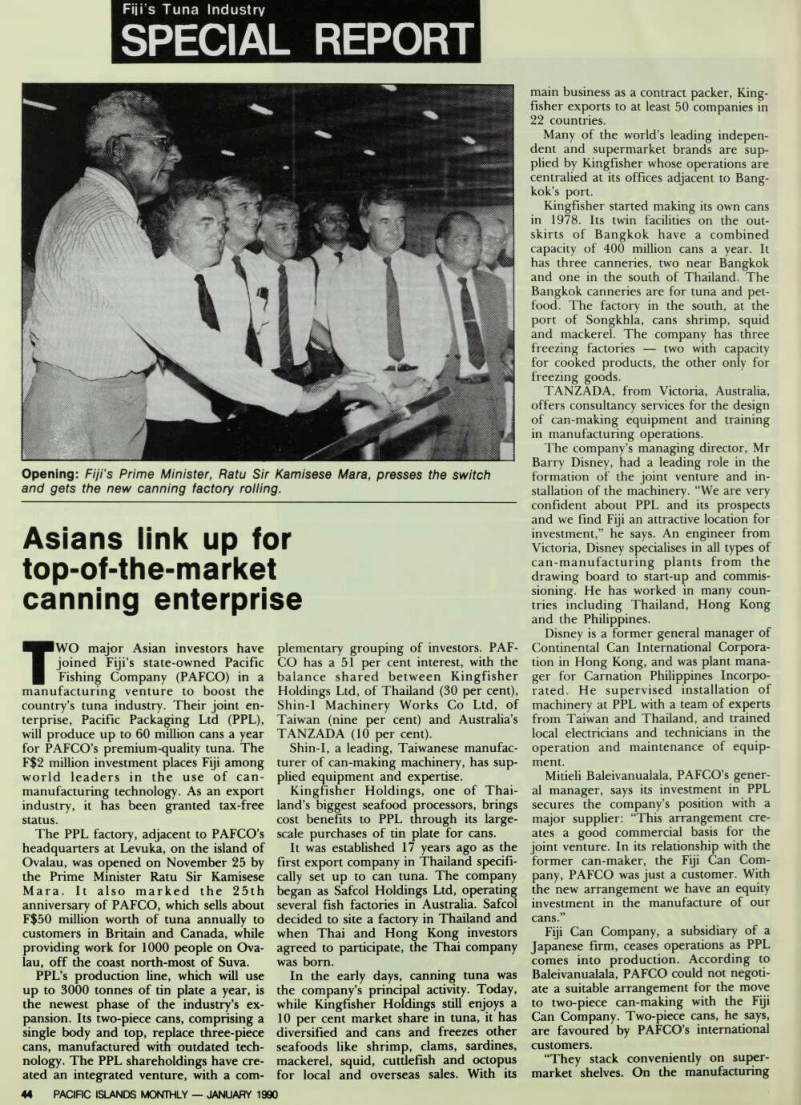
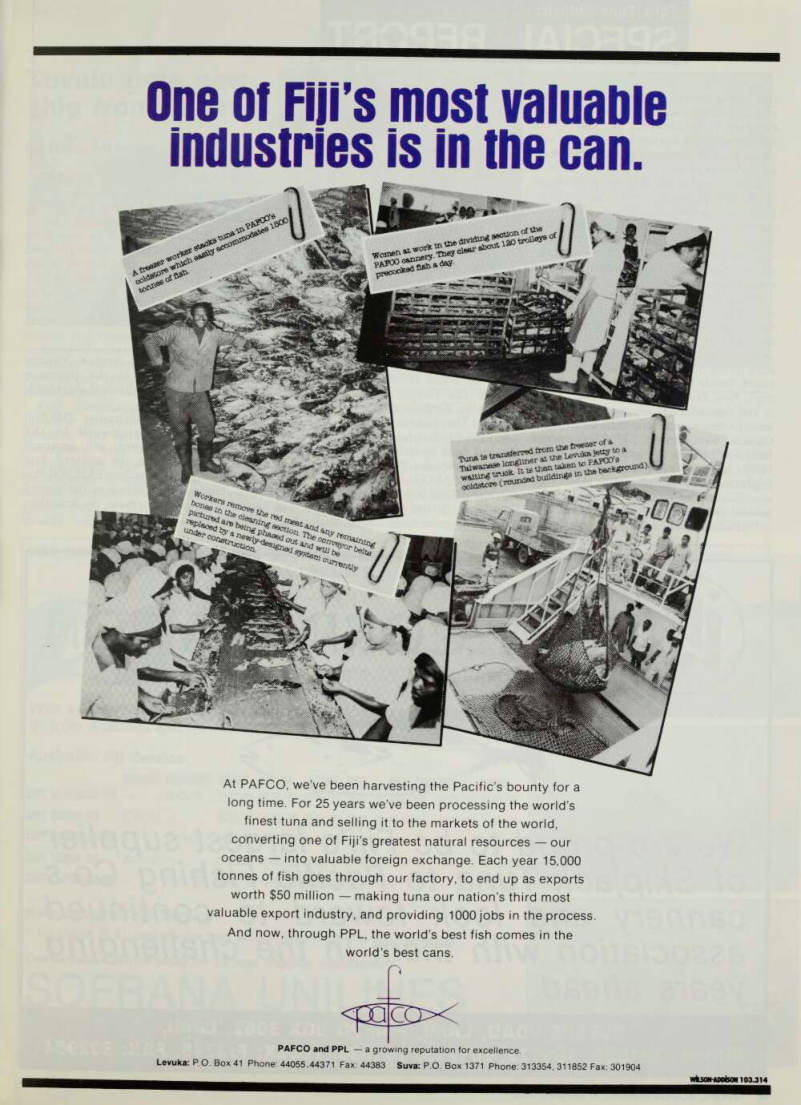
The PPL factory, adjacent to PAFCO’s headquarters at Levuka, on the island of Ovalau, was opened on November 25 by the Prime Minister Ratu Sir Kamisese Mara. It also marked the 25th anniversary of PAFCO, which sells about Fsso million worth of tuna annually to customers in Britain and Canada, while providing work for 1000 people on Ova lau, off the coast north-most of Suva.
PPL’s production line, which will use up to 3000 tonnes of tin plate a year, is the newest phase of the industry’s ex
pansion. Its two-piece cans, comprising a
single body and top, replace three-piece
cans, manufactured with outdated tech nology. The PPL shareholdings have cre ated an integrated venture, with a com
plementary grouping of investors. PAF CO has a 51 per cent interest, with the balance shared between Kingfisher Holdings Ltd, of Thailand (30 per cent), Shin-I Machinery Works Co Ltd, of Taiwan (nine per cent) and Australia’s TANZADA (10 per cent).
Shin-I, a leading, Taiwanese manufac turer of can-making machinery, has sup
plied equipment and expertise.
Kingfisher Holdings, one of Thai land’s biggest seafood processors, brings cost benefits to PPL through its large scale purchases of tin plate for cans.
It was established 17 years ago as the first export company in Thailand specifi cally set up to can tuna. The company
began as Safcol Holdings Ltd, operating
several fish factories in Australia. Safcol decided to site a factory in Thailand and when Thai and Hong Kong investors agreed to participate, the Thai company was born.
In the early days, canning tuna was
the company’s principal activity. Today,
while Kingfisher Holdings still enjoys a
10 per cent market share in tuna, it has diversified and cans and freezes other seafoods like shrimp, clams, sardines, mackerel, squid, cuttlefish and octopus for local and overseas sales. With its
main business as a contract packer, King fisher exports to at least 50 companies in 22 countries.
Many of the world’s leading indepen dent and supermarket brands are sup
plied by Kingfisher whose operations are
centralied at its offices adjacent to Bang kok’s port.
Kingfisher started making its own cans in 1978. Its twin facilities on the out skirts of Bangkok have a combined capacity of 400 million cans a year. It has three canneries, two near Bangkok and one in the south of Thailand. The Bangkok canneries are for tuna and pet food. The factory in the south, at the
port of Songkhla, cans shrimp, squid
and mackerel. The company has three freezing factories two with capacity for cooked products, the other only for
freezing goods.
TANZADA, from Victoria, Australia, offers consultancy services for the design
of can-making equipment and training
in manufacturing operations.
The company’s managing director, Mr Barry Disney, had a leading role in the formation of the joint venture and in stallation of the machinery. “We are very confident about PPL and its prospects and we find Fiji an attractive location for investment,” he says. An engineer from Victoria, Disney specialises in all types of
can-manufacturing plants from the
drawing board to start-up and commis sioning. He has worked in many coun tries including Thailand, Hong Kong and the Philippines.
Disney is a former general manager of Continental Can International Corpora tion in Hong Kong, and was plant mana ger for Carnation Philippines Incorpo rated. He supervised installation of machinery at PPL with a team of experts from Taiwan and Thailand, and trained local electricians and technicians in the operation and maintenance of equip ment.
Mitieli Baleivanualala, PAFCO’s gener al manager, says its investment in PPL secures the company’s position with a major supplier: “This arrangement cre ates a good commercial basis for the joint venture. In its relationship with the former can-maker, the Fiji Can Com pany, PAFCO was just a customer. With the new arrangement we have an equity investment in the manufacture of our cans.”
Fiji Can Company, a subsidiary of a Japanese firm, ceases operations as PPL comes into production. According to Baleivanualala, PAFCO could not negoti ate a suitable arrangement for the move
to two-piece can-making with the Fiji
Can Company. Two-piece cans, he says, are favoured by PAFCO’s international customers.
“They stack conveniently on super market shelves. On the manufacturing
Opening: Fiji’s Prime Minister, Ratu Sir Kamisese Mara, presses the switch and gets the new canning factory rolling.
side, no soldering is required, and the risk of leaks is minimised. Costs, too, are expected to be cheaper,” he said. “The new form of packaging for our tuna will consolidate its international reputation as an excellent product.”
Disney emphasises that the technology in the PPL factory places Fiji at the fore front of can-manufacturing. Plans are already in hand, he says, to adapt the factory to an even more advanced pro duction process. Says he: “This will cre ate stronger and lighter cans with an even greater cost advantage.”
PPL is able to make cans in three sizes, with a production capacity of up to 600 cans a minute. It hopes to supply cans also to food processing companies in Fiji and elsewhere, possibly with the assist ance of the Sparteca trade agreement be tween South Pacific Forum Island coun tries, New Zealand and Australia.
The canned PAFCO tuna finds its way into the best supermarkets in Britain and Canada. Says Disney: “The fish caught for PAFCO from the pure waters of the Pacific is superb. It has a reputation for freshness and flavour, and meets the specifications of retailers who prefer the
natural pole-and-fishing technique.”
PAFCO’s Levuka cannery processes
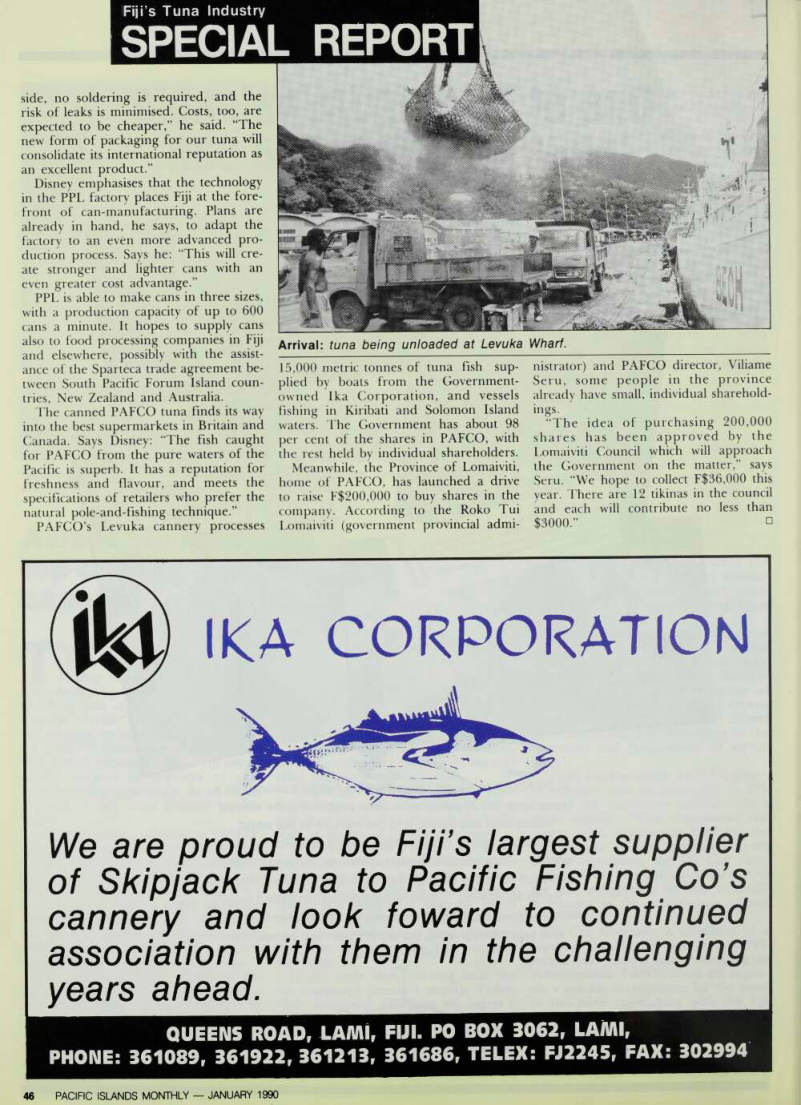
15,000 metric tonnes of tuna fish sup plied by boats from the Government owned Ika Corporation, and vessels fishing in Kiribati and Solomon Island waters. The Government has about 98 per cent of the shares in PAFCO, with the rest held by individual shareholders.
Meanwhile, the Province of Lomaiviti, home of PAFCO, has launched a drive to raise F 5200,000 to buy shares in the company. According to the Roko Tui Lomaiviti (government provincial admi
nistrator) and PAFCO director, Viliame Seru, some people in the province already have small, individual sharehold ings.
“The idea of purchasing 200,000 shares has been approved by the Lomaiviti Council which will approach the Government on the matter,” says Seru. “We hope to collect F 536,000 this year. There are 12 tikinas in the council and each will contribute no less than $3000.” □
Arrival: tuna being unloaded at Levuka Wharf.