Pacific
pp. 23-24 · Read in the full issue
Islands
Monthly
Business
Falling, falling, falling prices Cash crops take the plunge
By Robin Bromby
THE Pacific island nations have an
agricultural quandary: the cash
crops they grow most easily are going through troubled times, with prices falling alarmingly. But, at the same time, these crops must be sustained or their rural sectors will collapse. This has led to government’s ploughing money into plantations and crop rehabi litation with little hope of good returns in the coming years. Coffee and cocoa are in bad shape on the world market while that most traditional of products copra will probably never again see
good days.
In its latest tropical products review, Westpac describes coffee as the big loser.
The downward rush in the world price was renewed in October with a nine per cent drop at a time when world produc tion continues to rise. On the bright side, Westpac believes that sheer size of the recent price falls will lift consumption, but this will be insufficient to reduce stocks. It believes the International Cof fee Organisation (ICO) shows little sign of coming to a supply control agreement before 1991.
The bank believes cocoa prices are set to fall further because large stocks are being released on to the world market by Cote d’lvoire in the last year, this African country has been supporting world prices by refusing to sell cocoa below a certain price level.
Cocoa’s world price fell 13 per cent in September and another 11 per cent in October to reach its lowest level for 14 years. Some relief is in sight as dry weather and transport problems in West Africa will mean lower production there, and demand is inching upwards.
Palm oil has fallen in price by a far greater margin than other tropical oils,
one of the reasons being that its produc tion has risen much faster than its major competitors. Coconut oil’s price will also be affected by rising production in the coming year, the bank said.
Recent reports from Papua New
Guinea indicate the stabilisation funds for cocoa, copra and palm oil were due to have been exhausted by the end of 1989 and the coffee fund would follow them by the end of June 1990. The gov ernment has been told by its agricultural advisors that there appeared to be no respite in sight and forecast zero growth in the agricultural sector for 1990.
The EEC-funded copra fund was nearly at the end of its K 4 million for the year, while the emergency loan to the cocoa fund of Kl 5 million was almost exhausted. Two of the three palm oil stabilisation funds are almost broke.
The country’s richest fund, the Coffee Stabilisation Fund, has dwindled from an impressive sum of Kl2O million about 18 months ago to about K 24 million in the December quarter.
The Papua New Guinea Coffee Indus try Board added a new dimension to the crisis in early December when it slashed bounty payments by nearly 50 per cent.
The move is bound to place great finan cial strain on coffee growers. The board explained the new bounty had been calculated by dividing the remaining K 24 million in the stabilisation fund by the expected physical export for the 1989/ 90 season. The estimate of 1.2 million bags meant that growers could get a bounty of 35 toea about half what they received from the fund in the pre vious season.
Board executive officer Ray Ganarafo said no new government assistance was expected. “Everybody will be affected, especially the big plantations, as they will be going through very hard times,” he said. If the previous rate of payment had been continued, the stabilisation fund would have run out in the middle of the season.
The implications for this are enor mous in the skittish Papua New Guinea economy. All these crops are part of the cornerstone of Papua New Guinea gov ernment policy: to boost the agricultural sector in the interests of political stability and to head off migration (with its con sequent unemployment and crime) to the major towns. There is an added complication; one of the most important cocoa areas is located in the North Solo mons province, scene of the Bougainville copper mine crisis.
That mining crisis has, of course, sev erely damaged the economy and the
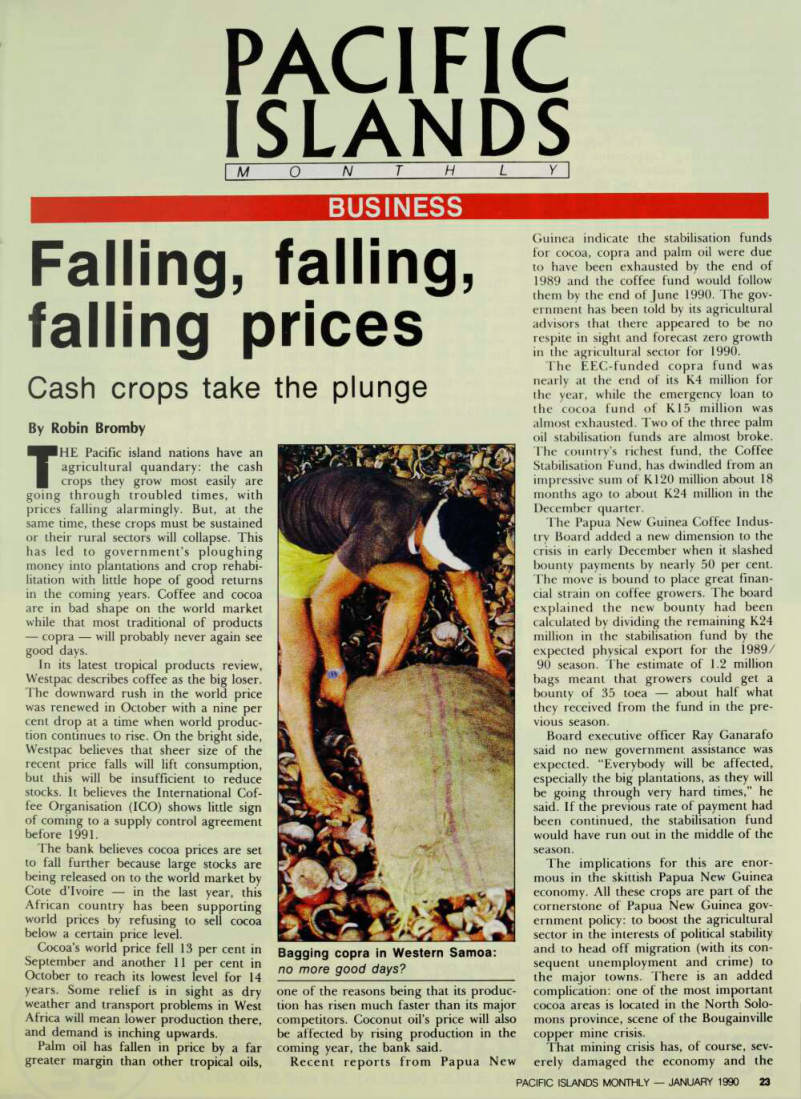
Bagging copra in Western Samoa: no more good days?
government’s revenue the revenue it so desperately needs to prop up the na tion’s farmers in their troubled times. As it is, the government has managed to scrape up some funds to cope with the immediate problem. The Papua New Guinea Banking Corporation is now working on an assistance package to the coffee growers, while the government will inject more money into the cocoa fund. Prime Minister Rabbie Namaliu has said the administration will stand be hind cash crop growers.
Just how expensive this will be is indi cated by the prediction that cocoa prices could drop so low that village and smal lholders produce might stop harvesting altogether. Cocoa Board chairman Jack Ockley has told the government the in
dustry faces bankruptcy, with resulting
serious unemployment.
Plantation managers warned the gov ernment of the problems in late Octo ber they added pressure to the call for more funds saying they would not pay more than K6OO a tonne for dried beans, and would hope the stabilisation fund would continue to pay an addition al K 528 a tonne to support growers.
They said about 40,000 families de pended entirely on cocoa as their only means of income, with North Solomons and East New Britain likely to be the areas most severely affected by price col lapses. About 63 per cent of Papua New Guinea’s cocoa is produced by smallhol ders.
Meanwhile, the Namaliu government has acted to ease pressure on farmers by
forcing the Agriculture Bank to suspend
interest payments on all outstanding loans made to cocoa and coffee produc ers. Finance Minister Paul Pora said the suspension was indefinite and any
change would depend on world price
movements. The government had taken another decision to lift taxes on the export of agricultural commodities which would help farmers now but will hit government revenue over the coming year.
Coffee growers have more than world prices to worry about.
Coffee Industry Association chairman Dick Hagon said recently armed hold ups and stealing of coffee on plantations also contributed to the problems faced by the industry. Hagon said prices of chemicals, fertilizers and other planta tion equipment had risen sharply.
But it is copra which is the real headache for the region. While coffee and cocoa can reasonably expect their industries to eventually revive, few such hopes can be held for copra. Agricultu ral experts are agreed the island coun tries will have to look to new uses for coconuts, mainly in the direction of pro cessing them into a range of food pro ducts.
While Papua New Guinea is the most dramatic example of the world price crisis in the cash crops, most of the region’s states are affected.
In September the Vanuatu Commodities Marketing Board reduced prices for both copra and cocoa falls of VTSOOO a tonne for copra and VT27,000 a tonne for cocoa. The board chairman, Edward Kaloris, said the decision came after four years of subsidising the growers. He said it was tempting to keep on using the cash reserves, but reality had to be faced if the industry was to survive in the long term - The same month, the Fiji government increased the copra support price by Fs2o a tonne, but cut the price of local cocoa beans as a result of the depression in world prices.
Just how critical crops are to the island people was shown in Tonga last year when the Tonga Commodities Board, despite its own financial problems, paid out T$ 10,000 to buy copra on the island of Niuafo’ou where the people were facing an acute money shortage. Because of shipping problems, the board had stopped buying copra in Niuafo’ou and the product had been piling up, leading the islanders into financial straits so serious they could not even afford to buy basic necessities.
Island producers have not been helped by a campaign organised by the American Soybean Association, now abandoned, which set out to convince
United States residents that coconut and palm oils were linked to heart disease, While the American soybean industry has now been forced to drop the cam paign, the damage has been done. West ern Samoa’s copra oil mill, for example, is expecting reduced sales until the cam
paign is forgotten,
Meanwhile, Papua New Guinea’s Cop ra Marketing Board chairman Sir John Guise has brushed aside talk that the industry is dying. He has been moving about the country telling growers that most of the rumours were being spread by foreigners and were “absolute non sense”, “The humble coconut palm has always had an important place in the village economy and it will continue to do so,” he has said. Copra would remain a vital element in the country’s economic strategy. He has asked the government to ensure the Copra Board was repre sented on the boards of all the banks in Papua New Guinea to ensure growers got a fair deal.
The people of Kiribati will certainly be hoping that Sir John is right about cop ra’s future, as that product is one of the mainstays of their economy. Coconuts form one of the main ingredients in the local diet and as well as providing cash when turned into copra.
The world price tells its own story; in 1979, US$733 per tonne; in 1982, US$27O a tonne, and in 1986 just US$l43 per tonne. □