Goff’s $6000
p. 22 · Read in the full issue
Education
Goff’s $6000 fees barrier
PACIFIC Island parents can no longer look to New Zealand to
provide senior secondary educa
tion for their children, unless they can afford at least NZ$6OOO a year in fees.
Just before Christmas, Education Minis ter Phil Goff oversaw the passage of leg islation which will effectively force hun dreds of Pacific Island students, particu larly in Auckland, to either overstay to finish their education, or return home to the islands next year.
The new laws are designed to encour age New Zealand to sell its educational skills on the international market, re
cruiting fee-paying foreign students to
schools and tertiary institutions. Goff says selling education is one of the fas test growing areas of international trade.
New Zealand’s trade development board estimates the country could earn as
much as NZ$2OO million in
foreign exchange from sell
ing education over the next two years.
Many schools are looking forward to taking on signi ficant numbers of fee paying Asian students next year. Already a mini re cruitment industry has sprung up, with agents
touring secondary schools
promising “bulk supplies”
of Asian students in return for a cut of the fees.
But many Auckland schools fear they’ll lose hundreds of their Pacific Is
land students. Auckland secondary prin cipals’ association president, Brother Pat Lynch, says the average fee for foreign students next year will be $6OOO, com pared to NZ$l745 a year for a fulltime degree student at the University of the South Pacific.
“That’s a mammoth amount of money for many people from the Pacific Island states,” says Brother Lynch. “It’s effec tively going to cut off what has been a flow of students from particularly Samoa and Tonga over many years.”
The fees will hit hardest at students from Samoa, Tonga and Fiji because those from the Cook Islands, Niue and Tokelau are entitled to free education by virtue of being New Zealand citizens.
Goff says the new fee regime “does not cut across New Zealand’s commitment to provide aid to developing countries and in particular the Pacific Islands”.
Those Pacific Island students already in New Zealand on study permits will get their fees covered by Ministry of Exter nal Relations and Trade (MERT) scho-
larships. Goff says these scholarships will be worth about $44 million next year.
But so far MERT hasn’t clarified how many new Pacific Island scholarships will be offered each year, and how far this will go towards meeting the demand.
The scholarships don’t impress Auck land principals, one of whom described them as a “blatant bribe” to buy the tem porary silence of local Pacific Island communities and the Pacific govern ments. Brother Lynch says the scho larships won’t help the hundreds of Is land students who arrived at school in 1989 on visitor’s permits.
“They’re the ones who I think are going to be trying to make up their minds as to whether they stay in New Zealand and become overstayers or simply bite the bullet and get the plane and go back home,” he said.
Brother Lynch says many Auckland schools view educating these Island stu dents, usually for their final two years at secondary school, as a form of develop ment aid to Pacific nations. The schools’
boards of trustees want these students to come back to complete their seventh form studies next year. But these students would be illegal residents, and would become what Goff calls “part of the wider problem of over
staying which is being
addressed by the immigra
tion service”.
Goff says schools won’t be required to act as an arm of the Immigration Service, but cannot “kno wingly enrol” a foreign stu dent who is not entitled to
free education. Auckland principals say this will simply mean Pacific Island stu dents who want to complete their educa tion on a visitors permit will lie to the schools.
The secondary teachers union, the PPTA, has a long-standing policy that its members will not police the Immigration Act. Nga Tapuwae College in South Au ckland has specifically requested the PPTA restate this policy, because up to 100 of the school’s 750 students may be come overstayers if they return to school next year. Board of trustees chairman Kepa Stirling says there’s no way his staff will interrogate every foreign looking student, check their passports or family circumstances. But he is worried about the penalties for accepting stu dents who aren’t entitled to a free educa tion.
“If we are found by Internal Affairs to have these people in our school, then we become liable to prosecution which will be taken out of our existing funding,” he said.
The deeper effects of the fee regime on funding for different schools is likely to become a touchy subject. Many South Auckland schools are already severely hampered by the lack of priority given
by the Government to funding English
as a Second Language (ESL) teaching.
The national inflow of immigrants is ris ing quickly, from 8600 in 1986 to an estimated 35,000 in 1990.
The PPTA says not only will the fee regime sharpen differences between already disadvantaged schools but it will cause dissension within schools as fee paying students claim privileged atten tion. This trend has already shown up elsewhere in South Auckland as a result of the Business Immigration Scheme, which gives preferential entry and permanent residency to mainly Asian families with substantial financial re sources.
During 1989, Pakuranga College had
to cope with an influx of 140 Asian stu dents, none of whom spoke passable En glish. Principal Pamela Stone says the school’s had to plunder resources from its existing budget to cope with these students, depriving other students. To cope next year, she says Pakuranga Col lege will need an immediate grant of $250,000. Should such a grant be forth coming, it will merely emphasise the dis parity between the Government’s help for Asian immigrants and those across South Auckland from the Pacific Islands.
One Samoan community leader says the fees regime is an immigration issue rather than one of education. His com ments are echoed by other Island leaders and diplomats who see it as another step by the Labour Government away from its traditional focus on the South Pacific, towards southeast Asia. The champion of the fees legislation, Education Minis ter Goff, was the first to go public earlier last year with the proposal that Western Samoa’s immigration quota be cut back.
Coupled with Immigration Minister Ro ger Douglas’ proposals for a Whites Only immigration policy in future, it’s led one Island diplomat to comment the New Zealand Government was giving its neighbours a clear message: we don’t want Pacific Islanders to come here any more.
The fees legislation hasn’t provoked much public comment from the local Pacific Island communities or the Pacific governments, mainly because there’s been little consultation from the New Zealand authorities. But Kepa Stirling says Nga Tapuwae parents are very angry about the fees regime. A similar backlash reported by other boards of trustees, particularly in South Auckland, spells trouble in an election year when Pacific Islanders are already registering their disenchantment with the Labour Government. □
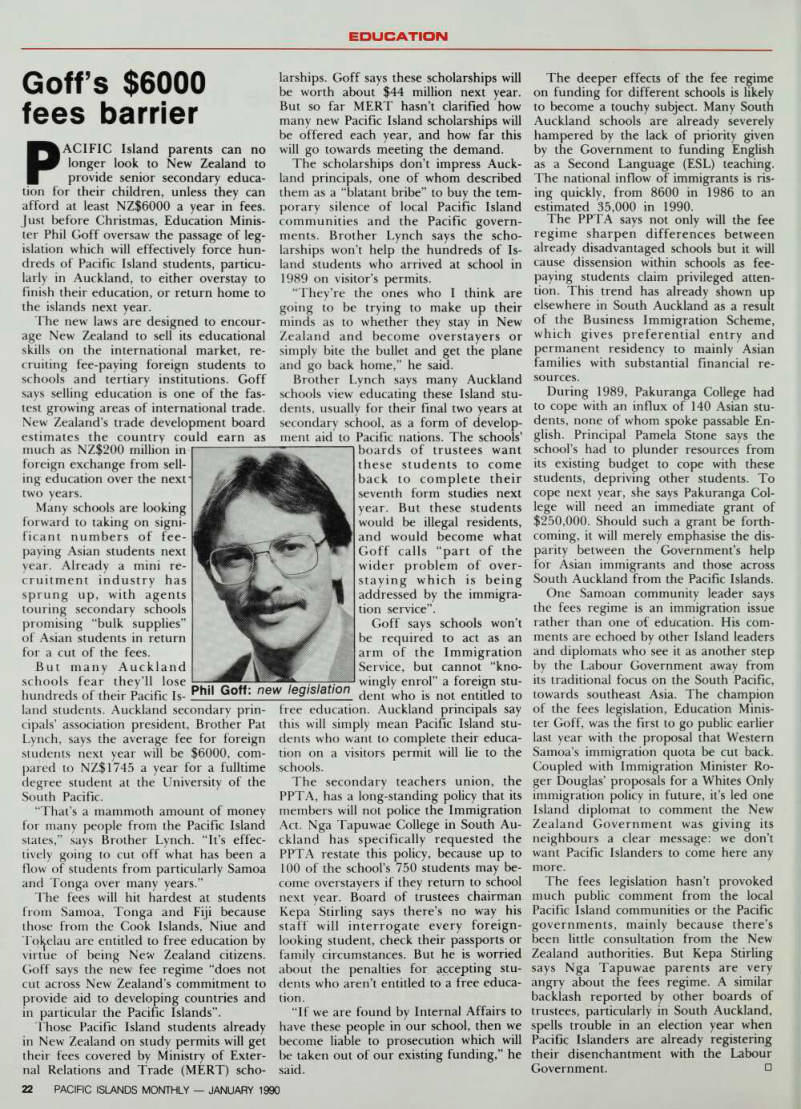
Phil Goff: new legislation