The discovery of Pitcairn
Stamps
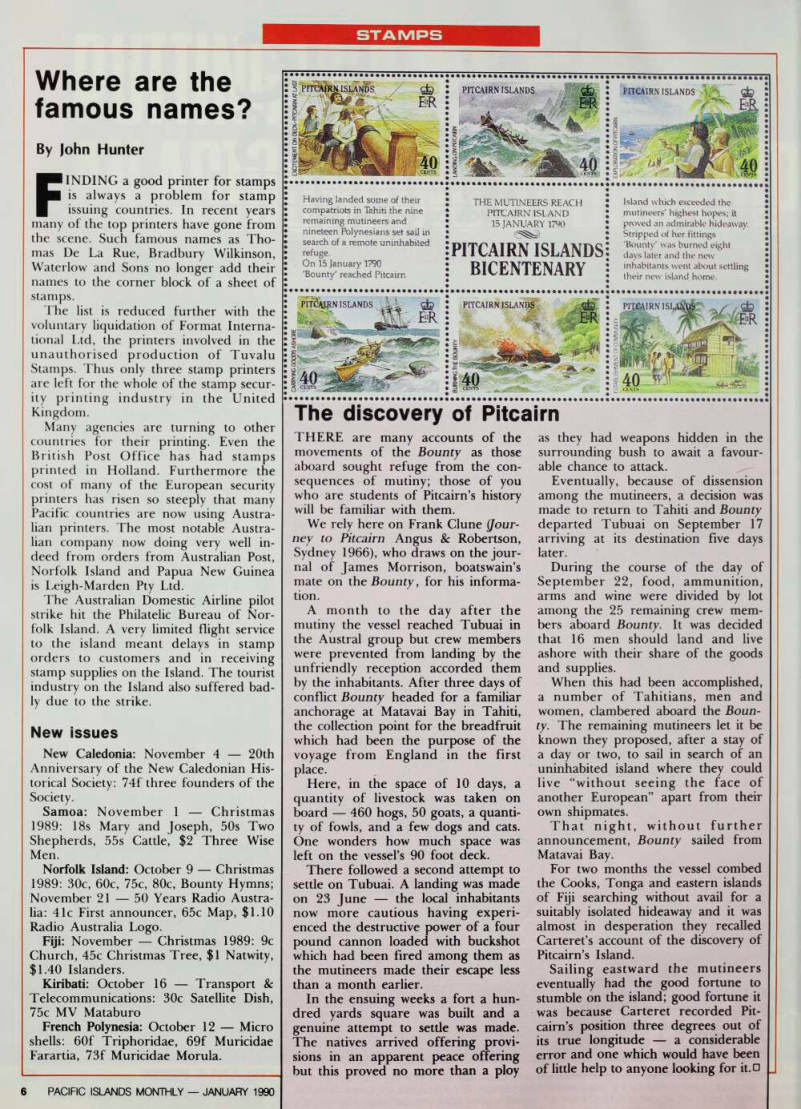
THERE are many accounts of the movements of the Bounty as those aboard sought refuge from the con sequences of mutiny; those of you who are students of Pitcairn’s history will be familiar with them.
We rely here on Frank Clune {Jour ney to Pitcairn Angus 8c Robertson, Sydney 1966), who draws on the jour nal of James Morrison, boatswain’s mate on the Bounty, for his informa tion.
A month to the day after the mutiny the vessel reached Tubuai in the Austral group but crew members
were prevented from landing by the
unfriendly reception accorded them
by the inhabitants. After three days of conflict Bounty headed for a familiar anchorage at Matavai Bay in Tahiti, the collection point for the breadfruit which had been the purpose of the voyage from England in the first
place.
Here, in the space of 10 days, a quantity of livestock was taken on board 460 hogs, 50 goats, a quanti ty of fowls, and a few dogs and cats.
One wonders how much space was left on the vessel’s 90 foot deck.
There followed a second attempt to settle on Tubuai. A landing was made on 23 June the local inhabitants now more cautious having experi enced the destructive power of a four pound cannon loaded with buckshot which had been fired among them as the mutineers made their escape less than a month earlier.
In the ensuing weeks a fort a hun dred yards square was built and a genuine attempt to settle was made.
The natives arrived offering provi sions in an apparent peace offering but this proved no more than a ploy
as they had weapons hidden in the surrounding bush to await a favour able chance to attack.
Eventually, because of dissension among the mutineers, a decision was made to return to Tahiti and Bounty departed Tubuai on September 17 arriving at its destination five days later.
During the course of the day of September 22, food, ammunition, arms and wine were divided by lot among the 25 remaining crew mem bers aboard Bounty. It was decided that 16 men should land and live ashore with their share of the goods
and supplies.
When this had been accomplished, a number of Tahitians, men and women, clambered aboard the Boun ty. The remaining mutineers let it be known they proposed, after a stay of a day or two, to sail in search of an uninhabited island where they could live “without seeing the face of another European” apart from their
own shipmates.
That night, without further announcement, Bounty sailed from Matavai Bay.
For two months the vessel combed the Cooks, Tonga and eastern islands of Fiji searching without avail for a suitably isolated hideaway and it was almost in desperation they recalled Carteret’s account of the discovery of Pitcairn’s Island.
Sailing eastward the mutineers eventually had the good fortune to stumble on the island; good fortune it was because Carteret recorded Pit cairn’s position three degrees out of its true longitude a considerable error and one which would have been of little help to anyone looking for it.o