Pacific
pp. 25-27 · Read in the full issue
Islands
Monthly
Business
The way of the aiga Living in Western Samoa’s fragile economy
By John McCrystal
IT’S a little after 9pm on a Thursday in Western Samoa. The visitor to the capital Apia was leaving by taxi when the radio announcer started reading long list of names. It was the Post Office list of postal money orders waiting to be collected. The driver also listened. He, too, was expecting money from relatives in New Zealand, Australia, United States “all over the place”. The money was
coming, “one day soon”.
Money sent home by Samoans living abroad has become the major part of the Western Samoan economy. At least 80 per cent of the money come from New Zealand. The balance comes by Samoans working in American Samoa, Australia, the United States all over the place.
Labour is by far Western Samoa’s biggest export commodity. In 1988, it returned WS$73.B million, compared to WS$3l.5 million earned by all other export pro ducts.
“Remittance,” said Economic Develop ment Director Tunaimatia Falani Chan Tung “is a positive contribution to the balance of payments”. Samoa’s depend ence upon remittance as a major source of income is manifest.
In 1989, the New Zealand government sought to scrap or reduce the special quota of visas granted to Samoan immig rant labourers. The Samoan response re sembled New Zealand’s familiar alarm whenever the European Economic Com munity proposes to cut the quota of New Zealand butter. Western Samoa is in the unenviable position of dependence upon a market commodity that is affected by more than just simple economic and political factors. Given the depressed state of New Zealand’s own domestic job market, cutting back on the immigration of unskilled labour is a politically temp ting measure. The Samoan situation is precarious, and economic dependence
has profound implications not only for
the standard of living of Western Sa moans, but also for the Samoan way of life.
Precarious as the situation is, for most Samoans today it is a comfortable one. It is a unique marriage of fa’asamoa, (the traditional Samoan Way), and the be nefits of the modern West.
Fa’asamoa is based upon the extended family, the aiga. Traditionally, the aiga is a self-sufficient unit, producing its own needs entirely from the land in purely subsistence terms, the productive capac ity of traditional agriculture is still such that most aiga remain theoretically self sufficient. Samoa’s commerce with the outside world owes to the taste that its people have acquired for consumer items. Aiga members sent overseas to
work and remit enable most aiga to en joy a very high standard of living. While living in a traditional fale, a house with a thatched roof and without walls, many families own televisions and video recor ders, and most aiga have a car. In a nation described as one of the most under-developed in the world, there are
incongruous signs of affluence.
“Any reduction in remittance levels would adversely affect the standard of living of Samoans,” admits Tanuvasa Livigisitone, the Ministries of Economic Affairs, Development and Planning, and Trade and Commerce. “We recognise the fragility of the situation.”
Clearly, the way out of the current “fragile” situation is to boost the per formance of the productive sectors of
the Samoan economy. If the stream of remittance money were to dry or even slow up in the near future, Samoa would pass from indirect dependence upon other nations to a direct one. To a nation that battled until 1962 to achieve autonomy, this is a repugnant prospect.
Few of the Pacific microstates can hope to achieve autonomy. Western Samoa, if anything, is worse off than
most. Hampered by geographical isola-
tion and a lack of native raw materials, it is an unattractive destination for overseas investment. Also, the history of Western Samoa since 1962 has been characterised by a mixture of mismanagement and economic bad luck that has
served to largely nullify development in-
itiatives undertaken since independence.
Chronic underdevelopment has persisted, and has to a large extent been perpetuated by the growth of remittance levels. As a consequence, Western Samoa is at a disadvantage in the world context from which it may never recover.
Yet within the parameters of these limitations, there is considerable scope for improvement in economic performance. The high standard of living enjoyed by its people disguises the woeful
state of the Western Samoan economy.
Until 1986, the Controller of Customs issued annually a report entitled Return of Trade, Commerce and Shipping of Western Samoa. This document in 1986
graphically illustrated the performance
of the economy. The register of exports and re-exports, which exhaustively lists all goods exported from Western Samoa in 1986, right down to the WSS2O worth of rubber bands exported to Fiji, accounts for eight pages of the report.
The register of imports, on the other hand, occupies 159 pages.
The Samoan economy is a voracious consumer and a very poor producer.
The gap between exports and imports in 1988 was WSsl2s million.
Since 1986, the report has exemplified another aspect of the economy: disorganisation. When the report next appears, it may well bear the title The Return of the Return of Trade, Commerce, etc: The report last appeared in 1986. The figures, according to Joe Devoe, the Controller of Customs, have been gathered since 1986, and in no less detail. They are all in the new computer.
Difficulties arose in getting them out again. The 1987 report is due out at the
end of 1989.
While the level of imports increases at an average rate of 16.68 per cent per annum, productivity stagnates. The aver age rate of increase of the Gross Domes tic Product between 1984 and 1988 was 1.9 per cent per annum. Production levels of all major agricultural products, declining steadily since 1984, recorded their biggest respective declines in 1988,
despite a general trend toward higher
world prices. Department of Economic Development figures estimate that the overall economic growth rate was “low by 20 per cent of its worth in 1987 in real terms”. The Department of Econo
mic Development singles out the agri
cultural sector in commenting on the poor performance of 1988: “ . . . a se rious concern in the behaviour of the Samoan economy should be with regards
to the stagnated production and produc
tivity in the acclaimed mainstay of the national economy. This among other things gives rise to the trade gap. It is very crucial as well as pertinent that the yields of the major agricultural crops should be sustained and improved”, It is precisely the quality of the Sa moan way of life that gives rise to poor
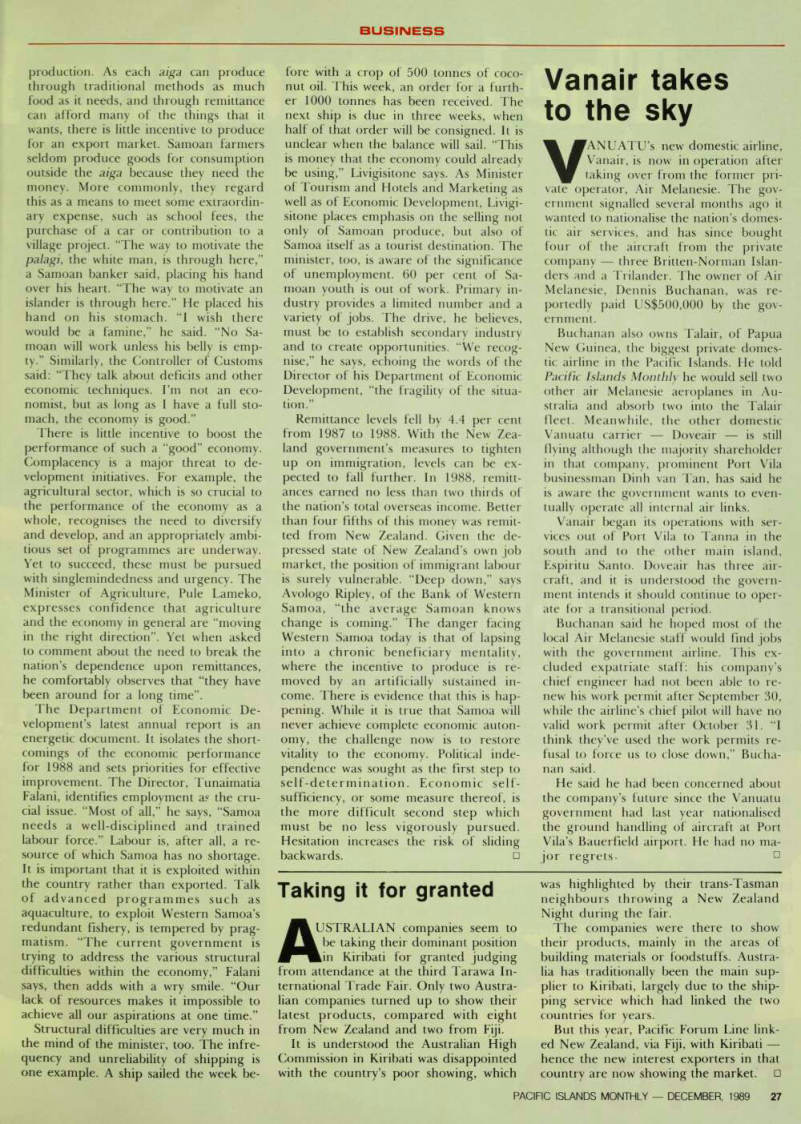
Children in agriculture: moving in the right direction?
production. As each aiga can produce through traditional methods as much food as it needs, and through remittance can afford many of the things that it wants, there is little incentive to produce for an export market. Samoan farmers seldom produce goods for consumption outside the aiga because they need the
money. More commonly, they regard
this as a means to meet some extraordin ary expense, such as school fees, the purchase of a car or contribution to a village project. “The way to motivate the palagi, the white man, is through here,” a Samoan banker said, placing his hand over his heart. “The way to motivate an islander is through here.” He placed his hand on his stomach. “I wish there would be a famine,” he said. “No Sa moan will work unless his belly is emp ty.” Similarly, the Controller of Customs said: “They talk about deficits and other economic techniques. I’m not an eco nomist, but as long as I have a full sto mach, the economy is good.”
There is little incentive to boost the performance of such a “good” economy.
Complacency is a major threat to de velopment initiatives. For example, the agricultural sector, which is so crucial to the performance of the economy as a whole, recognises the need to diversify and develop, and an appropriately ambi tious set of programmes are underway.
Yet to succeed, these must be pursued with singlemindedness and urgency. The Minister of Agriculture, Pule Lameko, expresses confidence that agriculture and the economy in general are “moving in the right direction”. Yet when asked to comment about the need to break the nation’s dependence upon remittances, he comfortably observes that “they have been around for a long time”.
The Department of Economic De velopment’s latest annual report is an energetic document. It isolates the short comings of the economic performance for 1988 and sets priorities for effective improvement. The Director, Tunaimatia Falani, identifies employment as the cru cial issue. “Most of all,” he says, “Samoa needs a well-disciplined and trained labour force.” Labour is, after all, a re source of which Samoa has no shortage.
It is important that it is exploited within the country rather than exported. Talk of advanced programmes such as aquaculture, to exploit Western Samoa’s
redundant fishery, is tempered by prag
matism. “The current government is trying to address the various structural difficulties within the economy,” Falani says, then adds with a wry smile. “Our lack of resources makes it impossible to achieve all our aspirations at one time.”
Structural difficulties are very much in the mind of the minister, too. The infre quency and unreliability of shipping is one example. A ship sailed the week be
fore with a crop of 500 tonnes of coco nut oil. This week, an order for a furth er 1000 tonnes has been received. The next ship is due in three weeks, when half of that order will be consigned. It is unclear when the balance will sail. “This is money that the economy could already be using,” Livigisitone says. As Minister of Tourism and Hotels and Marketing as well as of Economic Development, Livigi sitone places emphasis on the selling not only of Samoan produce, but also of Samoa itself as a tourist destination. The minister, too, is aware of the significance of unemployment. 60 per cent of Sa moan youth is out of work. Primary in dustry provides a limited number and a variety of jobs. The drive, he believes, must be to establish secondary industry and to create opportunities. “We recog nise,” he says, echoing the words of the Director of his Department of Economic Development, “the fragility of the situa tion,”
Remittance levels fell by 4.4 per cent from 1987 to 1988. With the New Zea land government’s measures to tighten up on immigration, levels can be ex pected to fall further. In 1988, remitt ances earned no less than two thirds of the nation’s total overseas income. Better than four fifths of this money was remit ted from New Zealand. Given the de pressed state of New Zealand’s own job market, the position of immigrant labour is surely vulnerable. “Deep down,” says Avologo Ripley, of the Bank of Western Samoa, “the average Samoan knows
change is coming.” The danger facing
Western Samoa today is that of lapsing into a chronic beneficiary mentality, where the incentive to produce is re moved by an artificially sustained in come. There is evidence that this is hap pening. While it is true that Samoa will never achieve complete economic auton omy, the challenge now is to restore vitality to the economy. Political inde pendence was sought as the first step to self-determination. Economic self sufficiency, or some measure thereof, is the more difficult second step which must be no less vigorously pursued.
Hesitation increases the risk of sliding backwards. □