Nz Embassy
p. 24 · Read in the full issue
Defence
Spy links at Deep Freeze
ANZUS may be dead but declassi fied American military docu ments made public last month reveal that low-level military cooperation still continues in the South Pacific be tween New Zealand and the United States.
Communications facilities linked with Operation Deep Freeze, involving New Zealand’s only foreign base which was set up in Christchurch in 1960 to support Antarctic research, are also routinely used as part of the military tie, say the papers.
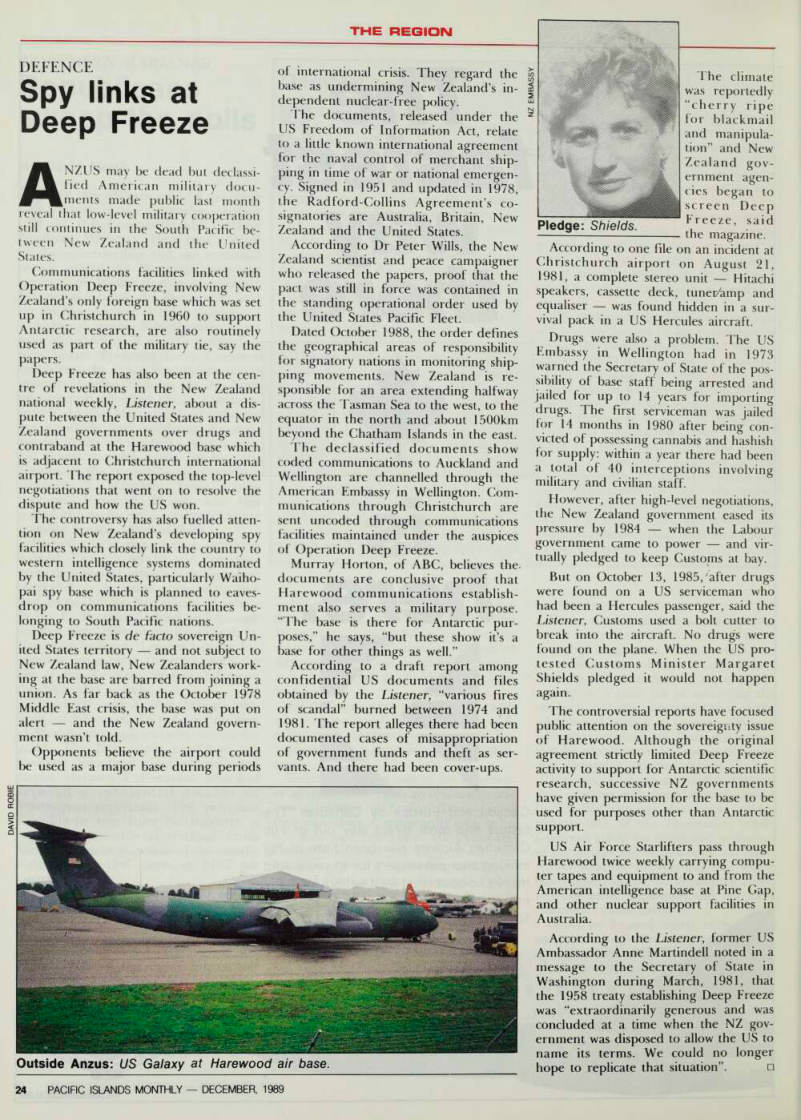
Deep Freeze has also been at the cen tre of revelations in the New Zealand national weekly, Listener, about a dis pute between the United States and New Zealand governments over drugs and contraband at the Harewood base which is adjacent to Christchurch international
airport. The report exposed the top-level
negotiations that went on to resolve the dispute and how the US won.
The controversy has also fuelled atten tion on New Zealand’s developing spy facilities which closely link the country to western intelligence systems dominated by the United States, particularly Waiho pai spy base which is planned to eaves drop on communications facilities be longing to South Pacific nations.
Deep Freeze is de facto sovereign Un ited States territory and not subject to New Zealand law, New Zealanders work ing at the base are barred from joining a union. As far back as the October 1978 Middle East crisis, the base was put on alert and the New Zealand govern ment wasn’t told.
Opponents believe the airport could be used as a major base during periods
of international crisis. They regard the base as undermining New Zealand’s in dependent nuclear-free policy.
The documents, released under the US Freedom of Information Act, relate to a little known international agreement for the naval control of merchant ship ping in time of war or national emergen cy. Signed in 1951 and updated in 1978, the Radford-Collins Agreement’s co signatories are Australia, Britain, New Zealand and the United States.
According to Dr Peter Wills, the New Zealand scientist and peace campaigner who released the papers, proof that the pact was still in force was contained in the standing operational order used by the United States Pacific Fleet.
Dated October 1988, the order defines the geographical areas of responsibility for signatory nations in monitoring ship ping movements. New Zealand is re sponsible for an area extending halfway across the Tasman Sea to the west, to the equator in the north and about 1500 km beyond the Chatham Islands in the east.
The declassified documents show coded communications to Auckland and Wellington are channelled through the American Embassy in Wellington. Com munications through Christchurch are sent uncoded through communications facilities maintained under the auspices of Operation Deep Freeze.
Murray Horton, of ABC, believes the documents are conclusive proof that Harewood communications establish ment also serves a military purpose.
“The base is there for Antarctic pur poses,” he says, “but these show it’s a base for other things as well.”
According to a draft report among confidential US documents and files obtained by the Listener, “various fires of scandal” burned between 1974 and 1981. The report alleges there had been documented cases of misappropriation of government funds and theft as ser vants. And there had been cover-ups.
The climate was reportedly “cherry ripe for blackmail and manipula tion” and New Zealand gov ernment agen cies began to screen Deep Freeze, said the magazine.
According to one file on an incident at Christchurch airport on August 21, 1981, a complete stereo unit Hitachi speakers, cassette deck, tuner/amp and equaliser was found hidden in a sur vival pack in a US Hercules aircraft.
Drugs were also a problem. The US Embassy in Wellington had in 1973 warned the Secretary of State of the pos sibility of base staff being arrested and jailed for up to 14 years for importing drugs. The first serviceman was jailed for 14 months in 1980 after being con victed of possessing cannabis and hashish for supply: within a year there had been a total of 40 interceptions involving military and civilian staff.
However, after high-level negotiations,
the New Zealand government eased its pressure by 1984 when the Labour government came to power and vir tually pledged to keep Customs at bay.
But on October 13, 1985, after drugs were found on a US serviceman who had been a Hercules passenger, said the Listener, Customs used a bolt cutter to break into the aircraft. No drugs were found on the plane. When the US pro tested Customs Minister Margaret Shields pledged it would not happen
again.
The controversial reports have focused public attention on the sovereignty issue of Harewood. Although the original agreement strictly limited Deep Freeze activity to support for Antarctic scientific research, successive NZ governments have given permission for the base to be used for purposes other than Antarctic support.
US Air Force Starlifters pass through Harewood twice weekly carrying compu ter tapes and equipment to and from the American intelligence base at Pine Gap, and other nuclear support facilities in Australia.
According to the Listener, former US Ambassador Anne Martindell noted in a message to the Secretary of State in Washington during March, 1981, that the 1958 treaty establishing Deep Freeze was “extraordinarily generous and was concluded at a time when the NZ gov ernment was disposed to allow the US to name its terms. We could no longer hope to replicate that situation”. □
Outside Anzus: US Galaxy at Harewood air base.
Pledge: Shields.