Jean-Pascal Couraud
pp. 15-16 · Read in the full issue
The Region
Cook Islands
A new formula for schools
By Cheryl Lily
EDUCATION in the Cook Islands appears likely to undergo radical changes if proposals from a recent taskforce inquiry are implemented. The controversial report, Polynesia Way, has been labelled by many parents and teachers as bold innovative, naive, idealistic, unworkable, egocentric and su perficial. However, Government argues that by 1994 the Cook Islands will have a much better education system.
Polynesia Way, is the result of six months work by a team of five who were chosen to reflect a good cross section of Cook Islands society. Taskforce chair man David Lewis says the team receives submissions from all sections of the Cook Islands community both here and over seas. The taskforce also joined forces with education colleagues in Hawaii, New Zealand and Tahiti in an attempt to provide a Polynesian basis for future education in the Cook Islands.
The release of Polynesia Way, fulfils the Government’s election promise to appoint a ministerial taskforce to review the education system of the Cook Islands and to submit, within six months, a com
prehensive policy statement.
Education Minister Ngereteina Puna says he is very excited with the report that he regards as a reflection of the wishes of all Cook Islanders.
Says Puna: “At the end of the tunnel I see a system that will help our young people face the challenges of the twenty
first century. Polynesia Way points the
direction, but we are taking four years to get there as opposed to other countries that were given twelve months to imple ment a new system. We are moving for
ward cautiously.”
There has been criticism over the choice of taskforce members by some teachers who were surprised by the makeup of the team. While recognising the fact that they were all good citizens, many teachers felt that the taskforce members were not qualified to review education in a professional way. Task force chairman Lewis was the only teacher on the team, along with repre sentatives from the business and public sectors, and a recent ex-student.
Puna says the taskforce team was handpicked by himself and is a very fair representation of the Cook Islands com
munity. “Many people are under the
misconception that only teachers know what is wanted from education. The community knows what they want,” he says.
The taskforce identified the national goals of Cook Islands education to be “an education which will enable Cook Islanders to exercise control over their own cultural, political, economic and financial lives.” The emphasis of the new system will be to “keep things simple; allow children to go at their own pace and make it hard to fail.”
Major reforms recommended by the taskforce include school based manage ment in the form of Boards of Trustees; a bi-lingual education system; the estab lishment of an Institute of Higher Edu cation; the setting up of educational pro vinces with the integration of many schools; and a national core curriculum of Mathematics, English and Cook Is lands Maori the remaining subjects to be chosen by the individual boards of trustees.
In recommending major educational
reforms the taskforce acknowledges that the Cook Islands public has no confi dence in the present system which it re gards as a failure. The public, says the taskforce, wants an education system that is fair, of a high standard and equal for all.
The move towards school based man agement aims to get parents actively in volved in education and to have a say about how and what their child is taught.
This new system is said to offer a higher level of accountability and allows every one to be involved in the decision mak
ing process.
A bi-lingual approach to education will ensure that every child can speak En
glish and Cook Islands Maori fluently.l It is to begin at the preschool level and will continue throughout the child’s school life.
Government has accepted the report and it has now been handed over to an implementation team (all teachers and professionals), who will be responsible for drafting policy within the framework of Polynesia Way. There will be no changes until policy has been formulated and approved by Cabinet.
Says implementation team member
Lionel Brown: “At present there is no direction in education, no national objec tives. Only eight per cent of Cook Is lands students pass at Form 7 and those that leave or do not pass, have no real skills. The present system does not cater for the less academically inclined stu dents. The new system will be more flexible and open ended. Students will actually leave school with work skills”.
Under the proposed new system, stu dents will stay at their chosen school un til they sit the Cook Islands School Cer tificate. They car) then enter the “Insti tute of Higher Education, where they can choose to pursue an academic career up to University Entrance level, or ac
quire specialist training to diploma level
in trade, agriculture, fisheries, tourism
Jean-Pascal Couraud
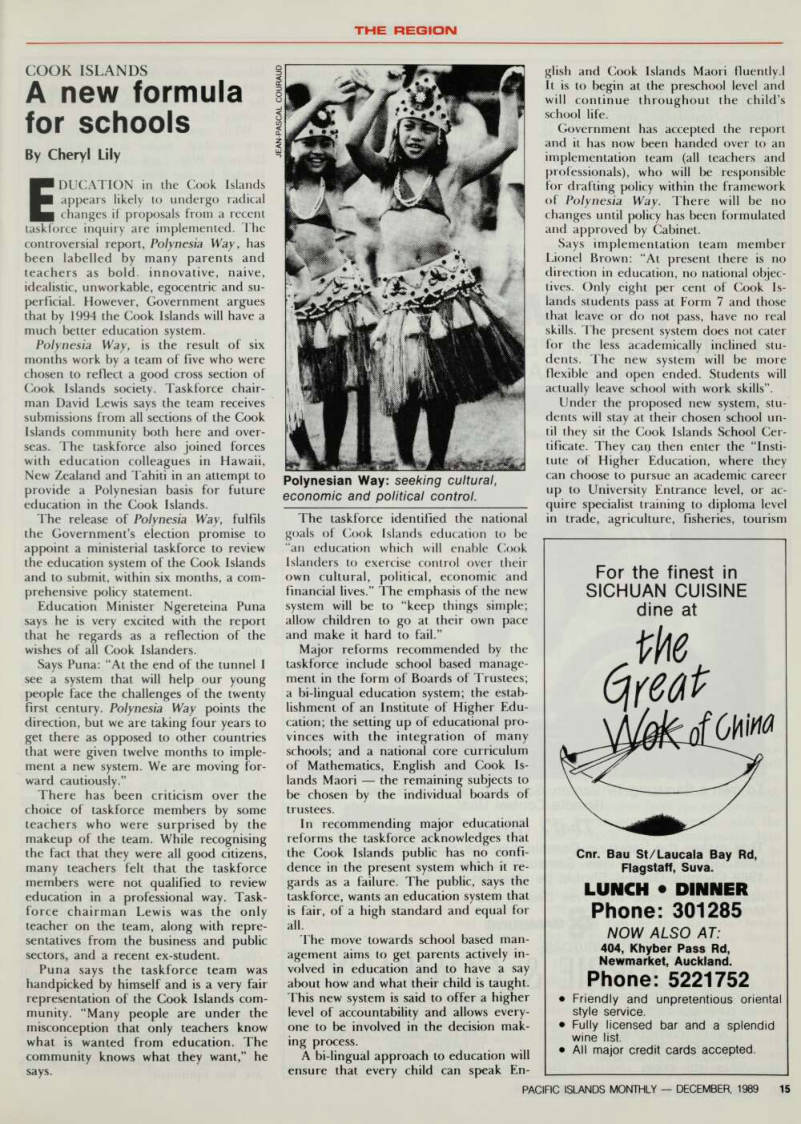
Polynesian Way: seeking cultural, economic and political control.
or the creative arts.
Chairman of the implementation team Assistant Minister of Education 1 iriamate Ngatokorua, says the team is now going out into the community to explain Polynesia Way and to gauge public reaction. He says there has been a lot of panic by people who do not really understand what Polynesia Way is all about. He hopes that by holding community meetings, there will be a general acceptance of it.
I he most important part of the new education system is bilingualism, says
Ngatokorua. “It (bilingualism) is essential for a Cook Islands child to live success
fullyintheCooklslandsandoverseas.lt
will also give us a sense of belonging. We will keep our Cook Islands identity through our language and our culture.”
The implementation team is quick to point out that Polynesia Way is only a guideline to education reform. “In ess ence, what we are doing is putting the meat on the skeleton,” says Brown, “Only if a school feels ready and has the necessary expertise to make up a board of trustees will it be able to change.
Schools are also free to choose to stay with the old system if they want or to ask for help from the Ministry of Education
during the transition period.”
While most people agree that changes are needed, many are sceptical of Polynesia Way. Lack of funds has been blamed for the dismal state of the pre sent education system and just how the
government plans to successfully provide
the resources for the proposed changes remains unclear for most people. The new system will require specialised teachers, more bi-lingual resources and additional school facilities to cater for the expanding curriculum.
Puna acknowledges the need for a big ger education budget. He says he is an xious to get more money to upgrade all the schools with new equipment and im proved facilities. “Trimming” the present bureaucratic structures within the educa tion system and diverting the money to the schools is one way. The 1988/89 education budget was NZ|5.4 million of which $4.8 million went in salaries and wages alone. With the change to educa tional provinces, smaller schools will merge and thus avoid duplicating facili ties and resources.
The principal of Rarotonga’s largest
college, Harry Ivaiti, is unhappy about many of the proposed changes. He says that some changes are needed, but no thing as drastic as Polynesia Way.
“We need a step not a leap,” he says, “Do not destroy the present system which is labelled colonial marry the old and Polynesia Way. We don’t need
Polynesia Way bulldozing it’s way
through”. Ivaiti feels that financially, the implementation of Polynesian Way is going to be a blunder. He argues that the burden of costs will fall back onto school committees and parents, who will have to fundraise to meet any shortfall.
Rarotonga’s Catholic college principal,
Father Paul, sees “boldness and vision” in the taskforce report. “I think this re port will have a big effect on Cook Is lands education and society for a long time to come. To implement Polynesia Way is a colossal job, I think the big question is, can government afford to spend more money on education?”
Links between New Zealand and the Cook Islands are very strong and con cern has been expressed over how prop osed changes to the present education system will affect these ties. Most teachers agree that there will be no effect and Education Minister Puna says he is hoping that any changes will strengthen links with New Zealand and maybe even provide an exchange of re sources and expertise.
While Puna says that the next four years will be exciting and challenging for education, many parents and teachers are less optimistic. □