Fiji: before and
pp. 13-14 · Read in the full issue
View
Fiji: before and after Bavadra
By Iva Tora
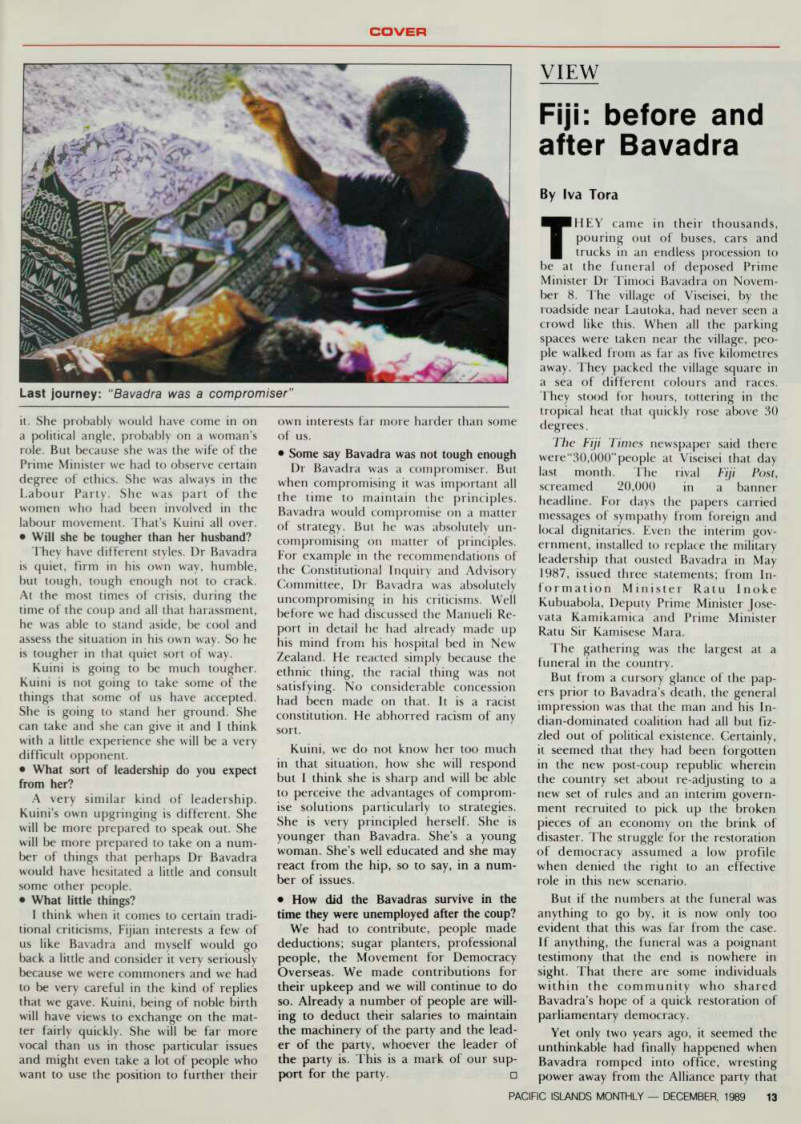
THEY came in their thousands, pouring out of buses, cars and trucks in an endless procession to be at the funeral of deposed Prime Minister Dr Timoci Bavadra on Novem ber 8. The village of Viseisei, by the roadside near Lautoka, had never seen a crowd like this. When all the parking spaces were taken near the village, peo ple walked from as far as five kilometres away. They packed the village square in a sea of different colours and races.
They stood for hours, tottering in the tropical heat that quickly rose above 30 degrees.
The Fiji Times newspaper said there were“3o,ooo”people at Viseisei that day last month. The rival Fiji Post, screamed 20,000 in a banner headline. For days the papers carried messages of sympathy from foreign and local dignitaries. Even the interim gov ernment, installed to replace the military leadership that ousted Bavadra in May 1987, issued three statements; from In formation Minister Ratu Inoke Kubuabola, Deputy Prime Minister Jose vata Kamikamica and Prime Minister Ratu Sir Kamisese Mara.
The gathering was the largest at a funeral in the country.
But from a cursory glance of the pap ers prior to Bavadra’s death, the general impression was that the man and his In dian-dominated coalition had all but fiz zled out of political existence. Certainly, it seemed that they had been forgotten in the new post-coup republic wherein the country set about re-adjusting to a new set of rules and an interim govern ment recruited to pick up the broken pieces of an economy on the brink of disaster. The struggle for the restoration of democracy assumed a low profile when denied the right to an effective role in this new scenario.
But if the numbers at the funeral was anything to go by, it is now only too evident that this was far from the case.
If anything, the funeral was a poignant testimony that the end is nowhere in sight. That there are some individuals within the community who shared Bavadra’s hope of a quick restoration of
parliamentary democracy.
Yet only two years ago, it seemed the unthinkable had finally happened when Bavadra romped into office, wresting power away from the Alliance party that
had been in government for almost two decades. A commoner, a westerner, and a novice to the political arena, Bavadra had defeated the odds and hit a nerve that struck at the very foundations of a very powerful customary establishment.
The Coalition’s victory exiled the Alliance party into the opposition and jolted it out of what was once a secure niche, leaving the conquered to lament its losses and gather the crumpled laurels of a crown held for 17 years.
The new government’s promise to the electorate of an inquiry into allegations of corruption became a shadow ever looming on an Alliance landscape where the sun was already beginning to set.
And it became a promise shortlived when 10 soldiers stormed parliament and brought to an abrupt end the 17year life of Fiji democracy.
The 1987 coups brought sharply into focus the distorted image of Fiji as the region’s model of a stable democracy and the underlying conflict of tradition versus progress. Perceived fears of threats to Fijian land and subsequent ex tremist Taukei reprisals; subjugation of Fijian interests to Indian and therefore “foreign” domination under a govern ment seen essentially as leftist with socialist tendencies became a justification for the coups led by the 38-year-old third-ranking army officer, Lieutenant- Colonel Sitiveni Rabuka.
The crisis opened up a Pandora’s box that sent investors flying, devalued the Fiji dollar, disrupted the economy and saw a mass exodus of mostly Indian pro fessionals escaping overseas on one-way tickets.
From 1987 until his health gave way, Dr Bavadra continued to wage a cam paign taken to the international stage, for the restoration of parliamentary democracy. But the push which initially
received fervent international support, particularly from Australia and New Zealand, ebbed into a lull as the interna tional community re-adjusted to a new regime and a new state of affairs.
The coup raised the traditional mechanisms of Fijian politicking to a
level not previously enjoyed nor given
extensive limelight under the Westmins ter system. And in so doing, uncovered a can of worms of conflict and friction
already existing, but lying dormant with
in the framework of traditional Fijian politics. It set a precedent for power blocks within the fragile aftermath of the coup, to grab a significant share of the cake and the spoils of power.
The coup gave licence to a new form of religious zeal that divided loyalties within the Methodist church, the reli gious, albeit imported, bastion of Fijian
spiritual life. Encouraged by the
Methodist Church’s General-Secretary, Rev Manasa Lasaro, Fijians erected roadblocks in a campaign to stop all work, sports and trade on Sundays. The power struggle within the church, re vealed the internal mechanism of the hierarchy at work, and a dirty side to church politics such as had never been disclosed before in such a candid and vindicative manner.
The coup provided the impetus for the formation of a fourth Fijian confed eracy based in the west of Fiji the Yasayasa Vakara confederacy. But while moves to form a western confederacy can be traced back to early this century, the issue was not revived until the coup.
For so long, despite their rich econo mic resources, western interests have been absorbed into Eastern Fiji priori ties. The economic backbone of the re public, the west, has provided sugar (Fiji’s main revenue earner), hydro electricity, timber and tourism.
With the coup came the realisation of their economic power. But unlike the Methodists, the Yasayasa Vakara group opted for a low-key approach in its
struggle for recognition and an indepen
dent voice.
But the Coalition jumped on the band wagon and formed a rival fourth confed eracy in a political gamble aimed at gathering more Fijian support.
Bavadra’s confederacy gained little
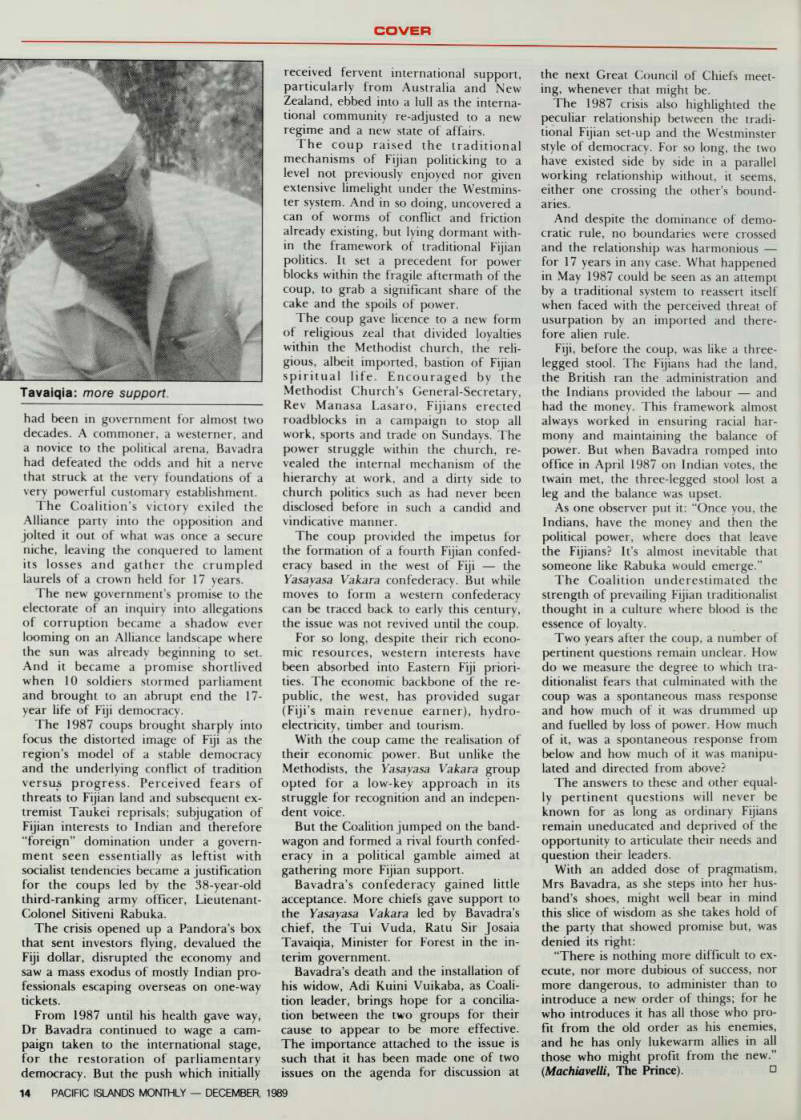
acceptance. More chiefs gave support to the Yasayasa Vakara led by Bavadra’s chief, the Tui Vuda, Ratu Sir Josaia Tavaiqia, Minister for Forest in the in terim government.
Bavadra’s death and the installation of his widow, Adi Kuini Vuikaba, as Coali tion leader, brings hope for a concilia tion between the two groups for their cause to appear to be more effective.
The importance attached to the issue is such that it has been made one of two issues on the agenda for discussion at
the next Great Council of Chiefs meet ing, whenever that might be.
The 1987 crisis also highlighted the peculiar relationship between the tradi tional Fijian set-up and the Westminster style of democracy. For so long, the two have existed side by side in a parallel working relationship without, it seems, either one crossing the other’s bound aries.
And despite the dominance of demo cratic rule, no boundaries were crossed and the relationship was harmonious for 17 years in any case. What happened in May 1987 could be seen as an attempt by a traditional system to reassert itself when faced with the perceived threat of usurpation by an imported and there fore alien rule.
Fiji, before the coup, was like a three legged stool. The Fijians had the land, the British ran the administration and the Indians provided the labour and had the money. This framework almost always worked in ensuring racial har mony and maintaining the balance of power. But when Bavadra romped into office in April 1987 on Indian votes, the twain met, the three-legged stool lost a leg and the balance was upset.
As one observer put it: “Once you, the Indians, have the money and then the political power, where does that leave the Fijians? It’s almost inevitable that someone like Rabuka would emerge.”
The Coalition underestimated the
strength of prevailing Fijian traditionalist
thought in a culture where blood is the essence of loyalty.
Two years after the coup, a number of pertinent questions remain unclear. How do we measure the degree to which tra ditionalist fears that culminated with the coup was a spontaneous mass response and how much of it was drummed up and fuelled by loss of power. How much of it, was a spontaneous response from below and how much of it was manipu lated and directed from above?
The answers to these and other equal ly pertinent questions will never be known for as long as ordinary Fijians remain uneducated and deprived of the opportunity to articulate their needs and question their leaders.
With an added dose of pragmatism, Mrs Bavadra, as she steps into her hus band’s shoes, might well bear in mind this slice of wisdom as she takes hold of the party that showed promise but, was denied its right: “There is nothing more difficult to ex ecute, nor more dubious of success, nor more dangerous, to administer than to introduce a new order of things; for he who introduces it has all those who pro fit from the old order as his enemies, and he has only lukewarm allies in all those who might profit from the new.” (, Machiavelli , The Prince). □
Tavaiqia: more support.