Back to
pp. 49-50 · Read in the full issue
Marshall Islands
Back to basics
A LITTLE bit of history was made in the Marshall Islands capital of
Majuro on Saturday September
2. It was not the kind of history the world has become so much used to in this part of the Pacific. It had nothing to do with a strategic location for defence.
It had nothing to do with atomic bomb tests or studies of the results from those tests. Not missile tracking, or toxic waste
disposal or dumping garbage from the
west coast of the United States into the lagoons. It had to with a cultural tradi tion that the residents of Majuro haven’t seen since World War Two, the ceremo
nial launching of traditionally designed
outrigger sailing canoe.
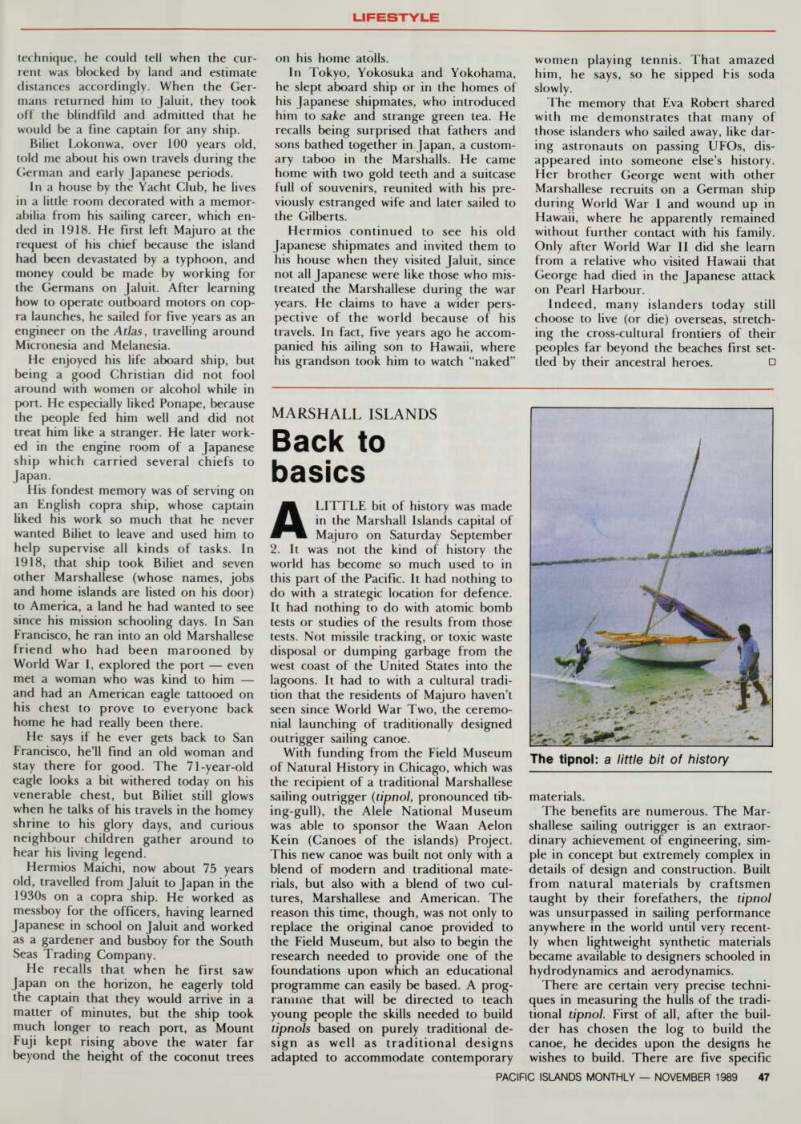
With funding from the Field Museum of Natural History in Chicago, which was the recipient of a traditional Marshallese sailing outrigger ( tipnol , pronounced tib ing-gull), the Alele National Museum was able to sponsor the Waan Aelon Kein (Canoes of the islands) Project.
This new canoe was built not only with a blend of modern and traditional mate rials, but also with a blend of two cul tures, Marshallese and American. The reason this time, though, was not only to
replace the original canoe provided to
the Field Museum, but also to begin the research needed to provide one of the foundations upon which an educational programme can easily be based. A prog ramme that will be directed to teach young people the skills needed to build tipnols based on purely traditional de sign as well as traditional designs adapted to accommodate contemporary
materials.
The benefits are numerous. The Mar shallese sailing outrigger is an extraor dinary achievement of engineering, sim pie in concept but extremely complex in details of design and construction. Built from natural materials by craftsmen taught by their forefathers, the tipnol
was unsurpassed in sailing performance
anywhere in the world until very recent ly when lightweight synthetic materials became available to designers schooled in hydrodynamics and aerodynamics, There are certain very precise techni ques in measuring the hulls of the tradi tional tipnol. First of all, after the buil der has chosen the log to build the canoe, he decides upon the designs he wishes to build. There are five specific
The tipnol: a little bit of history
designs of the Marshallese tipnol. They
are the mwijitbok, taburbur, malmel, to jeik and jekad. The malmel was decided upon because of its design capabilities for inter-atoll cargo and transpportation, but it also has the ability to go out into the open ocean. In order to keep the accuracy of design, the technique of measuring the hull directly on the bread fruit log was transferred to a scale draw ings on paper. Once the drawings were complete to the master canoe-builders’ liking, a scale model was produced to enable more fine tuning of the tradition
al design.
The knowledge of building canoes is generally passed down from father to son. There have been exceptions to these rules, but the master builder is generally careful to pass this knowledge to some one who will use and respect it as a very
precious gift. Traditionally, this know
ledge is held in the utmost secrecy. Since the proliferation of western values these traditional arts and skills are rapidly vanishing. Luckily the Marshallese peo ple have the foresight to preserve their rich and vibrant heritage, and are even working on reviving many of these skills that have not yet been totally lost.
Jinnade Leon, a canoe builder from Jaluit Atoll, was closely involved in build ing the replacement canoe for that sent to Chicago. Jinnade can’t remember when he first sailed with his father. He just knows that he always could sail.
When little, he used to watch his father build canoes. He apprenticed with his father from the age of 12 until he was 24, when he built his first canoe by him self.
During World War Two when Japanese troops occupied Jaluit Atoll, Jinnade was one of many men forced to fish with dynamite in order to feed the troops. A common accident happening throughout the Pacific was for dynamite to explode in the hands of the fisherman because the outside of the fuse was wet while the inside stayed relatively dry; it
used to fool the fisherman and explode in their hands. Jinnade was one of these victims. This didn’t stop him from build ing canoes. As soon as the war was over he started again. The girls wouldn’t like him because of his hand, “that was never the case, since I have 17 children.” Jin nade is 72 years old and still going strong. That is until he was hit by one of the local taxis while riding a bicycle, two weeks before the canoe was scheduled to be finished for an annual cultural festiv al that the Alele Museum hosts every year. It slowed him down. But not for
long.
It took three days to lash the canoe together using traditional coconut sennit made into line. The canoe is a blend of both modern and contemporary mate rials. The way that the tipnol is mea sured for a hull built from a breadfruit log had to be transferred somehow to
accommodate plywood.
Traditionally, when the log is down and cleaned it is determined how much of the length will be used for the actual hull. The builder then, with the help of a pandanus leaf or a coconut leaf, begins dividing the length of the hull in half, then half again, until there are eight evenly spaced sections on the log.
Then, the technique that the Jaluit buil der uses, and at this time there are only two builders alive that still use this method, is to find the center line or sta tion. Through intricate and very precise
measuring depending on which design
the builder wishes to build, he is able to determine the particular hull shape that he desires.
From these preliminary measure ments, he lays out his marks and begins chopping the log. The direction that Jin nade took was that he decided what length to build the canoe. Through his measuring techniques, an architect pro duced to scale on paper a grid in which he divided the proposed length into eight equal parts. In this case 18 feet.
The next step was determining the
length of the keel ( bejam ). So for this Jinnade brought in a pandanus leaf and, to scale he showed the architect how he measured for the design he was build ing. This was the Jaluit Malmel design.
The architect then transferred this in formation to scale onto the paper. The process was slow but after four days of drawing and redrawing he was able to accumulate enough information to com plete architecture drawings that were accurate to a traditional mamel design.
At this point a master builder from another atoll was asked to take a look at the drawings. He and Jinnade got together and discussed the differences in techniques. It was a very interesting meeting because it was discovered that the techniques are different from these two atolls which resulted in the length of the bejam line being different. From this
point the building began. The architect
took the measurements from his scale drawings and put them into full size. He first built a backbone and set it up level so it would accept the shape of the eight even parts of the boat that traditionally was measured. He made these parts out of plywood and set them up on the back bone. After fairing these “stations and
trying them all together, the plywood
was ready to go. The more they worked the more that the traditional shape took
place. Attaching the outriggers and out
rigger float, mast and sails were done
totally traditionally using traditional
materials and woods with the exception of the mast and part of the boom. The sail was made out of nylon which was traditionally built from pandanus. There was wire used to hold the mast up as opposed to the senet. All else was of Marshalles materials.
It felt so good to know that the skill to create all of these things hasn’t been lost.
And many Marshallese have a strong de sire to preserve this skill. Throughout the building most of the details of con struction was videotaped to be on hand at the museum for future teaching. □