Beyond the beach
pp. 48-49 · Read in the full issue
Lifestyle
Inl most accounts of the Pacific the stories have nearly always been of the European discovery of the islands. Few have told of the islanders’ journey of discovery when European shipping created new networks in their ocean.
David Chappell, who is researching Pacific Islands history at the University of Hawaii, spend six months in the Marshalls and spoke to some old timers. This is his story.
EUROPEAN contact transformed, in some cases destroyed, Pacific is land traditions, but the cultural beach between intruders and indigenous people was a two-way street, a crossroads which some islanders used to push their own frontier beyond the beach, onto the trans-cultural sea, to become beachcom bers on alien shores.
Namar Milne told me a story from Ebon, the southernmost atoll in the Mar shalls and a scene of frequent conflict between whalers and islanders. Lojeik was a warrior, with a chest tattoo to prove it, and in about 1840 he went out to a whaler but was kidnapped and nev er seen again. His people believed him dead and plotted the capture of that ship when it returned.
A long time passed, and when the ship came back, the islanders helped pull its longboat ashore, all the while discussing which sailor each of them would kill.
Suddenly, one sailor, dressed in Amer ican fashion like the rest of the crew, warned the people in Marshallese not to attack because the whites had guns.
Though surprised that a foreigner could
speak their language, the islanders doubted that the sailors’ wooden sticks could really be dangerous. So the Mar shallese-speaking sailor told his compan ions to shoot at a coconut tree.
When the loud gunshots sent all the nuts and palm fronds tumbling to the
ground, the islanders reconsidered their plan. Then a woman thought she recog nized the Marshallese-speaking sailor and opened his shirt to reveal his war rior tattoo. It was Lojeik! He had be come the best hapooner on the ship, and when he settled down again on Ebon, he was a respected intermediary between foreigners and his people.
Doraman Bujen told me a story from the German colonial period about a famous traditional navigator from Ujae
named Latap. In about 1890, the Ger mans decided to test his skills. With his consent, they took him blindfolded all around the Pacific, from Jaluit to Hawaii to Tahiti to Fiji to Guam. He only took off the blindfold to eat.
Whenever the ship came near any is lands, the Germans asked him what direction and how far away they were.
He would lie down on the deck, feel the movement of the waves and accurately locate the islands. Using the ka pun pit
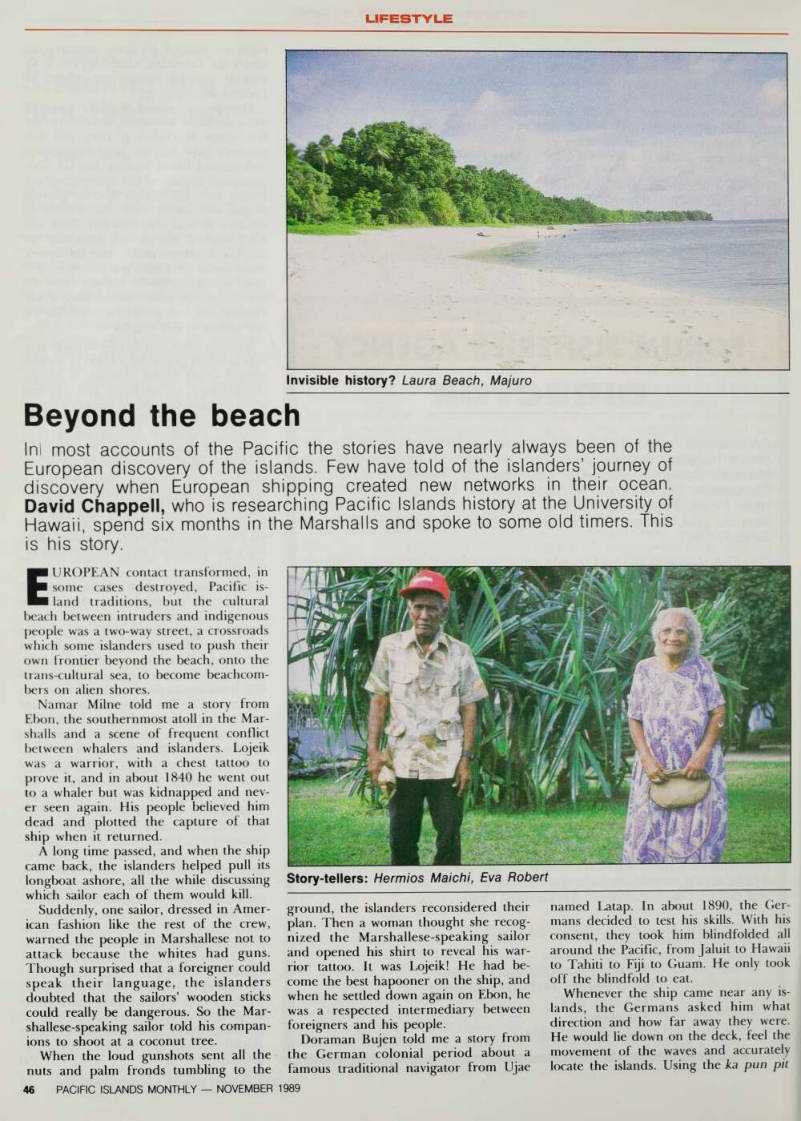
Invisible history? Laura Beach, Majuro
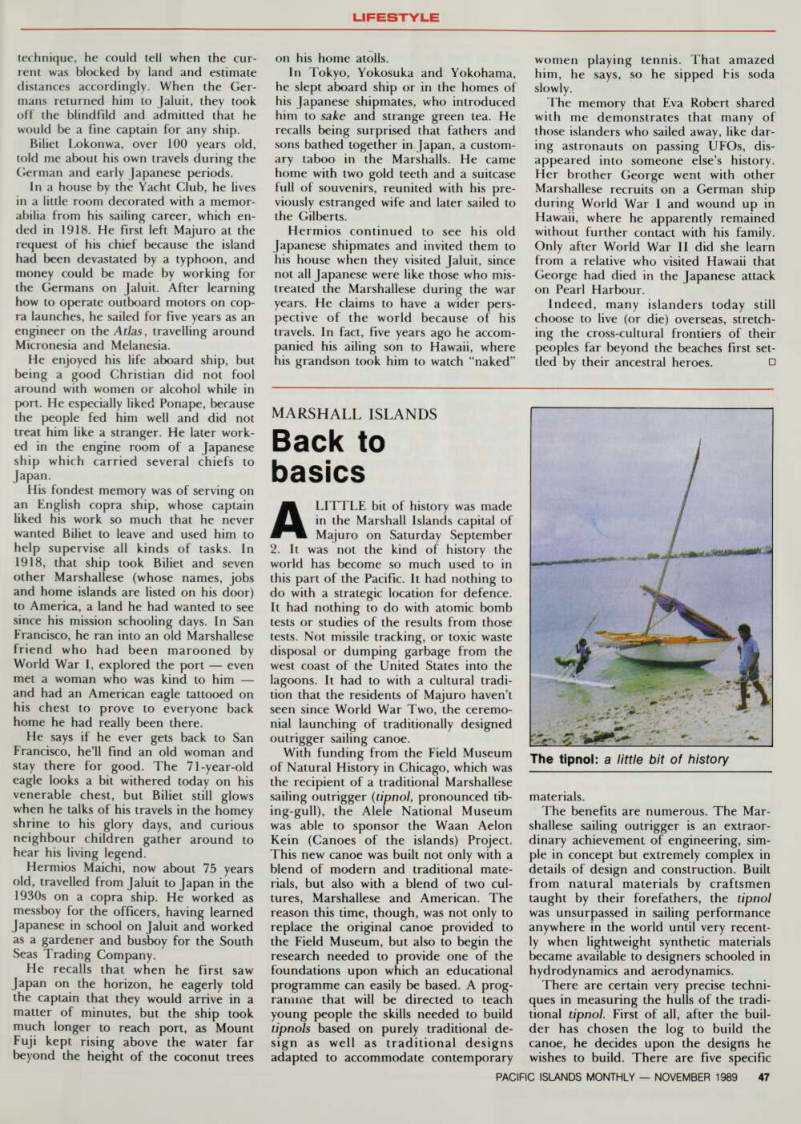
Story-tellers: Hermios Maichi, Eva Robert
technique, he could tell when the cur rent was blocked by land and estimate distances accordingly. When the Ger mans returned him to Jaluit, they took off the blindfild and admitted that he would be a fine captain for any ship.
Biliet Lokonwa, over 100 years old, told me about his own travels during the German and early Japanese periods.
In a house by the Yacht Club, he lives in a little room decorated with a memor abilia from his sailing career, which en ded in 1918. He first left Majuro at the request of his chief because the island had been devastated by a typhoon, and money could be made by working for the Germans on Jaluit. After learning how to operate outboard motors on cop ra launches, he sailed for five years as an engineer on the Atlas, travelling around Micronesia and Melanesia.
He enjoyed his life aboard ship, but being a good Christian did not fool around with women or alcohol while in port. He especially liked Ponape, because the people fed him well and did not treat him like a stranger. He later work ed in the engine room of a Japanese ship which carried several chiefs to Japan.
His fondest memory was of serving on an English copra ship, whose captain liked his work so much that he never wanted Biliet to leave and used him to help supervise all kinds of tasks. In 1918, that ship took Biliet and seven other Marshallese (whose names, jobs and home islands are listed on his door) to America, a land he had wanted to see since his mission schooling days. In San Francisco, he ran into an old Marshallese friend who had been marooned by World War I, explored the port even met a woman who was kind to him and had an American eagle tattooed on his chest to prove to everyone back home he had really been there.
He says if he ever gets back to San Francisco, he’ll find an old woman and stay there for good. The 71-year-old eagle looks a bit withered today on his venerable chest, but Biliet still glows when he talks of his travels in the homey shrine to his glory days, and curious neighbour children gather around to
hear his living legend.
Hermios Maichi, now about 75 years old, travelled from Jaluit to Japan in the 1930 s on a copra ship. He worked as messboy for the officers, having learned Japanese in school on Jaluit and worked as a gardener and busboy for the South
Seas Trading Company.
He recalls that when he first saw Japan on the horizon, he eagerly told the captain that they would arrive in a matter of minutes, but the ship took much longer to reach port, as Mount Fuji kept rising above the water far beyond the height of the coconut trees
on his home atolls.
In Tokyo, Yokosuka and Yokohama, he slept aboard ship or in the homes of his Japanese shipmates, who introduced him to sake and strange green tea. He recalls being surprised that fathers and sons bathed together in Japan, a customary taboo in the Marshalls. He came home with two gold teeth and a suitcase full of souvenirs, reunited with his previously estranged wife and later sailed to the Gilberts.
Hermios continued to see his old Japanese shipmates and invited them to his house when they visited Jaluit, since not all Japanese were like those who mistreated the Marshallese during the war years. He claims to have a wider perspective of the world because of his travels. In fact, five years ago he accompanied his ailing son to Hawaii, where his grandson took him to watch “naked”
women playing tennis. That amazed him, he says, so he sipped his soda
slowly.
The memory that Eva Robert shared with me demonstrates that many of those islanders who sailed away, like dar ing astronauts on passing UFOs, dis appeared into someone else’s history, Her brother George went with other Marshallese recruits on a German ship during World War I and wound up in Hawaii, where he apparently remained without further contact with his family.
Only after World War II did she learn from a relative who visited Hawaii that George had died in the Japanese attack on Pearl Harbour.
Indeed, many islanders today still choose to live (or die) overseas, stretch ing the cross-cultural frontiers of their peoples far beyond the beaches first set tied by their ancestral heroes. □