Straining the
pp. 46-47 · Read in the full issue
Northern Marianas
ties that bind
By David North
IT had all the symptoms of a classic syndrome: Leaders of a small Pacific island, expressing increasing disillu sionment with their state’s relations with its metropolitan mother country, warn that if the issues creating the disaffection are not resolved, the island would have no choice but to vote on cutting ties and striking out on its own.
At a critical negotiating session only weeks before the deadline, the metropo litan power’s chief representative with draws from the talks, cutting off all dis cussions. Major issues are left hanging.
The island leaders are shocked and con fused. At this point, the islanders could have been expected to stalk out of the
meeting, declaring the negotiations
hopeless and pushing ahead for a politic al status vote, which would undoubtedly and overwhelmingly support separation.
But the real-life scenario, played out in Washington this past summer between Northern Marianas leaders and Federal representatives, had an unexpected, iro nic, yet subtly logical ending. Led by Lieutenant Governor Pedro A Tenorio, the Northern Marianas delegation quiet ly huddled, consulted their Washington counsel, returned to the islands and issued a 19-page report calling the three year negotiating session generally suc cessful and recommending against a November vote on whether to end their political association with the United States.
Rather than demonstrating the incom patibility of small island communities with the vast and usually preoccupied federal system, Marianas officials said the negotiations were a sign of the underlying strength of the nascent com monwealth’s relations with the United States. “Despite the fact that all issues
regarding self-government or financial
assistance have not been resolved, we do not recommend that the Commonwealth Government support a November 1989 vote on whether to reaffirm, reject or negotiate the Covenant,” Tenorio said in the report.
The Commonwealth Covenant was “basically a good document”, and the negotiations, referred to as 902 talks af ter the Covenant section authorising them, had resolved several major issues, including citizenship, financial assistance and taxation questions, Tenorio said.
But he left the door open for a future vote. “We are not saying there will not come a time, perhaps relatively soon,
when we might support such a fun damental re-examination of our ties with the United States.”
The proposed vote on the Covenant stemmed from an initiative approved in a 1987 election, calling for the vote to reject, reaffirm or renegotiate the cove nant if the 902 talks left substantial mat ters regarding self-government or finan cial assistance unresolved as of July 1, 1989. Tenorio explained that the initia tive came about because he and the de legation “had been negotiating with an
openly hostile Special Representative of
the President who had declared at the opening of the consultations that his primary goal in dealing with the Com monwealth was uniformity in territorial policy, in effect regarding our Common wealth as just one more territory or pos session of the United States”.
Tenorio was referring to former Assis tant Secretary of the Department of the Interior Richard T. Montoya, who res igned in late 1987 to run for office in his home state of New Mexico. The situation changed, according to Tenorio, with the appointment in 1988 of another Interior official. “With Becky Norton Dunlop, the personality conflicts that plagued the first three rounds disappeared and issues were discussed in a serious fashion,”
Tenorio said. “In short, there is room for the Section 902 consultations to progress as they did with Mrs Dunlop or to fester, as they did with her prede cessor.”
Among the major issues resolved by the negotiations were extension of US citizenship to several thousand Marianas’ residents whom the US Justice Depart ment originally said were not eligible, and implementation of US long-term financial assitance to the Commonwealth.
During the 10-year transition from Trust Territory, the Northern Marianas re ceived about US$24 million annually in economic support. The new seven-year assistance plan provides about US$47
million annually to 1992.
The Bush Administration also agreed with the 902 recommendation not to col lect Federal income tax on interest paid to US-based holders of Northern Marianas housing bonds.
Without that agreement, the Common wealth would have had to pay those bond holders an estimated S2O million, because the bonds were sold as tax exempt an offer disputed by the US Treasury Department. Tenorio cited this victory as the most significant outcome of the consultations in monetary terms and “the best indication that issues affecting the relationship between the Commonwealth and the United States can be resolved through the 902 pro cess”.
Major unresolved issues include the extent of US sovereignty in the islands, control of the Exclusive Economic Zone and the use of alien workers in the Com monwealth garment industry. Northern Marianas leaders argue the Covenant gives them complete internal self government and that the United States
was only delegated authority for defense
and foreign affairs. Washington should not have the right, for example, to allow federal auditors to review the Common wealth books.
The United States maintains that the grant of self-government to the Com monwealth prevents Congress from in terfering with the fundamental institu tions of self-government, but that Feder al sovereignty, which is expressly recog nised in the Covenant, means that all US laws and regulations apply in the Com monwealth as they do in other US juris dictions, except when Congress provides specific exemptions. And that means, according to the US view, that its Inspec tor General’s office may audit certain Federal funds provided the Common
wealth, including monies designated by
Federal regulations to be used only for a
specific purpose.
The Commonwealth maintains the law allowing those audits does not apply in the islands because it was passed without the consent of the Northern Marianas government. Commonwealth and US attorneys have been arguing these points in court all summer over the right of Inspector General to audit the Marianas Island Housing Authority’s use of Feder al funds intended for the construction of
low-cost housing.
The Northern Mrianas also seeks own ership and control of the 200-mile EEZ around the islands, desiring like the in dependent states of the Pacific, to exploit the fishing resources of the zone and in the long term whatever seabed mineral wealth that may exist. Washington, which is receiving steady pressure from its own coastal and insular states for joint control of the zones, maintains that the
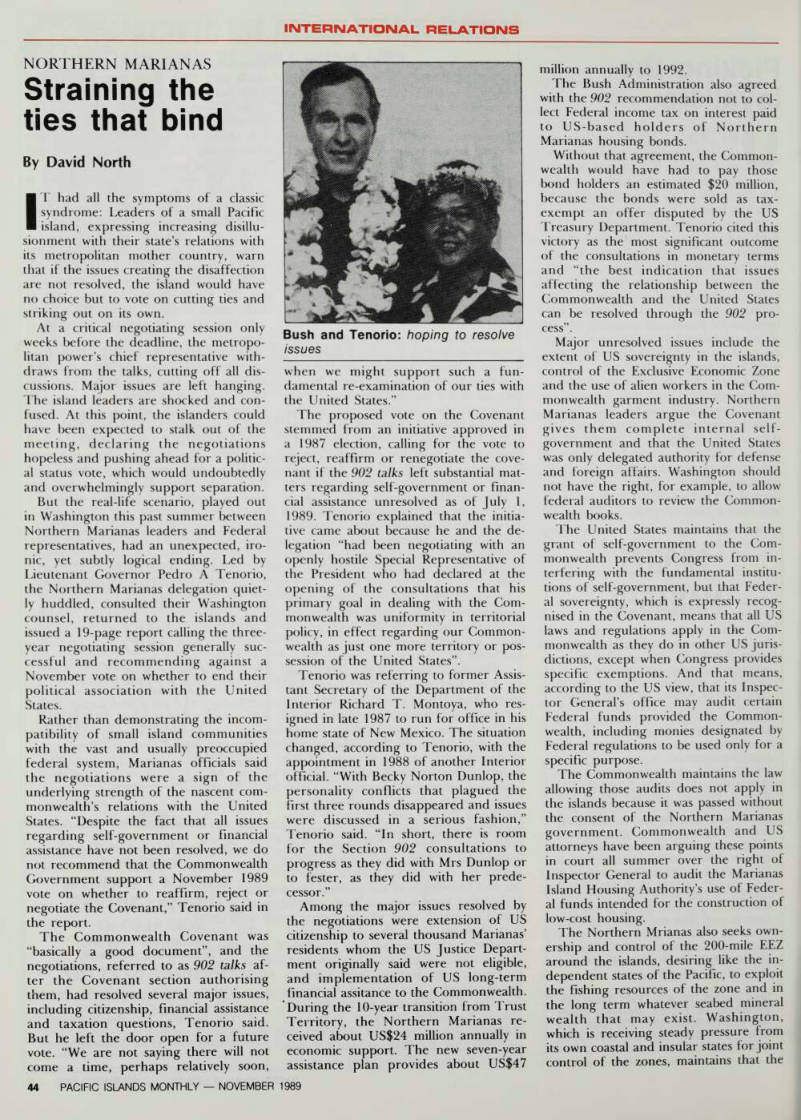
Bush and Tenorio: hoping to resolve issues
EEZ’s are under US sovereignty, giving management, control, and the revenue generated in them exclusively to the Federal government. To grant the Northern Marianas control would set a dangerous precedent that would be seized upon by other insular areas as well as Hawaii, Alaska and the west coast states.
The alien labour controversy involves the Commonwealth’s importation over the past 10 years of 14,000 alien workers mostly Filipino and Thais to produce shirts, sweaters and other garments that are exported to the United States
duty free under a special Customs prog ramme which is aimed at creating jobs for local US citizens and permanent resi dents in the islands. The alien labour
population almot equals the population
of permanent residents, which is about 16,000.
Montoya, when he was US representa tive at the 902 talks, argued that the Commonwealth was circumventing the intent of the provision, by not providing that the two dozen foreign-controlled and operated garment factories in the islands employ a majority of local work ers. The Commonwealth, which won the
right to control its own immigration under the Covenant, maintains this is an entirely internal matter, not subject to Federal oversight.
Montoya countered that the factories were of little economic benefit to the Northern Marianas if they did not generate jobs for the local population, and warned island leaders that US Con gressional leaders whose constituents are losing jobs to foreign textile imports might not agree with the Common wealth’s view of the situation. Since the US Congress has plenary authority for the US commonwealths and territories, there could be a backlash someday, sev erely restricting textile imports from the Northern Marianas, Montoya argued.
Dunlop did not press the issue during her tenure as US negotiator.
The booming Northern Marianas eco nomy, which generates a US$l75 million annual Gross Island Product, is feeling the pressure on its social and physical infrastructure because of the presence of so many alien workers. Water, power, housing, education and health services
particularly are suffering. The capital is
land of Saipan, where virtually all of the factories are located, has declared a moratorium on new garment plants, and regulations are being worked up that would provide stricter guidelines for the garment manufacturers, including zon ing restrictions and local employment re quirements.
The Commonwealth’s leaders tactical decision not to press for a vote on the Covenant at this time may also have been influenced by the islands’ coming gubernatorial election. Tenorio, who was seeking the Republican candidacy for the governorship, may have feared that his 902 flank was exposed to his Democratic opponent, Froilan Tenorio (no relation), who as the Northern Marianas Washing ton representative, has been an out spoken critic of the 902 negotiations.
When a Bush appointee to the 902 talks is named, the representative will face new pressures on the sovereignty, applicability of federal law and FEZ issues because other US insular areas Puerto Rico, Guam and the Virgin Is lands are now negotiating changes in their political status. They also seek many of the same prerogatives, controls, exemptions and exclusions as the North ern Marianas. As a united front on federal-territorial relations, these island commonwealths and territories may be able to rewrite the parameters of insular autonomy in the US federal system. And the experience of the Northern Marianas 902 talks over the past three years would be a valuable object lesson in how to motivate Uncle Sam to focus of three areas’ unique problems and rela
tionships. □