Hope for the
p. 46 · Read in the full issue
Wildlife
Norfolk
Hope for the Green Parrot
THE Norfolk Island green parrot has a lot in common with Rarotonga’s kakaerori (PIM March 1989). Both were widespread in the early 1800 s in their respective islands, both have suf fered from introduced fauna particularly the black rat and are now highly en dangered and both have attracted recent conservation attention.
When Norfolk Island was settled in 1788, Green Parrots were sufficiently numerous to be a nuisance. Captain Hunter wrote in 1790 that the parrots had destroyed vast quantities of corn “although men were constantly em ployed in beating them off with long poles”. By 1908, parrot numbers had dropped and the bird could only be legally destroyed if it was actually eating fruit or crops.
In some areas they were still reason ably common in the 1950 s but, by 1983, the population had dwindled to less than 30. The Norfolk Island Government asked the Australian National Parks and Wildlife Service to undertake a conserva tion programme. Rather than put all the eggs in one basket, the programme de
veloped along two lines: captive breeding
and wild management. With the help of the local Lion’s Club, an aviary was con structed to breed birds to supplement wild stocks. Initially only male parrots could be caught, partly because males are more easily captured and partly be cause there appears to be an imbalance in the sexes favouring males. Females were added to the aviary in 1985, a mother and a daughter from the only known nest of the parrot.
Most of the remaining native forest was protected in the 465-hectare Norfolk Island National Park declared jointly by the Commonwealth and Norfolk Island Governments in 1985 and 1986. Two
hundred years of settlement had re moved much of Norfolk’s sub-tropical rainforest and Green Parrots had not adapted to the cleared areas. Protection of its main habitat was crucial to its long term survival. To overcome the shortage of suitable nest hollows caused by past logging, defective tree hollows in the National Park were rat-proofed, drained, strengthened or enlarged to make them more suitable. Nest boxes were also erected.
Intensive searching for wild nests com menced in 1986 with assistance from David Crouchley, of the New Zealand Department of Conservation. Once nests were located, protection measures involv ing the control of introduced birds, rats and cats could be concentrated around active nests.
Gradually nest searching paid di
vidends. David Crouchley and Australian National Parks and Wildlife officer De rek Greenwood found one new nest in 1986, two in 1987, seven in 1988 and six (to May) in 1989. Protection measures around active nests assisted seven chicks to fledge in 1987, 16 in 1988 and 11 so far in 1989. One of the nests successful in 1988 and 1989 had previously been predated by black rats before being rat proofed. Another successful nest was in a previously unused tree hollow which had been modified to make it suitable.
The black rat is thought to have ar rived on Norfolk Island in the 1940 s and
its impact on already stressed popula
tions of three endemic land-bird species may have accelerated their decline.
Along with the green parrot, populations of Norfolk’s unique white-breasted, white-eye and guavabird have dramati cally dropped over the last 30 years.
Although rats are the number one villain at present, there are other problems.
Green parrots spend quite a lot of time foraging on the ground and are vulner able to feral cats. Cat hairs were found on the entrance to one low nest site.
Once the entrance was made cat-proof, this nest was successful.
The introduced red parrots and starl ings compete for the few available nest sites. Although green parrots can breed throughout the year, their peak season coincides with the off-season for these introduced species. Red Parrot numbers are controlled around Green Parrot nest
ing areas.
Back in the aviary, progress was slow.
Wild-caught birds take time to settle to
aviary conditions. Nevertheless, by early
1988, the two females had been captive for over two years and some sign of breeding activity was due. The younger female parrot showed a frustrating pre ference for males on the wild side of the fence. She first rejected her aviary mates and then her wild suitors when they
were captured and placed in her cage.
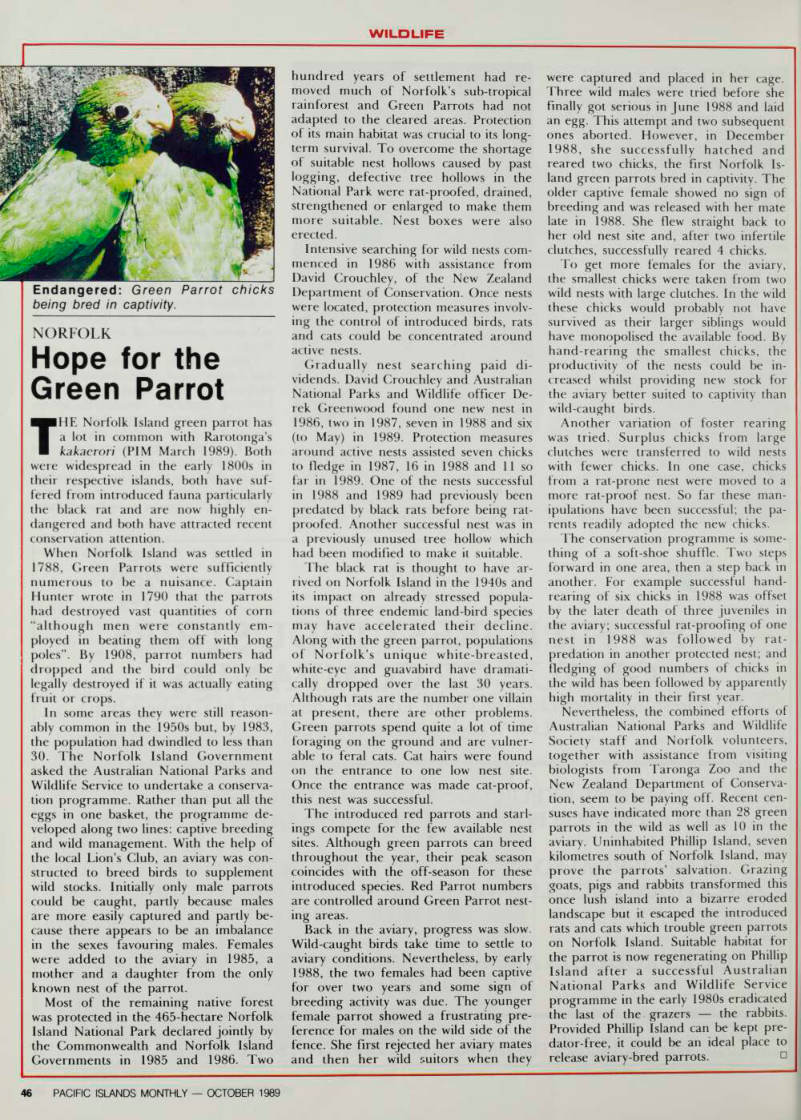
Three wild males were tried before she finally got serious in June 1988 and laid an egg. This attempt and two subsequent ones aborted. However, in December 1988, she successfully hatched and reared two chicks, the first Norfolk Is land green parrots bred in captivity. The older captive female showed no sign of breeding and was released with her mate late in 1988. She flew straight back to her old nest site and, after two infertile clutches, successfully reared 4 chicks.
To get more females for the aviary, the smallest chicks were taken from two wild nests with large clutches. In the wild these chicks would probably not have survived as their larger siblings would have monopolised the available food. By hand-rearing the smallest chicks, the productivity of the nests could be in creased whilst providing new stock for the aviary better suited to captivity than wild-caught birds.
Another variation of foster rearing was tried. Surplus chicks from large clutches were transferred to wild nests with fewer chicks. In one case, chicks from a rat-prone nest were moved to a more rat-proof nest. So far these man ipulations have been successful; the pa rents readily adopted the new chicks.
The conservation programme is some thing of a soft-shoe shuffle. Two steps forward in one area, then a step back in another. For example successful hand rearing of six chicks in 1988 was offset by the later death of three juveniles in the aviary; successful rat-proofing of one nest in 1988 was followed by rat predation in another protected nest; and fledging of good numbers of chicks in the wild has been followed by apparently high mortality in their first year.
Nevertheless, the combined efforts of Australian National Parks and Wildlife Society staff and Norfolk volunteers, together with assistance from visiting biologists from Taronga Zoo and the New Zealand Department of Conserva tion, seem to be paying off. Recent cen suses have indicated more than 28 green parrots in the wild as well as 10 in the aviary. Uninhabited Phillip Island, seven kilometres south of Norfolk Island, may prove the parrots’ salvation. Grazing goats, pigs and rabbits transformed this once lush island into a bizarre eroded landscape but it escaped the introduced rats and cats which trouble green parrots on Norfolk Island. Suitable habitat for the parrot is now regenerating on Phillip Island after a successful Australian National Parks and Wildlife Service programme in the early 1980 s eradicated the last of the grazers the rabbits.
Provided Phillip Island can be kept pre dator-free, it could be an ideal place to release aviary-bred parrots. n
Endangered: Green Parrot chicks being bred in captivity.