Mysteries
pp. 44-45 · Read in the full issue

The Arts
Mysteries of Easter
BY Nicholas Rothwell
S TARING out over the avenues of Frankfurt, the bronze portrait-bust of J.C. Senckenberg, green-tinged by the passing years, as the same solemn grandeur as the giant votive statues of
far-away Easter Island appropriately
enough, for within the Natural History Museum here that bears Senckenberrg’s name, a pioneering exhibition of Easter Islands mysterious cultural heritage is
being staged.
All through the northern summer, from April 5 to September 3, a section of the Senckenberg Museum, deep in this West German city’s university quar ter, has been hosting 1500 Years of Eas ter Island Culture Statuary from the Land of Hotu Matua. Despite the small scale of the exhibition, which naturally lacks any examples of the immovable monoliths of Easter Island, this is the
most comprehensive presentation of
cultural artefacts from the remote heart of Polynesia ever staged in Europe.
Museums and collections from all around the world have lent their hold ings, making possible a unified assess ment of the state of western knowledge of Easter Islands art and history: Austra lian, New Zealand, French, German, British, America and Russian curators have supported the display and the participation of the great Soviet ethnog raphic institutions is of special signifi cance.
Almost all the 150 objects displayed are wood carvings. Many were collected
by the earliest European visitors to Eas ter Island, such as Captain Cook, who encountered the mysteries that still attract the near-obsessive attention of scholars and romantics the world over: the vast statuary, the traces of vanished cultures, the elusive rongorongo script.
This exhibition is the work of the Frank furt-based German-Ibero-American Association. It testifies to the rich tradi-
lions of German ethnography, amply in evidence in the comprehensive exhibi tion catalogue. The catalogue includes detailed accounts of the discovery of Eas ter Island, summaries of the state of our knowledge of the giant statues and of contemporary cultural life on the island, which is now a possession of Chile.
But there is a further reason for the exhibition to be held in West Germany: dramatic progress has been recorded in recent years in the decipherment of the rongorongo script, which is chiefly known through examples inscribed on wooden paddles which are on view here.
This advance is in large part due to the efforts of Professor Thomas Barthel, a specialist in Polynesian culture at the
University of Tubingen, who expounds
in the exhibition catalogue his theories on the meaning of the texts as repositor ies of folklore.
The display itself brings together the
scattered examples of Easter Islands cul ture from the world’s museums, and uni fies them in distinct themes. The starkest wooden figurines are the Moai kavakava, with their skeletal rib-cages and inlaid eyes. Other groups of figures recall the impassive features of the Easter Islands monoliths, while a group of bird-man carvings, the Moai Tangata , remind the viewer of the central importance in the island’s mythology of the bird motif. The serpentine Moko figures and the famous Easter Island pectorals, the Red Miro,
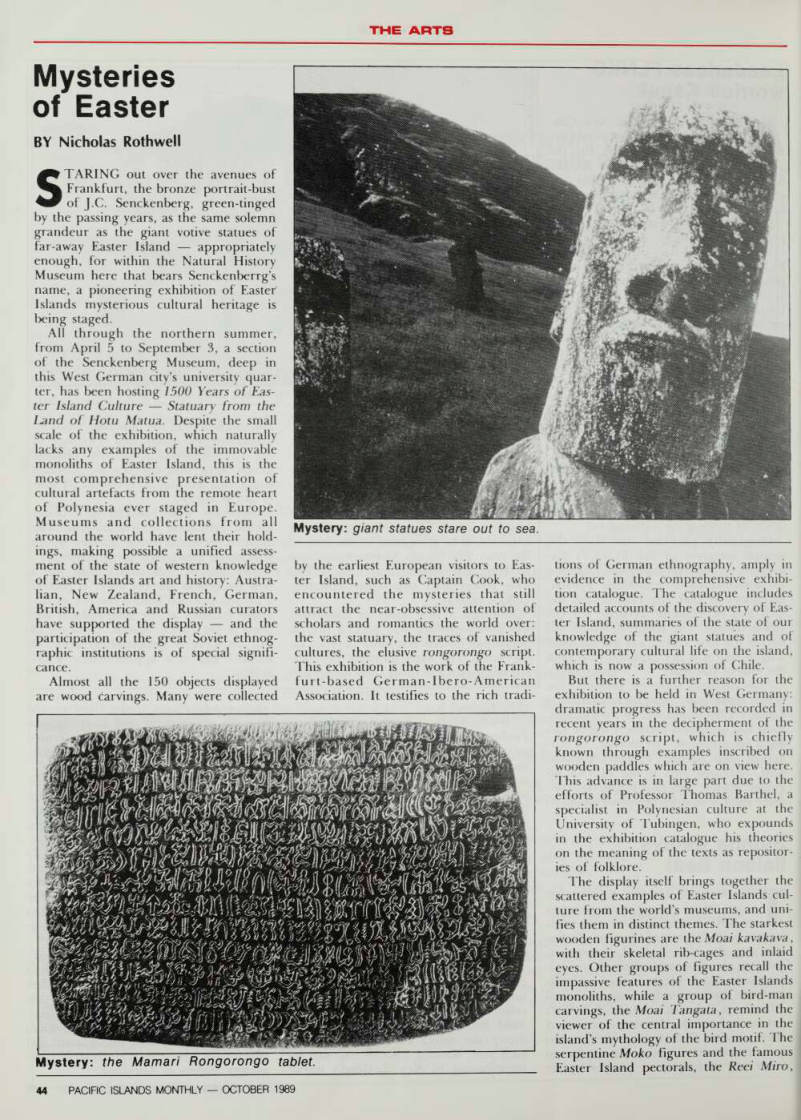
Mystery: the Mamari Rongorongo tablet.
Mystery: giant statues stare out to sea.
here seem to have little in common with the art of other Polynesian islands.
More familiar ground is reached with the great ceremonial staffs, the Ua , often decorated with human features. The di viding line between these double-headed rods and the paddles, known as Ao, often seems vestigial for some of the paddles also bear traces of anthropomor phic decoration. Various carved statuet tes of diverse size and subject twisted
figures, craning birds, kneeling women
with enlarged vulvas point to the complex range of Easter Island religion, and the importance for the culture of
the representation of spirits and symbols.
There are also specimens of the island’s petroglyphs stone slabs marked with incised designs that echo the statuary.
But the twin peaks of this exhibition are the objects specific to Easter Island culture, the rongorongo tablets and the
strange, squatting figures constructed
out of tapa, pounded bark-parchment.
Three of the most important rongoron
go inscriptions were brought together in
Frankfurt each one is covered by tiny inscriptions, and each has been the ob ject of years of study. There is the Aroukou-Kurenga tablet and the Mamari tablet, both held by the Mis sionaries of the Sacred Heart in Rome,
and the “large Leningrad tablet”, (see pic) from the Mikluho-Maclay Museum in the Soviet Union. All three are carved with examples of boustrophe don writing, so named because the script
runs first left to right, then right to left, tracing the pattern of an ox ploughing a field.
The most striking of the tapa figures, both from America’s Peabody Museum of Archaeology and Ethnology, are rich ly decorated male figures, painstakingly modelled, with individual fingers, toes and teeth. Their elaborate markings re call the tattoos and body traceries seen elsewhere in Polynesia: the technique of crafting a human shape from such plant material seems strangely reminiscent of the arts of certain Melanesian cultures and also of the prehistoric kingdoms of South America. The entire group of tapa figures, frozen in their glassy dis
play cases, grimacing and bulbous-eyed,
still seems possessed of fearsome magic force.
Though Easter Island may be half a world away, and these statutettes and plaques come from a lost age, the Senc kenberg Museum has briefly trans formed itself into a stage alive with the haunting potency of Polynesian civilisa tion. In its half-darkened spaces, bisected by the obsidian eyes of ever-staring deities, the frenetic rhythms of modern Germany recede an instant, and the spir it of Rapa Nui seems to survive distance and time. □
Mystery: tapa-modelled figure.