kissing cousins
pp. 21-22 · Read in the full issue
French Polynesia
More than kissing cousins
By Al Prince
Editor Tahiti Sun Press
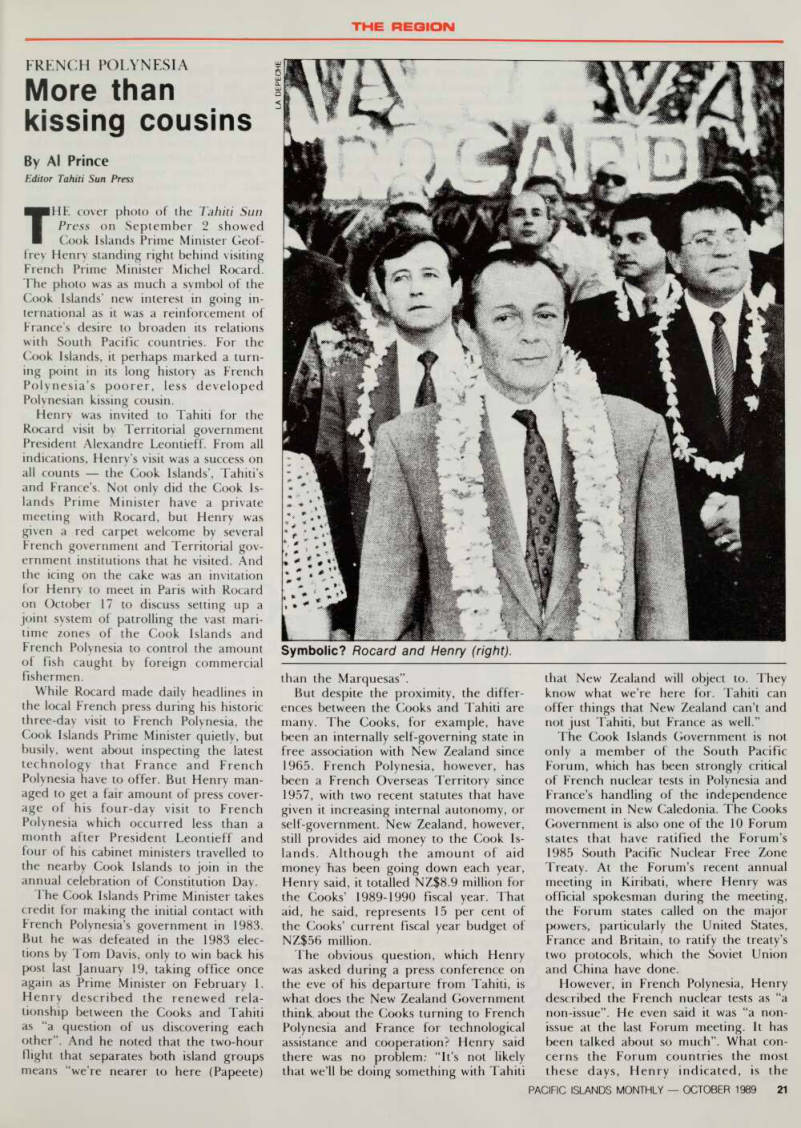
THE cover photo of the Tahiti Sun Press on September 2 showed Cook Islands Prime Minister Geof
frey Henry standing right behind visiting
French Prime Minister Michel Rocard.
The photo was as much a symbol of the Cook Islands’ new interest in going in ternational as it was a reinforcement of France’s desire to broaden its relations with South Pacific countries. For the Cook Islands, it perhaps marked a turn ing point in its long history as French
Polynesia’s poorer, less developed
Polynesian kissing cousin.
Henry was invited to Tahiti for the Rocard visit by Territorial government President Alexandre Leontieff. From all indications, Henry’s visit was a success on all counts the Cook Islands’, Tahiti’s and France’s. Not only did the Cook Is lands Prime Minister have a private meeting with Rocard, but Henry was given a red carpet welcome by several French government and Territorial gov ernment institutions that he visited. And the icing on the cake was an invitation for Henry to meet in Paris with Rocard on October 17 to discuss setting up a joint system of patrolling the vast mari time zones of the Cook Islands and French Polynesia to control the amount
of fish caught by foreign commercial
fishermen.
While Rocard made daily headlines in the local French press during his historic three-day visit to French Polynesia, the Cook Islands Prime Minister quietly, but busily, went about inspecting the latest technology that France and French Polynesia have to offer. But Henry man aged to get a fair amount of press cover age of his four-day visit to French Polynesia which occurred less than a month after President Leontieff and four of his cabinet ministers travelled to the nearby Cook Islands to join in the annual celebration of Constitution Day.
The Cook Islands Prime Minister takes credit for making the initial contact with French Polynesia’s government in 1983.
But he was defeated in the 1983 elec tions by Tom Davis, only to win back his post last January 19, taking office once again as Prime Minister on February 1.
Henry described the renewed rela tionship between the Cooks and Tahiti as “a question of us discovering each other”. And he noted that the two-hour flight that separates both island groups means “we’re nearer to here (Papeete)
than the Marquesas”.
But despite the proximity, the differences between the Cooks and Tahiti are many. The Cooks, for example, have been an internally self-governing state in free association with New Zealand since 1965. French Polynesia, however, has been a French Overseas Territory since 1957, with two recent statutes that have given it increasing internal autonomy, or self-government. New Zealand, however, still provides aid money to the Cook Islands. Although the amount of aid money has been going down each year, Henry said, it totalled NZ$B.9 million for the Cooks’ 1989-1990 fiscal year. That aid, he said, represents 15 per cent of the Cooks’ current fiscal year budget of NZ$56 million.
The obvious question, which Henry was asked during a press conference on the eve of his departure from Tahiti, is what does the New Zealand Government think, about the Cooks turning to French Polynesia and France for technological assistance and cooperation? Henry said there was no problem: “It’s not likely that we’ll be doing something with Tahiti
that New Zealand will object to. They know what we’re here for. Tahiti can offer things that New Zealand can’t and not just Tahiti, but France as well.”
The Cook Islands Government is not only a member of the South Pacific Forum, which has been strongly critical of French nuclear tests in Polynesia and France’s handling of the independence movement in New Caledonia. The Cooks Government is also one of the 10 Forum states that have ratified the Forum’s 1985 South Pacific Nuclear Free Zone Treaty. At the Forum’s recent annual meeting in Kiribati, where Henry was
official spokesman during the meeting,
the Forum states called on the major powers, particularly the United States, France and Britain, to ratify the treaty’s two protocols, which the Soviet Union and China have done.
However, in French Polynesia, Henry described the French nuclear tests as “a non-issue”. He even said it was “a non issue at the last Forum meeting. It has been talked about so much”. What con cerns the Forum countries the most these days, Henry indicated, is the
Symbolic? Rocard and Henry (right).
Japanese practice of drift-net fishing in the South Pacific. Henry said during the Forum meeting: “The fisheries issue has drawn us all together against Japan and Taiwan the two countries have got us against them now. The issue of fisheries has certainly been a powerful force in drawing the Forum countries together.”
And although Tahiti does not qualify to be a Forum member because of its non-independent status, the fisheries issue has drawn it, along with France, closer to the Cook Islands and Kiribati.
The Cooks’ 15 islands are scattered over
more than two million square kilometres of ocean. By comparison, French Polynesia’s more plentiful islands are part of an economic zone that totals four million square kilometres of ocean.
When the economic maritime zones of French Polynesia, the Cooks and Kiribati are put together, the result is some nine million square kilometres of ocean, a
huge area to patrol.
The Cooks are getting their first pat rol boat on October 2, Kiribati is looking at getting its first patrol boat also, Henry said. French Polynesia’s Territorial gov
eminent does not have any patrol boats, but the French Navy has several ships permanently based in Tahiti and New Caledonia, another of France’s Pacific overseas territory. Henry showed a very practical approach to the problem. The three island governments are working on
a joint fishing operation venture, he
said. “We are looking at the time when the Cook’s and Tahiti’s fishermen fish together rather than buy back their own fish in cans.” French Polynesia has 18 fishing vessels for the venture and the Cooks are hoping to have six vessels it can use, Henry said.
The Cook Islands’ fishing problem is
simple, he said. Rarotonga, the biggest
of the Cooks with a population of 9000, has 21 restaurants, all of which are short of fresh fish, he said. Henry said his meeting with French Prime Minister Rocard on August 24 dealt with direct cooperation from France and indirect
cooperation through French Polynesia.
Henry said the Cook Islands are looking for cooperation from France “in every
way possible economically, socially,
technologically and educationally”.
Speaking of French Polynesia, the Cooks Prime Minister said, “This coun try leads the Pacific in solar energy, tele communications and hydroelectricity,” which were among the installations that he visited.
Television broadcasting is scheduled to begin in the Cooks shortly before Christ mas, he said. Besides locally-produced programmes, there will be programmes sent from New Zealand and daily world news broadcasts transmitted from New Zealand by satellite. However, the Cooks are also interested in French assistance to set up a satellite system that will per mit the transmission of French and Tahitian language television program mes to the Cooks and the eventual trans mission of programmes from the Cooks to Tahiti.
During the Cook Islands Prime Minis ter’s visit to French Polynesia members of his government met with the Caisse Centrale de Cooperation Economique to negotiate an agreement for a 15-year loan of 660 million French Pacific francs (about $5.7 million) for a thermo electricity plant on Rarotonga. This would be the Caisse Centrale’s first loan to the Cooks. If the loan is approved next month by the Caisse Centrale in Paris, interest rate will be 7 per cent.
But Henry emphasised that the Cooks are not just turning to France for aid.
The Australian Government recently announced Asl million in economic aid for the Cooks, he said. And the Cooks should know sometime this month how much economic assistance it will be re ceiving from the United States over the next three years. Henry expects the amount to be “significant”. n