The fall of
p. 20 · Read in the full issue
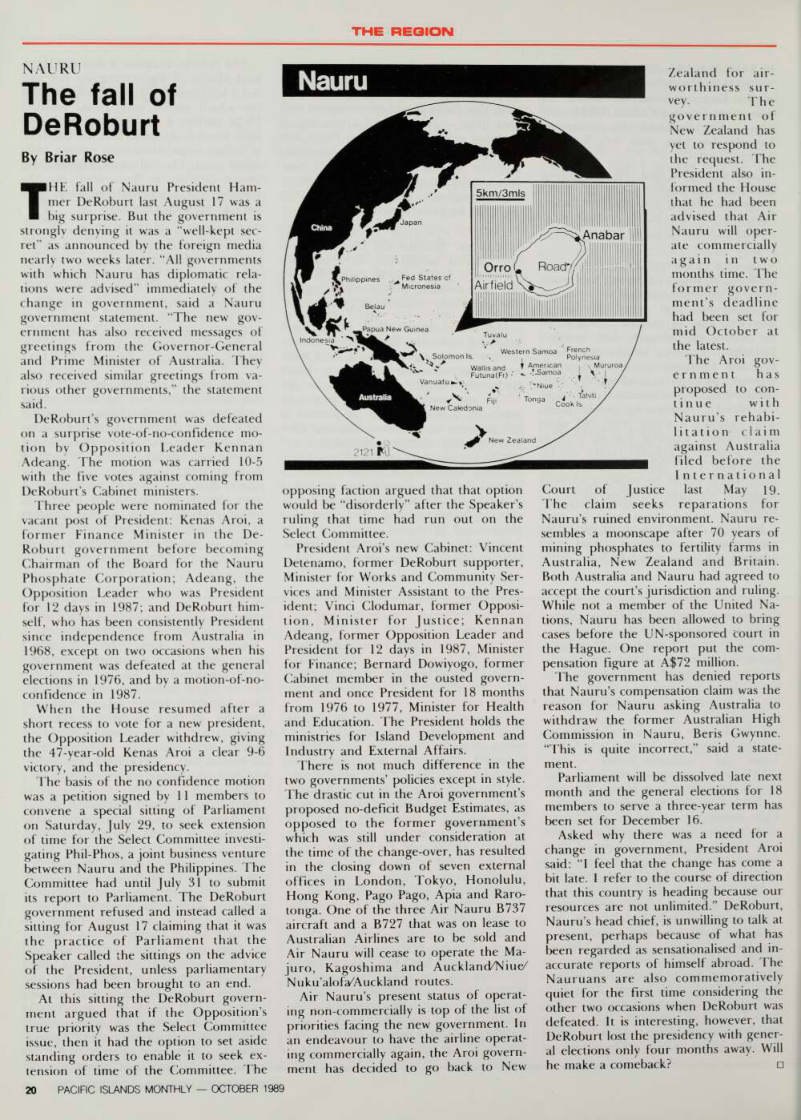
Nauru
The fall of Deroburt
By Briar Rose
THE fall of Nauru President Ham mer Deßoburt last August 17 was a big surprise. But the government is strongly denying it was a “well-kept sec ret” as announced by the foreign media nearly two weeks later. “All governments with which Nauru has diplomatic rela tions were advised” immediately of the change in government, said a Nauru government statement. “The new gov ernment has also received messages of greetings from the Governor-General and Prime Minister of Australia. They also received similar greetings from va rious other governments,” the statement said.
Deßoburt’s government was defeated on a surprise vote-of-no-confidence mo tion by Opposition Leader Kennan Adeang. The motion was carried 10-5 with the five votes against coming from Deßoburfs Cabinet ministers.
Three people were nominated for the vacant post of President: Renas Aroi, a former Finance Minister in the De- Roburt government before becoming Chairman of the Board for the Nauru
Phosphate Corporation; Adeang, the
Opposition Leader who was President for 12 days in 1987; and Deßoburt him self, who has been consistently President since independence from Australia in 1968, except on two occasions when his government was defeated at the general elections in 1976, and by a motion-of-no confidence in 1987.
When the House resumed after a short recess to vote for a new president, the Opposition Leader withdrew, giving the 47-year-old Renas Aroi a clear 9-6
victory, and the presidency.
The basis of the no confidence motion was a petition signed by 11 members to convene a special sitting of Parliament on Saturday, July 29, to seek extension of time for the Select Committee investi gating Phil-Phos, a joint business venture between Nauru and the Philippines. The Committee had until July 31 to submit its report to Parliament. The Deßoburt government refused and instead called a sitting for August 17 claiming that it was the practice of Parliament that the Speaker called the sittings on the advice of the President, unless parliamentary sessions had been brought to an end.
At this sitting the Deßoburt govern ment argued that if the Opposition’s true priority was the Select Committee issue, then it had the option to set aside standing orders to enable it to seek ex tension of time of the Committee. The
opposing faction argued that that option
would be “disorderly” after the Speaker’s ruling that time had run out on the Select Committee.
President Aroi’s new Cabinet: Vincent Detenamo, former Deßoburt supporter, Minister for Works and Community Services and Minister Assistant to the Presidem; Vinci Clodumar, former Opposition, Minister for Justice; Kennan Adeang, former Opposition Leader and President for 12 days in 1987, Minister for Finance; Bernard Dowiyogo, former Cabinet member in the ousted government and once President for 18 months from 1976 to 1977, Minister for Health and Education. The President holds the ministries for Island Development and Industry and External Affairs.
There is not much difference in the
two governments’ policies except in style.
The drastic cut in the Aroi government’s proposed no-deficit Budget Estimates, as opposed to the former government’s which was still under consideration at the time of the change-over, has resulted in the closing down of seven external offices in London, Tokyo, Honolulu, Hong Kong, Pago Pago, Apia and Rarotonga. One of the three Air Nauru 8737 aircraft and a 8727 that was on lease to Australian Airlines are to be sold and Air Nauru will cease to operate the Ma-
jure, Kagoshima and Auckland/Niue/
Nuku’alofa/Auckland routes.
Air Nauru’s present status of operating non-commercially is top of the list of priorities facing the new government. In an endeavour to have the airline operat-
ing commercially again, the Aroi govern-
ment has decided to go back to New
Zealand for air worthiness sur vey. The government of New Zealand has yet to respond to the request. The President also in formed the House that he had been advised that Air Nauru will oper
ate commercially
again in two months time. The former govern ment’s deadline had been set for mid October at the latest.
The Aroi gov ernment has proposed to con tinue with Nauru’s rehabi litation claim
against Australia
filed before the International
Court of Justice last May 19.
The claim seeks reparations for Nauru’s ruined environment. Nauru re sembles a moonscape after 70 years of
mining phosphates to fertility farms in
Australia, New Zealand and Britain.
Both Australia and Nauru had agreed to accept the court’s jurisdiction and ruling.
While not a member of the United Na tions, Nauru has been allowed to bring cases before the UN-sponsored court in the Hague. One report put the com pensation figure at As 72 million.
The government has denied reports that Nauru’s compensation claim was the reason for Nauru asking Australia to withdraw the former Australian High Commission in Nauru, Beris Gwynne.
“This is quite incorrect,” said a state ment.
Parliament will be dissolved late next month and the general elections for 18 members to serve a three-year term has been set for December 16.
Asked why there was a need for a change in government, President Aroi said: “I feel that the change has come a bit late. I refer to the course of direction that this country is heading because our resources are not unlimited.” Deßoburt, Nauru’s head chief, is unwilling to talk at present, perhaps because of what has been regarded as sensationalised and in accurate reports of himself abroad. The Nauruans are also commemoratively quiet for the first time considering the other two occasions when Deßoburt was defeated. It is interesting, however, that Deßoburt lost the presidency with gener al elections only four months away. Will he make a comeback? □