Harvey Helfand
p. 50 · Read in the full issue
Books
Ciardi’s war
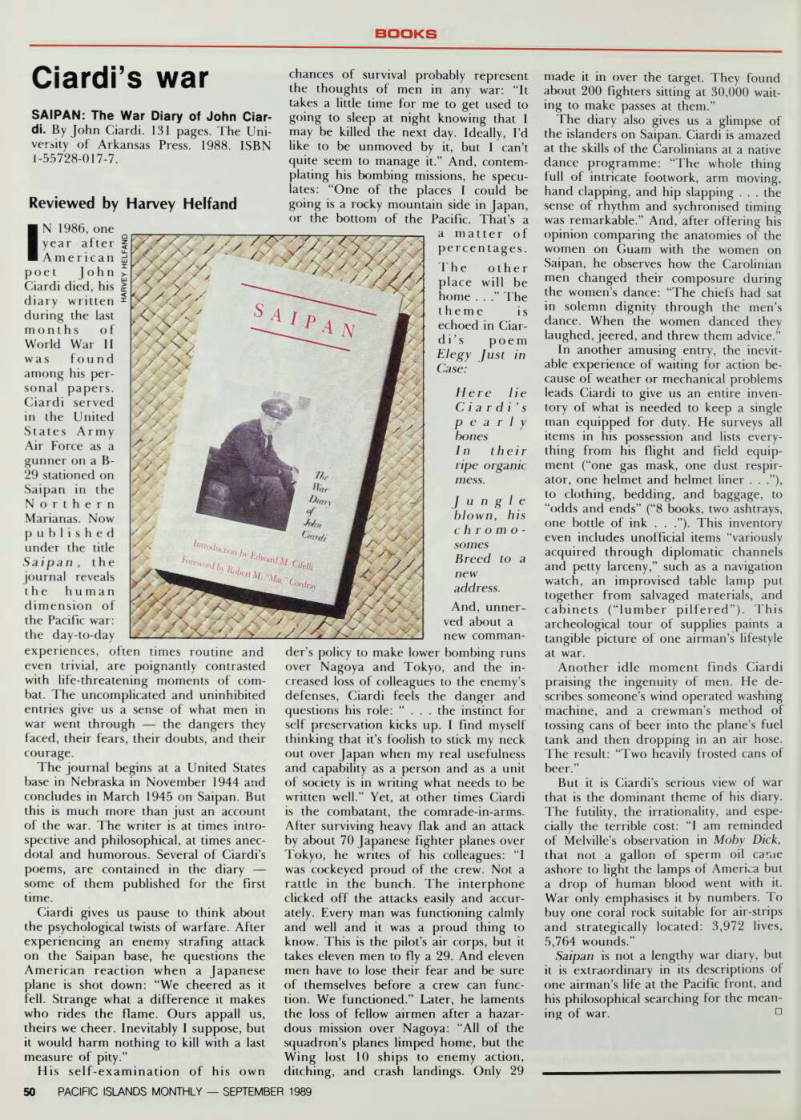
SAIPAN: The War Diary of John Ciar di. By John Ciardi. 131 pages. The Uni versity of Arkansas Press. 1988. ISBN 1-55728-017-7.
Reviewed by Harvey Helfand
IN 1986, one year after American poet John Ciardi died, his
diary written
during the last months of World War II was found among his per sonal papers.
Ciardi served in the United States Army Air Force as a gunner on a B -29 stationed on Saipan in the Northern Marianas. Now published under the title Saipan , the
journal reveals
the human dimension of the Pacific war: the day-to-day
experiences, often times routine and even trivial, are poignantly contrasted with life-threatening moments of com bat. The uncomplicated and uninhibited entries give us a sense of what men in
war went through the dangers they
faced, their fears, their doubts, and their courage.
The journal begins at a United States base in Nebraska in November 1944 and concludes in March 1945 on Saipan. But this is much more than just an account of the war. The writer is at times intro spective and philosophical, at times anec dotal and humorous. Several of Ciardi’s poems, are contained in the diary some of them published for the first time.
Ciardi gives us pause to think about the psychological twists of warfare. After experiencing an enemy strafing attack on the Saipan base, he questions the American reaction when a Japanese plane is shot down: “We cheered as it fell. Strange what a difference it makes who rides the flame. Ours appall us, theirs we cheer. Inevitably I suppose, but it would harm nothing to kill with a last measure of pity.”
His self-examination of his own
chances of survival probably represent the thoughts of men in any war: “It takes a little time for me to get used to going to sleep at night knowing that I may be killed the next day. Ideally, I’d like to be unmoved by it, but I can’t quite seem to manage it.” And, contem plating his bombing missions, he specu lates: “One of the places I could be going is a rocky mountain side in Japan, or the bottom of the Pacific. That’s a
a matter of percentages.
The other place will be home . . .” The theme is echoed in Ciar di’s poem Elegy Just in Case: Here lie Ciardi’s
pearly
bones In their
ripe organic
mess.
Jungle
blown, his chro m o somes Breed to a new address.
And, unner ved about a new comman
dec’s policy to make lower bombing runs over Nagoya and Tokyo, and the in creased loss of colleagues to the enemy’s defenses, Ciardi feels the danger and questions his role: “ . . . the instinct for self preservation kicks up. I find myself thinking that it’s foolish to stick my neck out over Japan when my real usefulness and capability as a person and as a unit of society is in writing what needs to be written well.” Yet, at other times Ciardi is the combatant, the comrade-in-arms.
After surviving heavy flak and an attack by about 70 Japanese fighter planes over Tokyo, he writes of his colleagues: “I was cockeyed proud of the crew. Not a rattle in the bunch. The interphone clicked off the attacks easily and accur
ately. Every man was functioning calmly
and well and it was a proud thing to know. This is the pilot’s air corps, but it takes eleven men to fly a 29. And eleven men have to lose their fear and be sure of themselves before a crew can func tion. We functioned.” Later, he laments the loss of fellow airmen after a hazar dous mission over Nagoya: “All of the
squadron’s planes limped home, but the
Wing lost 10 ships to enemy action, ditching, and crash landings. Only 29
made it in over the target. They found about 200 fighters sitting at 30,000 wait ing to make passes at them.”
The diary also gives us a glimpse of the islanders on Saipan. Ciardi is amazed at the skills of the Carolinians at a native dance programme: “The whole thing full of intricate footwork, arm moving, hand clapping, and hip slapping ... the
sense of rhythm and sychronised timing
was remarkable.” And, after offering his opinion comparing the anatomies of the women on Guam with the women on Saipan, he observes how the Carolinian men changed their composure during the women’s dance: “The chiefs had sat in solemn dignity through the men’s dance. When the women danced they laughed, jeered, and threw them advice.”
In another amusing entry, the inevit able experience of waiting for action be cause of weather or mechanical problems leads Ciardi to give us an entire inven tory of what is needed to keep a single man equipped for duty. He surveys all items in his possession and lists every thing from his flight and field equip ment (“one gas mask, one dust respir ator, one helmet and helmet liner . . .”),
to clothing, bedding, and baggage, to
“odds and ends” (“8 books, two ashtrays, one bottle of ink . . .”). This inventory even includes unofficial items “variously
acquired through diplomatic channels
and petty larceny,” such as a navigation watch, an improvised table lamp put together from salvaged materials, and cabinets (“lumber pilfered”). This
archeological tour of supplies paints a
tangible picture of one airman’s lifestyle
at war.
Another idle moment finds Ciardi praising the ingenuity of men. He de scribes someone’s wind operated washing machine, and a crewman’s method of tossing cans of beer into the plane’s fuel tank and then dropping in an air hose.
The result: “Two heavily frosted cans of beer.”
But it is Ciardi’s serious view of war that is the dominant theme of his diary.
The futility, the irrationality, and espe cially the terrible cost: “I am reminded of Melville’s observation in Moby Dick, that not a gallon of sperm oil came ashore to light the lamps of America but a drop of human blood went with it.
War only emphasises it by numbers. To buy one coral rock suitable for air-strips and strategically located: 3,972 lives, 5,764 wounds.”
Saipan is not a lengthy war diary, but it is extraordinary in its descriptions of one airman’s life at the Pacific front, and his philosophical searching for the mean ing of war. D