Pieces of
pp. 47-49 · Read in the full issue
The Arts
Pieces of Paradise
By Nicolas Rothwell
SINCE the first days of the colonial era, the plunder from the first ex plorations of the Pacific Ocean has graced the museums of the western world. From Leningrad to London, trea sures of Polynesian, Melanesian and Mic ronesian art rest within the glass cases of exhibition displays, far from the islands and societies that gave their carved forms meaning.
Only slowly, in this post-colonial period, as the world adjusts to the poli tical independence of the Pacific, is a reassessment of this process of despolia
tion taking place. Pacific region
museums are beginning to demand the return of priceless cultural artefacts, while some museum curators in western countries have developed a heightened awareness of the continued importance of ancient Pacific art-works for today’s island societies.
Perhaps the most remarkable illustra tion of this new approach came in a landmark exhibition organised by the Australian Museum in Sydney last year a bicentennial celebration of Pacific Art, titled Pieces of Paradise. While Pieces of Paradise, was the most spec tacular showcase of Pacific art since the 1979 exhibition mounted by the Amer ican National Gallery of Art, its most important legacy may well prove to be a pioneering approach to the repatriation of Pacific objects of art from western museums to their home cultures. This is difficult terrain, fraught with questions
of political sensitivity.
Pacific museum curators know very well that many of the greatest treasures produced by the civilisations of their re gion languish in the museums of Europe and North America, often not even dis played to the public. Yet there is little that the small Pacific states can do, beyond request the return of their cultu
ral patrimony.
Most western museums, run as hard edged enterprises in a competitive world,
and naturally seeking always to expand,
rather than reduce, their holdings, have little interest in the idea of returning their collections to the countries of origin; obviously, they argue, if this poli cy were consistently pursued, every
museum in the world would be emptied.
The most famous example of this de bate focuses on the British Museum’s re tention of the “Elgin Marbles” the frieze of statues from the Parthenon in Athens. The Greek Government insists this greatest of all classical masterpieces has been ripped from its natural place of rest, the temple-site in the heart of the
Greek capital.
Public opinion in Britain and the rest of Europe is at least aware of this argument; but disturbingly, hardly any one hears of the claims made by the peoples of the Pacific, whose right to their ancestral art-works is far more im mediate.
Repatriation of art works to the Paci fic, then, depends on a change in the attitudes of western museums and gov ernments. In this process of reshaping the opinions of the art establishment, the Pieces of Paradise exhibition may have played a crucial role. In the Australian Museum, for the first time, the role of a museum as abode for foreign artefacts was combined with the complex process of repatriation. Officials at the museum have been elaborating a coherent phi losophy of their duties as custodians of collections, and as friends of the people of other cultures.
In a special presentation of the ideas behind Pieces of Paradise, prepared for Pacific Islands Monthly, the museum’s director, Dr Des Griffin, outlined the progression he would like to see in the relationship between western collections and the cultures of the Pacific.
As one of the largest museums in the Southern hemisphere, and perhaps the “western” collection most engaged with the Pacific, the Australian Museum’s approach is likely to exert considerable influence especially given the success of Pieces of Paradise, which was especial ly well-received by one vital audience, the representatives of Pacific nations present at its opening.
Dr Griffin saw Pieces of Paradise as an opportunity not only to display the arte facts assembled in the exhibition, but also to try to persuade visitors to the museum to understand “the richness and the validity of another culture”.
Museums, according to Dr Griffin, have for most of their history “been behaving more like the repositories of the booty of colonial or conquering countries, the kind of annexe to the castle of some king or emperor, and at the same time even now many museums maintain the artefacts they have are enriching the society in which the museum is situated”.
But he believes that a vital element in the life of such museums is often com mitted: “I don’t think the two can go together unless there is that extra strand of forming a close relationship with the
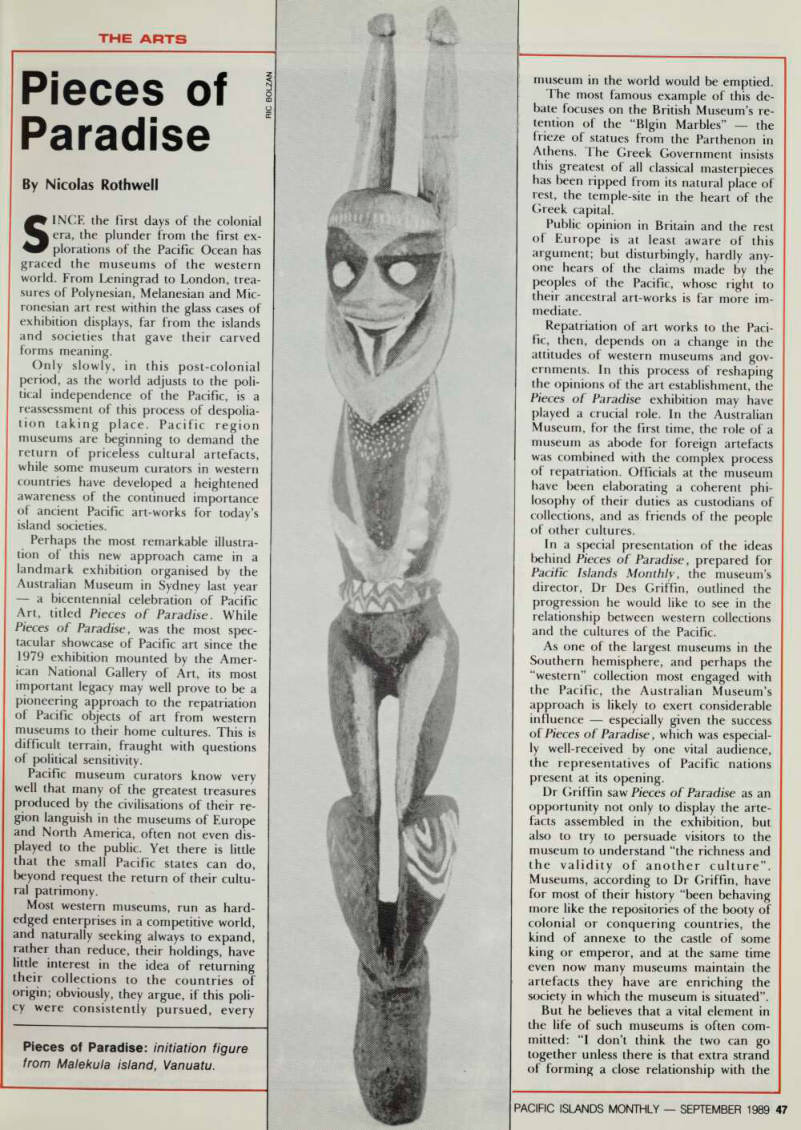
Pieces of Paradise: initiation figure from Malekula island, Vanuatu.
Ric Bolzan
people whose cultural material the museum has.”
Dr Griffin is sharply critical of east coast American museums, which he con tends claims to play a role in their socie ty as interpreters of the meaning of other cultures, but “do nothing to return to native American Indian peoples arte facts which in many cases, have huge meaning to those peoples without those artefacts their culture, their exist ence is threatened”.
This active view of a museum’s role as a conduit between cultures gave special resonance to Pieces of Paradise, which reinforced the connection between Australia and Pacific peoples. Yet Dr Griffin, whose idealism is certainly not dewy-eyed, quickly admits that the pro cess of forging links he is sketching runs the risk of being labelled “paternalist”.
“In Pieces of Paradise, we quite natur ally wanted to have Melanesian people involved, we didn’t simply want their en dorsement it was not a feeling, you know, look you come along, and say, you whites running the museum, you’ve done a good job showing this cultural material,” he said.
“We wanted them to speak about what the cultural material meant to them, and we wanted to do something else we chose the day on which we opened the exhibition to again return some very sig nificant items to each of the three na tions whose cultural material we were displaying Papua New Guinea, The
Solomons and Vanuatu.”
This active view of a modern museum’s role is regarded with alarm by some more traditional curators, who fear the return of some cultural materials to the nations of the Pacific will precipitate calls for the return of everything. There are even those who argue that Pacific nations would simply resell artefacts re turned to them on the booming interna tional tribal art market, or would fail to look after the artworks properly, Dr Griffin discounts these suggestions as
“silly statements only rationalisations
to justify the retention in museums of this cultural material”.
He reports that the experience of the Australian Museum in returning Pacific artefacts to their host cultures “have shown us quite the contrary”.
The interaction between the museum and the peoples of the Pacific that Dr Griffin wants to see is not just a one sided, history-stricken gift-giving; he re calls the weight of validity lent his vision on the opening day of Pieces of Para dise, when representatives from the three independent Melanesian states
“spoke strongly, fiercely of the import
ance of the cultural material to them what they said showed that their culture still lives for them and they also ex pressed their gratitude to us for looking after, and returning, their cultural mate rial, and for us, that is a kind of icing on the cake”.
For Dr Griffin and the other figures at the Australian Museum involved in the development of the exhibition believe museums only justify their existence if
they bring alive the familiar description
of their task, as institutions holding cultural materials in trust; “Museums must not only show their collections but involve people whose cultural material they hold in interpreting that material, and they must help those people to real ise the benefits of the existence of these artefacts, even though many of them may have been made for particular cere monies and then thrown in the bush for now increasingly little of that mate rial exists and there may be for many people little reminder of their past life, of their custom.”
While the dominant impression con veyed by familiar western exhibits of Pacific art-works may be one of a confi dent, powerful culture’s munificient dis play of materials from a threatened and exiguous world, Dr Griffin also sees great value for the western museums and societies that explore the Pacific’s very different outlook on life. In this they are staged. “In these western societies,” Dr Griffin argues, “religions
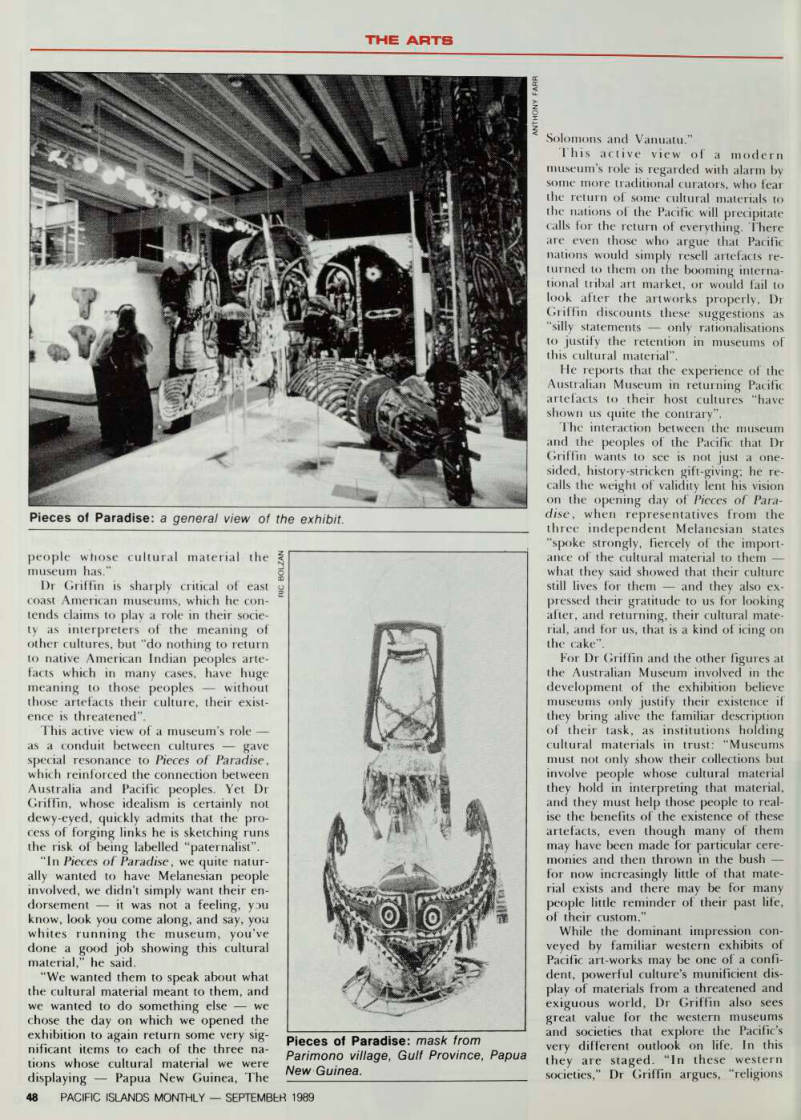
Pieces of Paradise: a general view of the exhibit.
Ric Bolzan
Anthony Farr
Pieces of Paradise: mask from Parimono village, Gulf Province, Papua New Guinea.
don t forge a link between people and the environment in which they live, in deed they almost legitimize the destruc tion of the environment; while many of these other societies African, Pacific, American their beliefs, their traditions place them as part of the environment; and the traditions and the culture of these peoples and nations give them something of the nature of the strength to live and to have dignity”.
Dr Griffin quotes a New Zealand Maori saying, to the effect that “where there is artistic excellence, there is hu
man dignity”, before concluding simply
that the task of his museum the show ing of the cultural material of other peo- Pj es “can help to give us human
dignity”.
Such creative and sympathetic display of Pacific treasures in western museums, and the repatriation of cultural artefacts that forms the heart of the Australian Museum’s programme, may not yet be widespread but this process is already exerting a tangible effecton the islands of the South Pacific.
On the island of Efate in Vanuatu, for example, repatriation has played the key role in reviving the traditional art of slit drum carving. Most of Vanuatu’s well known slit-drums come from the island of Ambrym, but once these spectacular instruments were also made on Efate, the island of the nation’s capital. Port Vila. Only five slit-drums in the Efate style have been preserved.
The Australian Museum had a speci men collected in 1896 from the village of Mele, outside Vila. It was repatriated in 1981, and, according to Kirk Huffman of the Vanuatu Cultural Centre, its arrival in Efate inspired the people to begin making their drums once again.
The first new drum was completed early last year, and now stands in the Vila Cultural Centre, an example of a revived tradition that had once been thought lost forever.
Dr Huffman describes the repatriation process as “incredibly important for peo ple in the Pacific, if they have such in terest in culture as the people of Vanuatu for the return of an impor tant ritual object like the slit drum can itself spark off the retelling of a whole series of myths and stories that might have gone by the wayside.
In this way, the enlightened practices of the Australian Museum are far more than just fine ideas applied within the confines of exhibition halls, they have a direct connection to the cultures of to day’s Pacific, helping to continue the evolution of traditional societies in the change-tormented present world. □
Ric Bolzan
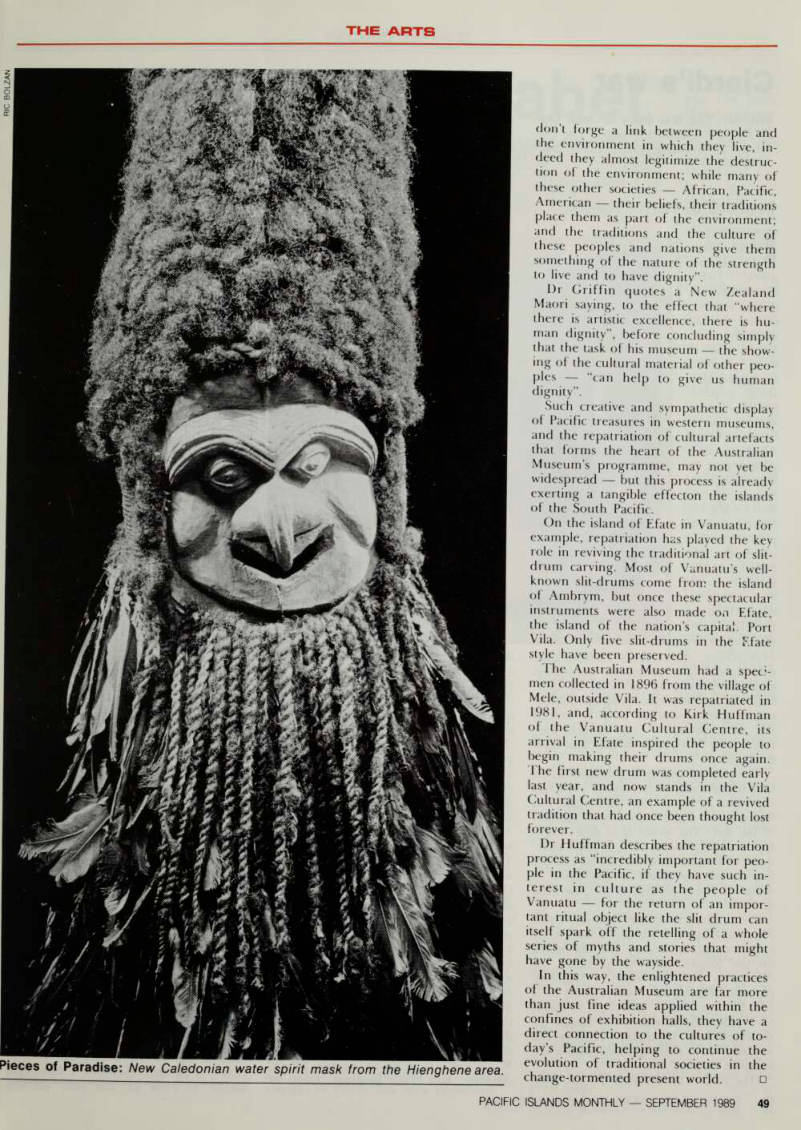
Pieces of Paradise: New Caledonian water spirit mask from the Hienghene area.