Solomons
pp. 33-34 · Read in the full issue
New wave in Solomons
A CLEAR change in economic direction has been signalled in recent speeches in the Solomon Islands, with Prime Minister Solomon Mamaloni calling for harder work and belt-tightening while Governor-General Sir George Lepping has indicated the
country’s foreign policy would now con
centrate on trade links.
Speaking in Honiara on the eleventh anniversary of
independence, Mamaloni
called on all sectors of the country’s economy to be de dicated, work harder and co-operate in all areas of de velopment in order to help restore the Solomon Islands’ shaky economy.
The Prime Minister recal led that in 1984, when peo ple were spending freely, he had warned that more money should be saved.
“The more money people
had in their pockets and bank savings, the more they spent it on imported lux-
uries instead of investing in income
generating ventures. Consequently, by
late 1984 the volume of imports to Solo mon Islands rose dramatically while ex ports decreased,” he said.
The adventure of Cyclone Namu in 1986 turned the snowball into an avalan che and the nation’s economy had gone from bad to worse.
Mamaloni said the government would now aim at making sure that capital flows were used to help the economy recover, a task made harder by the dis mal economic performance in recent
years, including the inflation rate jumping from seven per cent in 1984 to 22 per cent in 1988.
“The increase in budget deficit from $l2 million in 1984 to over $7O million in 1988 was staggering, to say the least,” he said. Foreign debt went from SSI 79 mil lion to $2BO million over the same period. The current account sagged from a sur plus of $8.6 million to a de ficit of $B.B million, and the value of the Solomon Islands
dollar declined by about ou per cent against other currencies.
The previous government had mis directed investment priorities and fore ign aid had been used inefficiently, the Prime Minister continued. “In addition, we have also inherited a defunct public service and a demoralised private sector.
The situation is both fragile and poten
tially explosive and requires a major
surgery to put the country back on its feet.” To blame it all on Namu was avoiding reality and “it is time we faced squarely the barest of realities facing us today,” said Mamaloni.
To pull itself out of the present “com atose state”, the Solomon Islands needed to place more emphasis on the role of the rural people whose participation would be crucial. Mamaloni signalled he had come to the same conclusion as lead ers in Papua New Guinea by giving high priority to building a sound economic base in the countryside.
“Improvement to the national eco nomy does not mean mass production of futile plans, masses and masses of papers and computers or sitting in our cool offices drinking cup after cup of coffee,” he said. Rather, everyone had to work harder, with the national and provincial governments taking the lead. The public service needed to reinstate its respecta bility and seriousness as the chief orga niser of government policies. The Prime Minister warned the public service that it must “re-attune itself to service the wel fare and interests of the public at large”.
The whole government apparatus would be overhauled, and management of fore
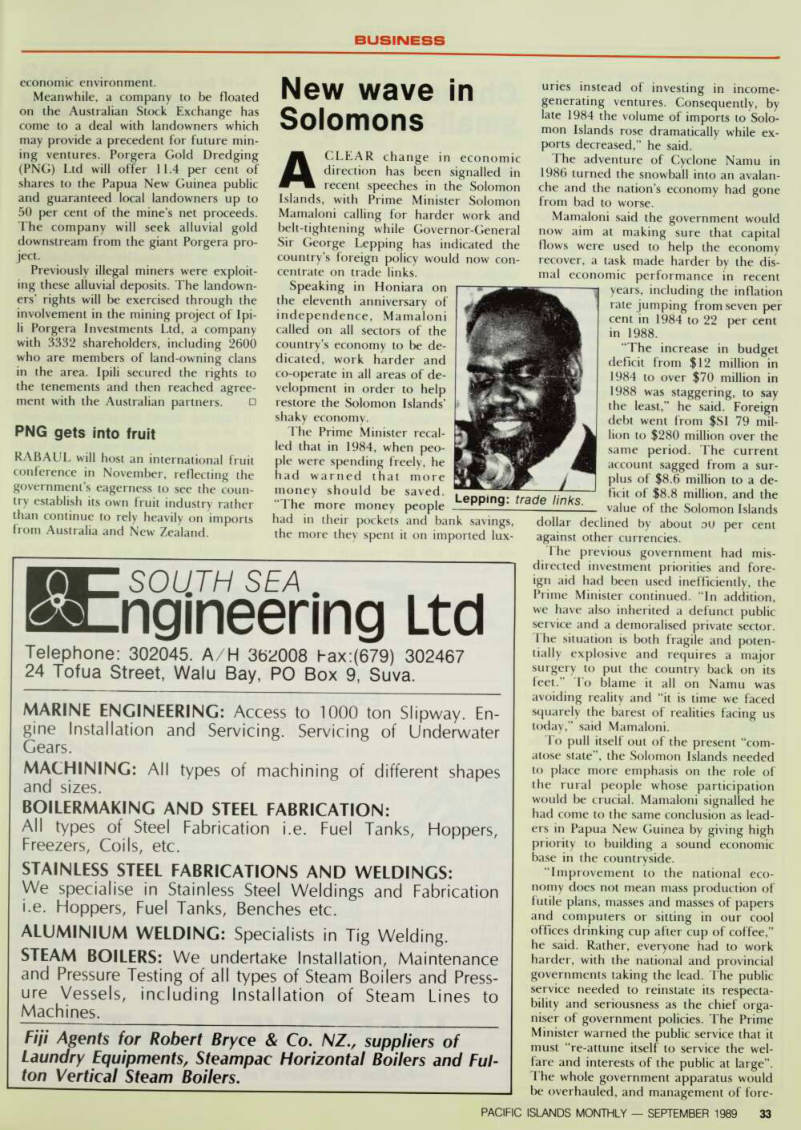
Lepping: trade links.
ign aid funds improved. It was essential that the Solomon Island Government lived within its means.
Waste through mis-spending, abuse of government property and duplication would all be attacked. “The establish ment of the highly unpopular three-men junta is aimed at curbing ministerial careless spendings of public funds.
Those, especially public officers, who dare to complain against the junta are
doing nothing else but making self
confessions of their past sins,” Mamaloni continued.
The private sector would benefit from new concessions, tariffs, tax incentives.
Mamaloni also broke the news that the government planned to phase out the export of whole logs.
At the opening of the Solomon Islands
parliament, Governor-General Lepping
set out the government’s five-year prog ramme of economic and constitutional reforms. Core projects would include
processing of timber projects, develop
ment and rehabilitation of the coconut
industry, expansion of cocoa develop
ment and the establishment of a spices industry on a commercial basis. Agricul ture will be geared to transform it from what has traditionally been a low pro ductive sector to a modern and commer cial enterprise within 10 years.
The Governor-General also announced the Solomon Islands would make changes to its overseas representa tion to aim it more directly toward the nation’s trade needs. The links will now be based on the requirement for trade and market promotion; already the gov ernment has announced the closure of the Solomon Islands mission at the Un ited Nations on the grounds of cost. The country is now looking at opening an office in Brisbane to look after trade links with Australia, Papua New' Guinea and Indonesia.
Meanwhile, the Solomon Islands will raise the possibility with the two other members of the Melanesian Spearhead Group Papua New Guinea and Vanuatu — of giving economic aid to the poorer nations of the South Pacific, in cluding Tuvalu and Niue.
Mamaloni, who is the most enthusiastic proponent of the three countries form ing the Federated States of Melanesia, said such a union would allow the mem ber countries to divert assistance to those neighbours with few natural resources so that the smaller states could be less re liant on aid from Australia and New Zealand. I=l More Fijian involvement FIJIANS are to be encouraged to play a greater part in the tourism industry, said the nation’s Minister for Trade and Commerce, Berenado Vunibobo.