Pacific
pp. 31-33 · Read in the full issue
Islands
Monthly
Business
Troubled times ahead
RABBIE Namaliu’s government was able to convince Bougainville Cop per Ltd (BCL) to announce repair work on the beseiged Panguna mine was about to begin, but the whole question of
mining and land rights remains prob
lematical. Threats to disrupt the OK Tedi mine, the cutting of telecom munications links, even a row over the sale of land by Burns Philp not to mention the continuing tension in the North Solomons province suggest that the government and mining industry have some troubled times ahead.
Namaliu, anxious to present an image of a situation under control, said the Panguna mine could be operating within four weeks of repair work beginning. It is understood that the government brought considerable pressure on BCL to go along with the announcement, de spite the company’s recent advertise ments announcing lay-offs. The mine, which has been closed since May 15, has been costing the government and the company millions of kina a week. Just how hard the government has been hit was indicated by the announcement that Deputy Prime Minister Akoka Doi had called off a visit to New Zealand in order to save money.
At least three departmental heads have been ordered to cancel their over seas trips as part of the government’s
belt-tightening.
All government vehicles have been ordered off the road after 4.06 pm, the public service knock-off time.
BCL reported a sharp profit drop for the six months to June 30. Profit after tax and before extraordinaries was 37.77 million kina compared with K 51.8 mil lion for the same period last year. An extraordinary provision of K 9.6 million has been allowed to cover costs for re pairs, redundancies and other items con nected with the closure of the mine.
The result was also affected by the necessity to increase the deferred taxa tion provision by K 19.6 million to cor rect an error in accounting an error which had been accumulating since the
1980 revaluation of assets and the exten sion of mine life, and which had not been detected until this year. There will be no interim dividend.
Cash reserves at June 30 were K 56.9
million and the company said it had be nefitted from cash flow from sales made before the closure. “The main impact of the stoppage will be felt in the second half,” a BCL statement said.
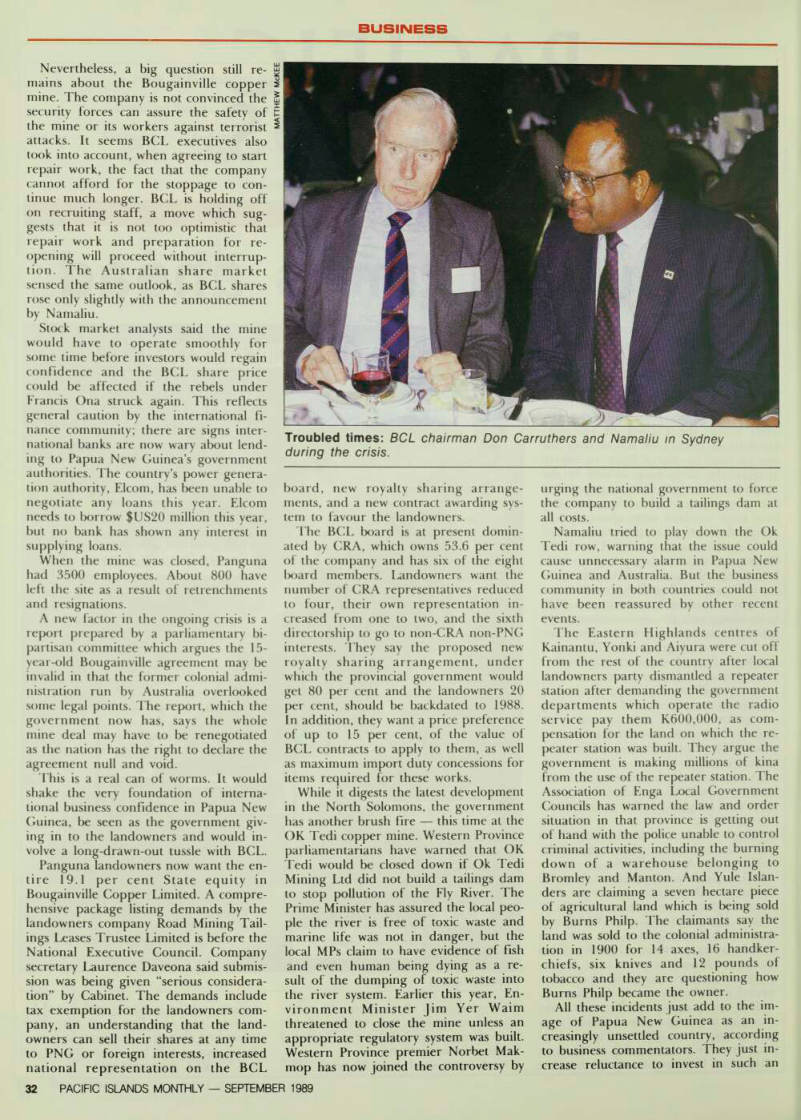
Trouble island
Nevertheless, a big question still re mains about the Bougainville copper mine. The company is not convinced the security forces can assure the safety of the mine or its workers against terrorist attacks. It seems BCL executives also took into account, when agreeing to start repair work, the fact that the company cannot afford for the stoppage to con tinue much longer. BCL is holding off on recruiting staff, a move which sug gests that it is not too optimistic that repair work and preparation for re
opening will proceed without interrup
tion. The Australian share market sensed the same outlook, as BCL shares rose only slightly with the announcement by Namaliu.
Stock market analysts said the mine would have to operate smoothly for some time before investors would regain confidence and the BCL share price could be affected if the rebels under Francis Ona struck again. This reflects general caution by the international fi nance community; there are signs inter national banks are now wary about lend ing to Papua New Guinea’s government authorities. The country’s power genera tion authority, Elcom, has been unable to negotiate any loans this year. Elcom needs to borrow SUS2O million this year, but no bank has shown any interest in
supplying loans.
When the mine was closed, Panguna had 3500 employees. About 800 have left the site as a result of retrenchments
and resignations.
A new factor in the ongoing crisis is a
report prepared by a parliamentary bi
partisan committee which argues the 15year-old Bougainville agreement may be invalid in that the former colonial admi nistration run by Australia overlooked some legal points. The report, which the government now has, says the whole mine deal may have to be renegotiated as the nation has the right to declare the agreement null and void.
This is a real can of worms. It would shake the very foundation of interna tional business confidence in Papua New Guinea, be seen as the government giv ing in to the landowners and would in volve a long-drawn-out tussle with BCL.
Panguna landowners now want the en tire 19.1 per cent State equity in Bougainville Copper Limited. A compre hensive package listing demands by the landowners company Road Mining Tail ings Leases Trustee Limited is before the National Executive Council. Company secretary Laurence Daveona said submis sion was being given “serious considera tion” by Cabinet. The demands include tax exemption for the landowners com pany, an understanding that the land owners can sell their shares at any time to PNG or foreign interests, increased national representation on the BCL
board, new royalty sharing arrange ments, and a new contract awarding sys tem to favour the landowners.
The BCL board is at present domin ated by CRA, which owns 53.6 per cent of the company and has six of the eight board members. Landowners want the number of CRA representatives reduced to four, their own representation in creased from one to two, and the sixth directorship to go to non-CRA non-PNG interests. They say the proposed new
royalty sharing arrangement, under
which the provincial government would get 80 per cent and the landowners 20 per cent, should be backdated to 1988.
In addition, they want a price preference of up to 15 per cent, of the value of BCL contracts to apply to them, as well as maximum import duty concessions for items required for these works.
While it digests the latest development in the North Solomons, the government has another brush fire this time at the OK Tedi copper mine. Western Province parliamentarians have warned that OK Tedi would be closed down if Ok Tedi Mining Ltd did not build a tailings dam to stop pollution of the Fly River. The Prime Minister has assured the local peo ple the river is free of toxic waste and marine life was not in danger, but the local MPs claim to have evidence of fish and even human being dying as a re sult of the dumping of toxic waste into the river system. Earlier this year, En vironment Minister Jim Yer Waim threatened to close the mine unless an appropriate regulatory system was built.
Western Province premier Norbet Mak mop has now joined the controversy by
urging the national government to force the company to build a tailings dam at all costs.
Namaliu tried to play down the Ok Tedi row, warning that the issue could cause unnecessary alarm in Papua New Guinea and Australia. But the business community in both countries could not have been reassured by other recent events.
The Eastern Highlands centres of Kainantu, Yonki and Aiyura were cut off from the rest of the country after local landowners party dismantled a repeater station after demanding the government departments which operate the radio service pay them K 600,000, as com pensation for the land on which the re peater station was built. They argue the government is making millions of kina from the use of the repeater station. The Association of Enga Local Government Councils has warned the law and order situation in that province is getting out of hand with the police unable to control criminal activities, including the burning down of a warehouse belonging to Bromley and Manton. And Yule Islan ders are claiming a seven hectare piece of agricultural land which is being sold by Burns Philp. The claimants say the land was sold to the colonial administra tion in 1900 for 14 axes, 16 handker chiefs, six knives and 12 pounds of tobacco and they are questioning how Burns Philp became the owner.
All these incidents just add to the im age of Papua New Guinea as an in
creasingly unsettled country, according
to business commentators. They just in crease reluctance to invest in such an
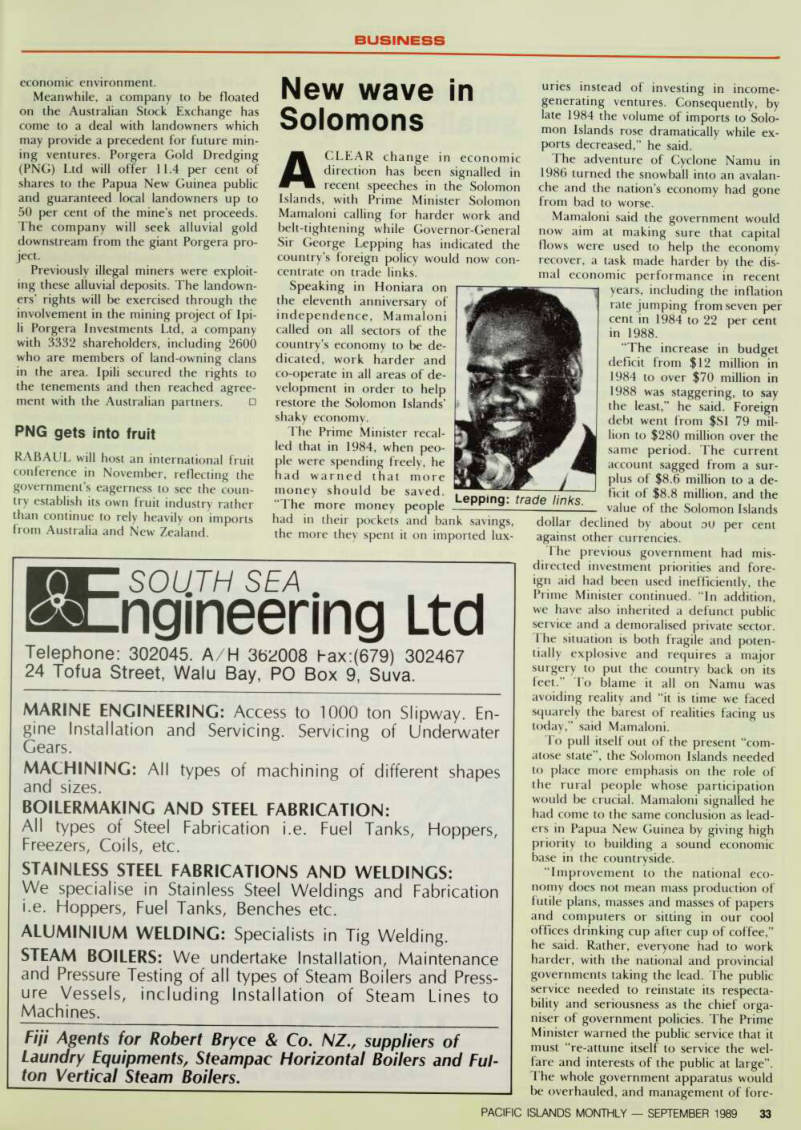
Matthew Mckee
Troubled times: BCL chairman Don Carruthers and Namaliu in Sydney during the crisis.
economic environment.
Meanwhile, a company to be floated on the Australian Stock Exchange has come to a deal with landowners which may provide a precedent for future min ing ventures. Porgera Gold Dredging (PNG) Ltd will offer 11.4 per cent of shares to the Papua New Guinea public and guaranteed local landowners up to 50 per cent of the mine’s net proceeds.
The company will seek alluvial gold downstream from the giant Porgera pro ject.
Previously illegal miners were exploit ing these alluvial deposits. The landown ers’ rights will be exercised through the involvement in the mining project of Ipi li Porgera Investments Ltd, a company with 3332 shareholders, including 2600 who are members of land-owning clans in the area. Ipili secured the rights to the tenements and then reached agree ment with the Australian partners. □ PNG gets into fruit RABAUL will host an international fruit conference in November, reflecting the government’s eagerness to see the coun try establish its own fruit industry rather than continue to rely heavily on imports from Australia and New Zealand.