Ghosts of empires past
pp. 26-27 · Read in the full issue
Assistance
By David North
GREAT Britain and Germany were once the principal colonial pow ers in the Pacific but now only the ghosts of empire can be detected in their capital cities. They are, however,
friendly, helpful ghosts.
The presence is more visible in Lon don than in Bonn. A visitor can walk past the massive monument to Nelson (and British naval power) in Trafalgar Square, past statues of Captain Cook and former Colonial Secretary Winston Churchill and down Whitehall to the Foreign and Commonwealth Office where peaceable executives now make decisions about aid to the islands. One could spend weeks tracking down all the London-located, British-Commonwealth oriented organizations which relate to the South Pacific.
Whereas both the Brits and the Ger mans have lost their colonies, the British held on to their imperial capital, Lon don, in a way that Germany did not.
Berlin is still a divided city, and West Germany established its post-war capital in the pleasant university town of Bonn, on the Rhine. There are no physical re minders of the German Empire in Bonn, but again there is an outreach to the islands with funds and technical assist ance. Most young Germans have no idea
that their country once ruled all of West ern Samoa, Nauru, and half of Papua New Guinea, as well as the four jurisdic tions of the Marianas, the Marshalls, Palau and the Federated States of Mic ronesia.
One of my favourite ghostly presences in Britain is the London Missionary Soci ety. Merged into the Council for World Missions a decade or so ago, it is still listed in the London phone book. The polite but reserved voice at the other end of the wire says that the organisa tion continues to support about a dozen missionaries “in the LMS tradition” in Nauru, Kiribati, the Solomons, Tuvalu and Western Samoa and has ties with missionary activities in the Cook Islands and with the Pacific Theological Semi nary in Fiji.
The continuing interest of Her Majes ty’s Government is housed, among other places, in the splendidly old fashioned India House, from whence the Raj was managed. Just down the hall from the ornate Durber Court, where India’s ra jahs and princes gathered from time to time to give obeisance to Queen Victoria, is the high-ceilinged office of the South Pacific Dpeartment of what is now the Foreign and Commonwealth Office.
It is from here that some 18 million pounds are spent annually on assitance to former British colonies in the Pacific;
to this one could add another 12 million pounds in annual investments made by the Commonwealth Development Cor poration, which makes more or less com mercial investments in palm oil and other agricultural schemes. The total, thirty million pounds, or about U 5548,000,000, is between four and five times the amount of assitance extended to non-US controlled states in this region by the American government.
What are the Brits doing with their money in the region? To some extent the United Kingdom, is, as all assistance giving nations are, paying its own nation als to provide technical assistance to the island states. Some of them are veterina rians who work with Vanuatu’s herds of beef cattle, while others seek to limit the damages that insects inflict on island crops, such as cassava in the Solomons.
Still others, such as the 140 Britons in the Voluntary Services Overseas, teach in the Solomons and elsewhere.
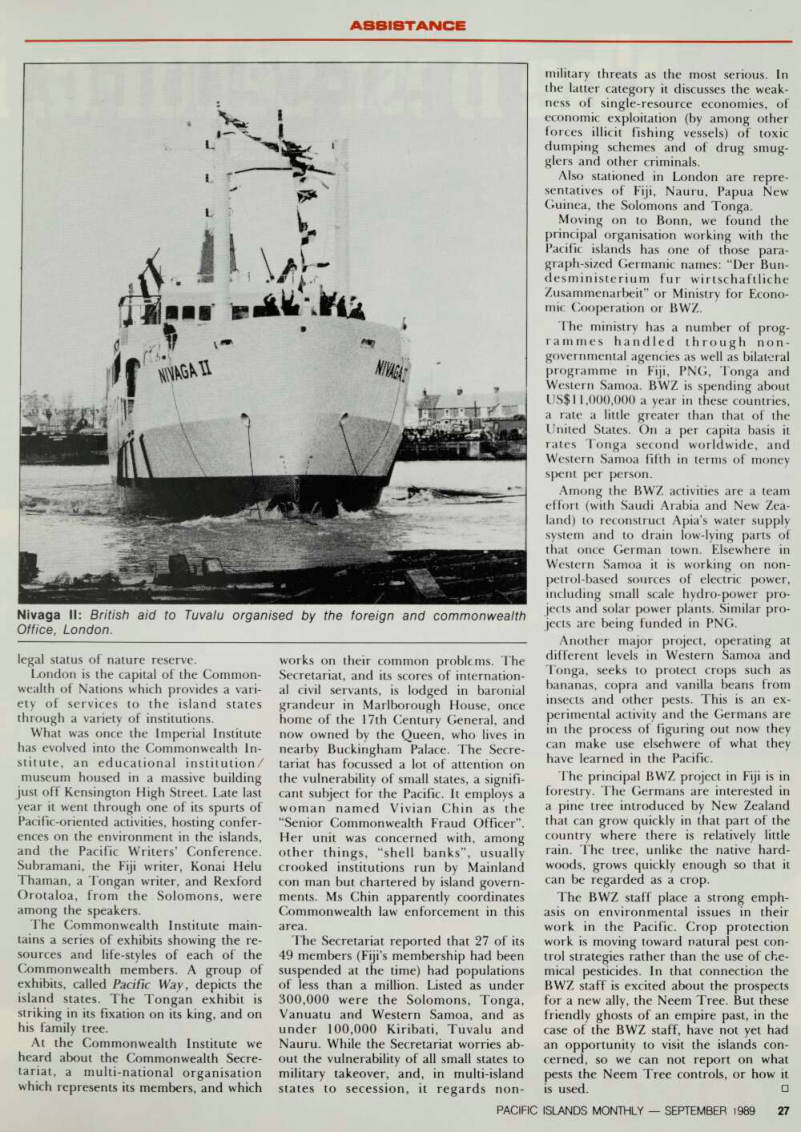
Managing the aid is the Overseas De velopment Administration, which has provided tangible goods as well as tech nical assistance, such as a tuna fishing boat for Kiribati, the inter-island ferry Nivaga II for Tuvalu, and a water-main leak detections system for the Solomons.
The most interesting decision about British assistance to the South Pacific came in the wake of the coups in Fiji.
Although the country’s military lead
ership tossed aside a British-written con stitution, and caused the nation to leave the Commonwealth, the Brits turned the other cheek. Instead of decreasing assist ance because of these events, it increased it and made special efforts to bring addi tional health resources to Fiji to make up for the departure of some physicians of Indian descent.
Britain’s one remaining colony in the Pacific presents no political problems, only logistical ones. The Governor of Pit cairn Island, whose principal job is that of UK High Commissioner to New Zea land, has recently made two vain efforts to visit his domain, only to be driven away by storms. There were also sub stantial problems in getting construction equipment to the island in connection with the British-funded reconstruction of the island’s jetty (there is no natural har bour).
Another bit of assistance to the island must have been a fascinating challenge to someone; it was a survey of land own ership on the island. The population of the island is so small that most people have only given names, which must com plicate recordkeeping. On a more endur ing note, the Foreign and Common wealth Office is weighing the future of Henderson Island, the never-populated,
lushly-forested dependency of Pitcairn’s.
The World Heritage Committee has re commended that Henderson be- given
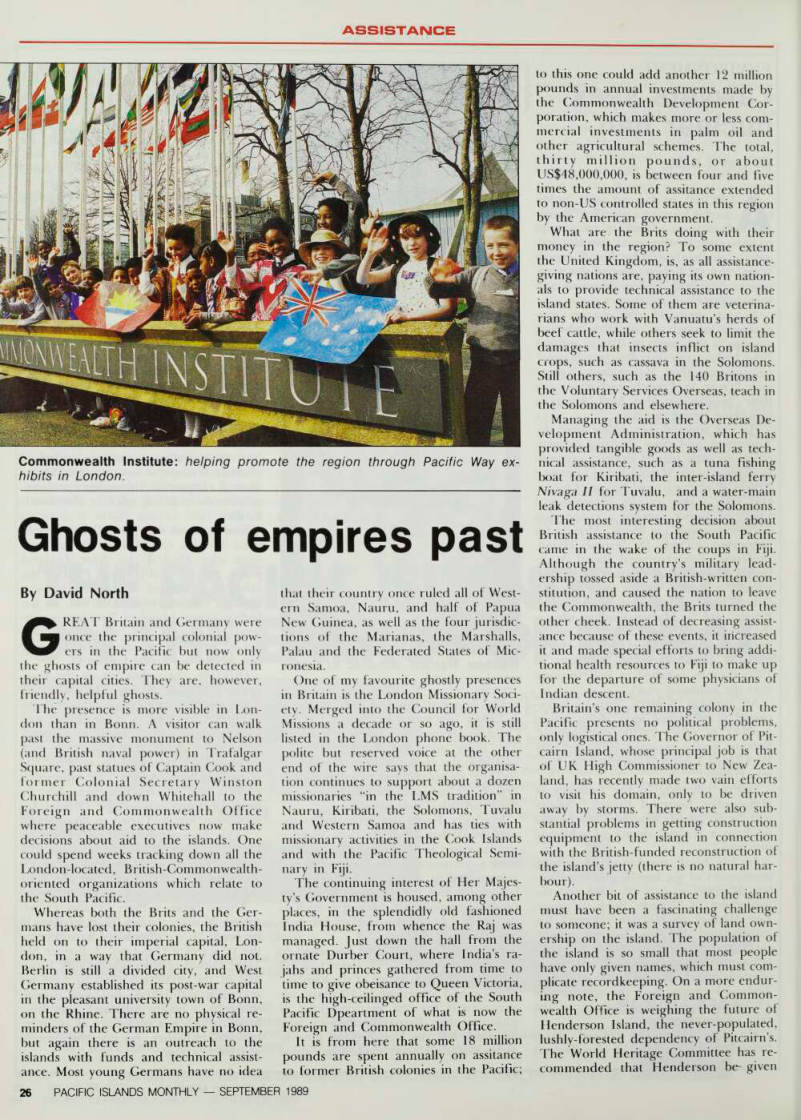
Commonwealth Institute: helping promote the region through Pacific Way ex hibits in London.
legal status of nature reserve.
London is the capital of the Commonwealth of Nations which provides a variety of services to the island states through a variety of institutions.
What was once the Imperial Institute has evolved into the Commonwealth Institute, an educational institution/ museum housed in a massive building just off Kensington High Street. Late last year it went through one of its spurts of Pacific-oriented activities, hosting conferences on the environment in the islands, and the Pacific Writers’ Conference, Subramani, the Fiji writer, Konai Helu Thaman, a Tongan writer, and Rexford Orotaloa, from the Solomons, were among the speakers.
The Commonwealth Institute maintains a series of exhibits showing the resources and life-styles of each of the Commonwealth members. A group of exhibits, called Pacific Way, depicts the island states. The Tongan exhibit is striking in its fixation on its king, and on his family tree.
At the Commonwealth Institute we heard about the Commonwealth Secretariat, a multi-national organisation which represents its members, and which
works on their common problems. The Secretariat, and its scores of internation al civil servants, is lodged in baronial grandeur in Marlborough House, once home of the 17th Century General, and now owned by the Queen, who lives in nearby Buckingham Palace. The Secre tariat has focussed a lot of attention on the vulnerability of small states, a signifi cant subject for the Pacific. It employs a woman named Vivian Chin as the “Senior Commonwealth Fraud Officer”.
Her unit was concerned with, among other things, “shell banks”, usually crooked institutions run by Mainland con man but chartered by island govern ments. Ms Chin apparently coordinates Commonwealth law enforcement in this area.
The Secretariat reported that 27 of its 49 members (Fiji’s membership had been suspended at the time) had populations of less than a million. Listed as under 300,000 were the Solomons, Tonga, Vanuatu and Western Samoa, and as under 100,000 Kiribati, Tuvalu and Nauru. While the Secretariat worries ab out the vulnerability of all small states to military takeover, and, in multi-island states to secession, it regards non
military threats as the most serious. In the latter category it discusses the weak ness of single-resource economies, of economic exploitation (by among other forces illicit fishing vessels) of toxic dumping schemes and of drug smug glers and other criminals.
Also stationed in London are repre sentatives of Fiji, Nauru, Papua New Guinea, the Solomons and Tonga.
Moving on to Bonn, we found the
principal organisation working with the
Pacific islands has one of those para graph-sized Germanic names; “Der Bun desministerium fur wirtschaftliche Zusammenarbeit” or Ministry for Econo mic Cooperation or BWZ.
The ministry has a number of prog rammes handled through non governmental agencies as well as bilateral programme in Fiji, PNG, Tonga and Western Samoa. BWZ is spending about US$ll,OOO,OOO a year in these countries, a rate a little greater than that of the United States. On a per capita basis it rates Tonga second worldwide, and Western Samoa fifth in terms of money spent per person.
Among the BWZ activities are a team effort (with Saudi Arabia and New Zea land) to reconstruct Apia’s water supply system and to drain low-lying parts of that once German town. Elsewhere in Western Samoa it is working on non petrol-based sources of electric power, including small scale hydro-power pro jects and solar power plants. Similar pro jects are being funded in PNG.
Another major project, operating at
different levels in Western Samoa and Tonga, seeks to protect crops such as bananas, copra and vanilla beans from insects and other pests. This is an ex perimental activity and the Germans are in the process of figuring out now they can make use elsehwere of what they have learned in the Pacific.
The principal BWZ project in Fiji is in forestry. The Germans are interested in a pine tree introduced by New Zealand that can grow quickly in that part of the country where there is relatively little rain. The tree, unlike the native hard woods, grows quickly enough so that it can be regarded as a crop.
The BWZ staff place a strong emph asis on environmental issues in their work in the Pacific. Crop protection work is moving toward natural pest con trol strategies rather than the use of che mical pesticides. In that connection the BWZ staff is excited about the prospects for a new ally, the Neem Tree. But these friendly ghosts of an empire past, in the case of the BWZ staff, have not yet had an opportunity to visit the islands con cerned, so we can not report on what pests the Neem Tree controls, or how it is used. □
Nivaga II: British aid to Tuvalu organised by the foreign and commonwealth Office, London.