Lawyers seek
p. 25 · Read in the full issue
Environment
Lawyers seek nuclear ban
By David Robie
A GROUP of lawyers and politi cians is forming a so-called “Pacific Committee of 100” in an attempt to have nuclear weapons outlawed, parti cularly in the South Pacific, A piped ream? Not so, believes one of the orga nisers, Auckland author, barrister and former psychic Colin Amery.
A bete noir of the Lange gov ernment through an ill-fated maverick attempt in the courts in 1986 to prevent New Zealand releasing Rainbow Warrior conspirators Alain Mafart and Domini que Prieur to French authorities for their “holiday” on Hao Atoll, Amery is mustering strong support.
He was spurred into action after the Australian and New Zealand govern ments recently turned down a proposal by former judge Harold Evans to invoke Article 96 of the United Nations Charter and take a case to the International Court of Justice seeking a ruling that nuclear weapons are illegal. Already his supporters include Dr Jerome Elkind, professor of international law at Auck land University; law lecturer Klaus Bos selman, a founder of the West German Green Party; Tasmanian MP Dr Bob Brown, and Dr Martyn Findley, who as the then New Zealand Attorney-General put France in the dock at the Hague over its atmospheric nuclear tests in 1973 (France switched to underground tests the following year).
An eminent Western Samoan is ex pected to be named soon, along with a number of other Pacific personalities.
Support is also expected from the New York-based Lawyers Committee on Nuc lear Policy.
“We’re following in the footsteps of philosopher Bertrand Russell,” Amery told Pacific Islands Monthly. “We believe we have a realistic chance of achieving
our goal.”
In his book marking the fourth anniversary of the bombing of the Rain bow Warrior on July 10, 1985 and the promotion of Captain Prier to major, Ten Minutes to Midnight, Amery has embarrassed the New Zealand govern ment over his accusations of Secret In telligence Service collusion with other Western secret services to prevent New Zealand knowing about the operation of 13 French spies in the country at the time of the sabotage.
He also claims the United States helped block the efforts by New Zealand
police to arrest three of the agents including two actual bombers in the Coral Sea before they reached Noumea.
The three men and the yacht Ouvea vanished; the yacht was probably scuttled and the agents plucked to safety by the French nuclear submarine Rubis and spi rited through Tahiti to safety.
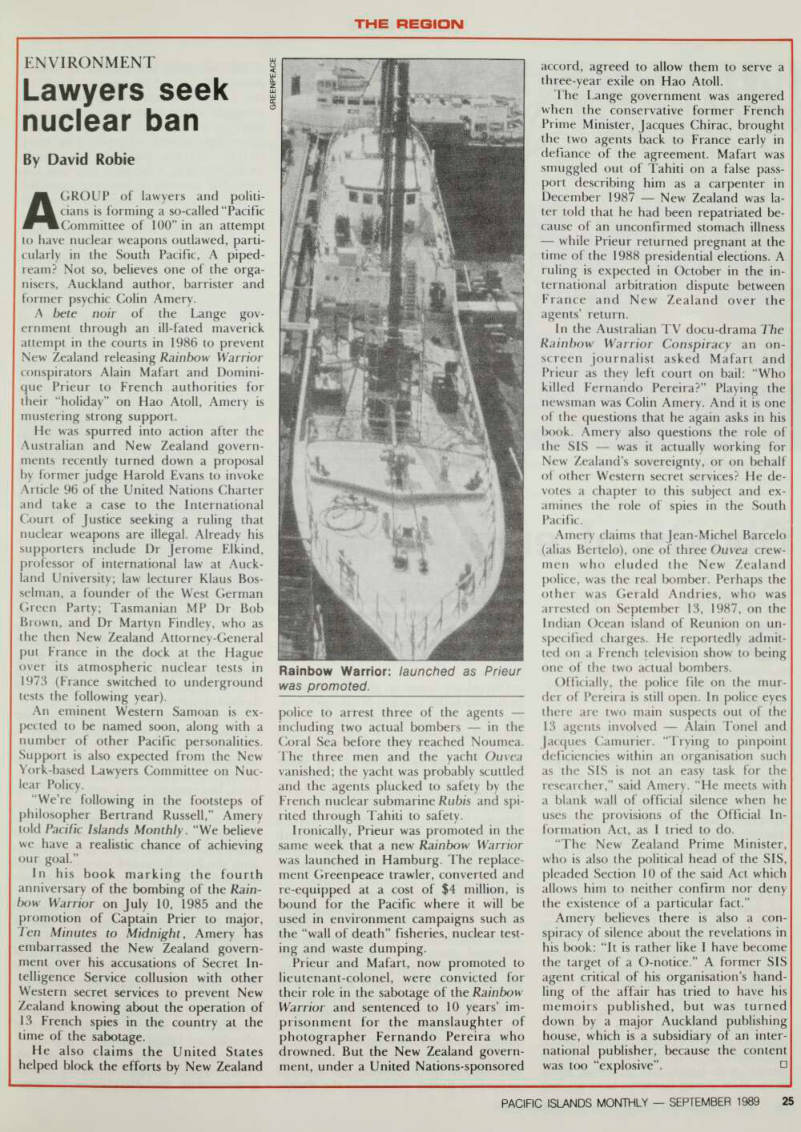
Ironically, Prieur was promoted in the same week that a new Rainbow Warrior was launched in Hamburg. The replace ment Greenpeace trawler, converted and re-equipped at a cost of $4 million, is bound for the Pacific where it will be used in environment campaigns such as the “wall of death” fisheries, nuclear test
ing and waste dumping.
Prieur and Mafart, now promoted to lieutenant-colonel, were convicted for their role in the sabotage of the Rainbow Warrior and sentenced to 10 years’ im prisonment for the manslaughter of photographer Fernando Pereira who drowned. But the New Zealand govern ment, under a United Nations-sponsored
accord, agreed to allow them to serve a three-year exile on Hao Atoll.
The Lange government was angered when the conservative former French Prime Minister, Jacques Chirac, brought the two agents back to France early in defiance of the agreement. Mafart was smuggled out of Tahiti on a false pass port describing him as a carpenter in December 1987 New Zealand was la ter told that he had been repatriated be cause of an unconfirmed stomach illness while Prieur returned pregnant at the time of the 1988 presidential elections. A ruling is expected in October in the in ternational arbitration dispute between France and New Zealand over the agents’ return.
In the Australian TV docu-drama The Rainbow Warrior Conspiracy an on screen journalist asked Mafart and Prieur as they left court on bail: “Who killed Fernando Pereira?” Playing the newsman was Colin Amery. And it is one of the questions that he again asks in his book. Amery also questions the role of the SIS was it actually working for New Zealand’s sovereignty, or on behalf of other Western secret services? He de votes a chapter to this subject and ex amines the role of spies in the South Pacific.
Amery claims that Jean-Michel Barcelo (alias Bertelo), one of three Ouvea crew men who eluded the New Zealand police, was the real bomber. Perhaps the other was Gerald Andries, who was arrested on September 13, 1987, on the Indian Ocean island of Reunion on un
specified charges. He reportedly admit
ted on a French television show to being one of the two actual bombers.
Officially, the police file on the mur der of Pereira is still open. In police eyes there are two main suspects out of the 13 agents involved Alain Tonel and Jacques Camurier. “Trying to pinpoint deficiencies within an organisation such as the SIS is not an easy task for the researcher,” said Amery. “He meets with a blank wall of official silence when he uses the provisions of the Official In formation Act, as I tried to do.
“The New Zealand Prime Minister, who is also the political head of the SIS, pleaded Section 10 of the said Act which allows him to neither confirm nor deny the existence of a particular fact.”
Amery believes there is also a con spiracy of silence about the revelations in his book: “It is rather like I have become the target of a O-notice.” A former SIS agent critical of his organisation’s hand ling of the affair has tried to have his memoirs published, but was turned
down by a major Auckland publishing
house, which is a subsidiary of an inter national publisher, because the content was too “explosive”. □
Rainbow Warrior: launched as Prieur was promoted.