Sunday
pp. 16-17 · Read in the full issue
tug-of-war
FOR nearly eight months the
Methodist Church of Fiji was being rocked by a dispute over the sanctity of the Sunday. On one side stood the church President, Rev Josateki Koroi, and a handful of moderates who saw the Sunday as being made for man and not vice versa. On the other stood the church general secretary, Rev Man asa Lasaro, and most of the 75 per cent
of the indigenous Fijian population who
are Methodists. They want to keep the Sunday holy and free of the encumber ances of trading and work, much to the indignation of the Indian population who would rather work on their farm.
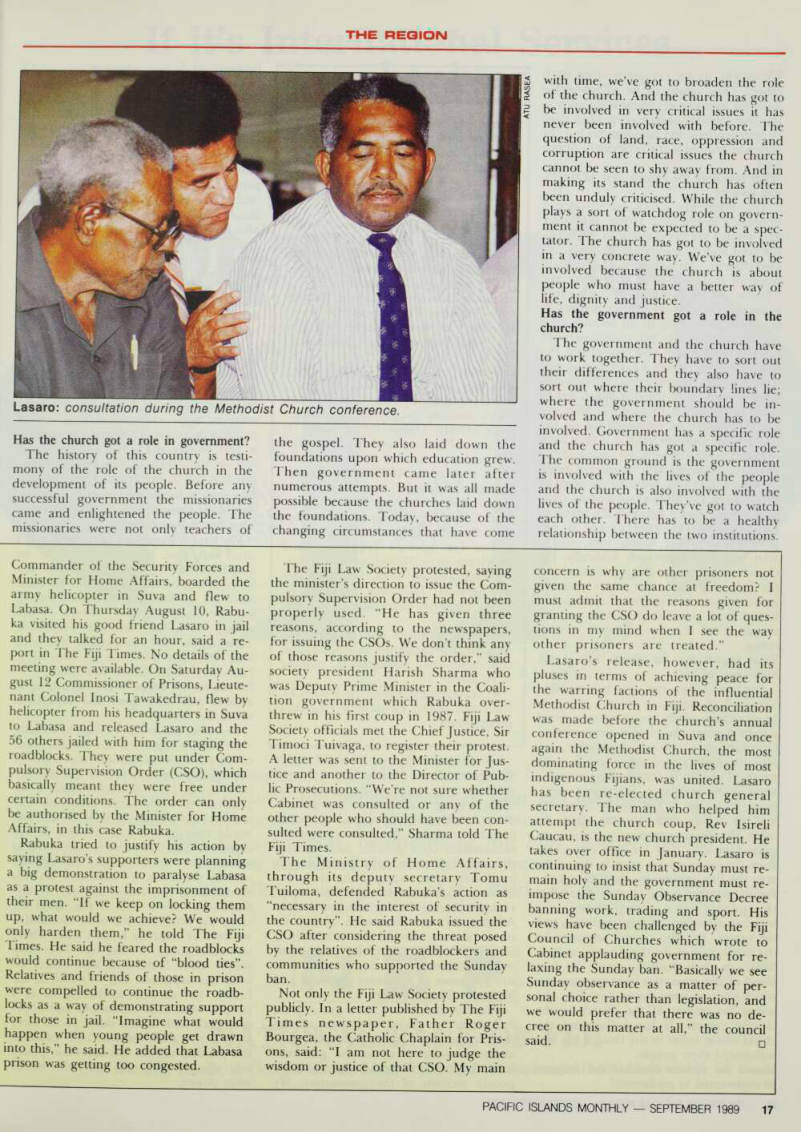
For all of those eight months Lasaro stood up for his belief as a fundamental ist Methodist to protect the holiness of the Sunday. He organised roadblocks in Suva, staged a religious coup which tried to overthrow Koroi, and defied a sup reme court judgement which ruled his coup illegal. For the interim govern ment, trying to show the world poli tical problems were under wrap and the economy was blooming, Lasaro was a pain in the neck. Having being one of the strongest supporters of the military coups of 1987, many thought his bold
ness stemmed from his very close friendship with coup leader Major- General Sitiveni Rabuka. He was un stoppable. By a series of quick political manouevres, which included moving his protest base home to Labasa, on the second largest island of Vanua Levu Lasaro slowly won the upper hand.
Koroi and his handful of moderates were isolated. Lasaro, although having lost the attempt to overthrow the legiti mate church leadership, became the glorified liberator of the mostly rural based Methodist Church.
The Methodist Church in Fiji was split. On one hand stood the die-hard fundamentalists, mostly uneducated from the rural areas. On the other stood Koroi and a handful of backers whose moderate views were welcomed by the non-Methodists who believed that to work, to play and to trade on Sunday was a basic human right. Then it hap pened. Lasaro organised a roadblock in Labasa and Chief Magistrate Apaitia Seru put him in jail for six months. By the first week of August Lasaro and 56 of his supporters were in jail in Labasa for unlawful obstruction. Some said it was “God’s will” that Lasaro was in jail, safely out of the way at a time when the church was preparing for its annual con ference in which all major decisions were made. They were wrong.
On Wednesday August 9, Rabuka,
Commander ol the Security Forces and Minister for Home Affairs, boarded the army helicopter in Suva and flew to Labasa. On Thursday August 10, Rabu ka visited his good friend Lasaro in jail and they talked for an hour, said a re port in The Fiji Times. No details of the meeting were available. On Saturday Au gust 12 Commissioner of Prisons, Lieute nant Colonel Inosi Tawakedrau, flew by helicopter from his headquarters in Suva to Labasa and released Lasaro and the 56 others jailed with him for staging the roadblocks. They were put under Com pulsory Supervision Order (CSO), which basically meant they were free under certain conditions. The order can only be authorised by the Minister for Home Affairs, in this case Rabuka.
Rabuka tried to justify his action by saying Lasaro’s supporters were planning a big demonstration to paralyse Labasa as a protest against the imprisonment of their men. “If we keep on locking them up, what would we achieve? We would only harden them,” he told The Fiji Times. He said he feared the roadblocks would continue because of “blood ties”.
Relatives and friends of those in prison were compelled to continue the roadb locks as a way of demonstrating support for those in jail. “Imagine what would happen when young people get drawn into this,” he said. He added that Labasa prison was getting too congested.
The Fiji Law Society protested, saying the minister’s direction to issue the Com pulsory Supervision Order had not been properly used. “He has given three reasons, according to the newspapers, for issuing the CSOs. We don’t think any of those reasons justify the order,” said society president Harish Sharma who was Deputy Prime Minister in the Coali tion government which Rabuka over threw in his first coup in 1987. Fiji Law Society officials met the Chief Justice, Sir Timoci Tuivaga, to register their protest.
A letter was sent to the Minister for Jus tice and another to the Director of Pub lic Prosecutions. “We’re not sure whether Cabinet was consulted or any of the other people who should have been con sulted were consulted,” Sharma told The
Fiji Times.
The Ministry of Home Affairs, through its deputy secretary Tomu Tuiloma, defended Rabuka’s action as “necessary in the interest of security in the country”. He said Rabuka issued the CSO after considering the threat posed by the relatives of the roadblockers and communities who supported the Sunday ban.
Not only the Fiji Law Society protested publicly. In a letter published by The Fiji Times newspaper, Father Roger Bourgea, the Catholic Chaplain for Pris ons, said: “I am not here to judge the wisdom or justice of that CSO. My main
concern is why are other prisoners not given the same chance at freedom? I must admit that the reasons given for granting the CSO do leave a lot of ques tions in my mind when I see the way other prisoners are treated.”
Lasaro’s release, however, had its pluses in terms of achieving peace for the warring factions of the influential Methodist Church in Fiji. Reconciliation was made before the church’s annual conference opened in Suva and once again the Methodist Church, the most dominating force in the lives of most indigenous Fijians, was united. Lasaro has been re-elected church general secretary. The man who helped him attempt the church coup, Rev Isireli Caucau, is the new church president. He takes over office in January. Lasaro is continuing to insist that Sunday must re main holy and the government must re impose the Sunday Observance Decree banning work, trading and sport. His views have been challenged by the Fiji Council of Churches which wrote to Cabinet applauding government for re laxing the Sunday ban. “Basically we see Sunday observance as a matter of per sonal choice rather than legislation, and we would prefer that there was no de cree on this matter at all,” the council said. □