The church and I
pp. 16-18 · Read in the full issue
Fiji
For most of this year Rev Manasa Lasaro was the biggest threat in Fiji as the interim government steered the country back to political and economic stability. A fundamentalist Methodist Church general secretary, he stood up against the government and challenged its wisdom to relax the Sunday Observance Decree, and allow agricultural work and leisure sport. Lasaro chose the roads as his battlegrounds, blocking them on Sundays and disrupting traffic and other services. To some Lasaro was a trouble-maker. To others he was an idealist fighting for his faith.
What really drives this man? Jope Balawanilotu had an exclusive interview with Lasaro in Suva:
What events led to the division in the Methodist Church in Fiji?
The issues and events involving the church now are part of the national crisis that we’ve been facing over the past two years. The crisis has got to do with Fi jians as a people who are trying to keep their own identity, who are trying to see what their future is in their own country.
And when you’re talking about the Fijian
people you’re really talking about the
Methodist Church. The personalities who are involved are the grassroots on the one hand and the well to do Fijians on the other hand.
Why is a strict observance of the Sunday important?
This has always been the stand of the Methodist Church in Fiji: Not a total ban on activities on Sunday but it has got to be observed with provision for essential services like hospitals and PWD (Public Works Department) controlled transport system to facilitate worship in the urban centres. Sunday has its additional special significance to Fijians and its observance helps Fijians maintain values which set them apart as a people. There are cer tain human values which we need to hold on to keep us sane and human. The Fijians look to the observance of Sunday as a means of maintaining these values.
People ought to be free to worship on Sunday and not being interfered with.
We’ve got instances where people are worshipping and in the next building people are on a building construction programme. In the rural areas, where some Fijians have moved away from their villages to settle on their farms, Sunday brings them back to their vil lages, to their communities, to their fami lies to worship together. So Sunday is very important to Fijians as a uniting in fluence. This is nothing new and the fight to observe Sunday is not new either. It has been going on for years.
And as long as Fijians want to observe
Sunday the way they have in the past they will continue to fight for it.
In ensuring that your faith and beliefs are respected and in view of the presence of others in Fiji who have other beliefs con trary to yours and your followers, is there a common ground for compromise?
The common ground through which we can exist together in this country is that we’re asking the other people of
other faith to respect us and to respect our faith. We’re not asking them to be lieve in what we believe, but to respect what we believe in the same way we re spect their holy days and the way they worship. And for us as Methodist Christ ians we ask them to observe Sunday and not to interfere with Sunday. Besides we’re asking for only one day in the week.
Has the church got a role in government?
The history of this country is testi mony of the role of the church in the development of its people. Before any successful government the missionaries came and enlightened the people. The missionaries were not only teachers of
the gospel. They also laid down the foundations upon which education grew.
Then government came later after numerous attempts. But it was all made possible because the churches laid down the foundations. Today, because of the changing circumstances that have come
with time, we’ve got to broaden the role of the church. And the church has got to be involved in very critical issues it has never been involved with before. The question of land, race, oppression and corruption are critical issues the church cannot be seen to shy away from. And in making its stand the church has often been unduly criticised. While the church plays a sort of watchdog role on govern ment it cannot be expected to be a spec tator. The church has got to be involved in a very concrete way. We’ve got to be involved because the church is about people who must have a better way of life, dignity and justice.
Has the government got a role in the church?
The government and the church have to work together. They have to sort out their differences and they also have to sort out where their boundary lines lie; where the government should be in volved and where the church has to be involved. Government has a specific role and the church has got a specific role.
The common ground is the government is involved with the lives of the people and the church is also involved with the lives of the people. They’ve got to watch each other. There has to be a healthy relationship between the two institutions.
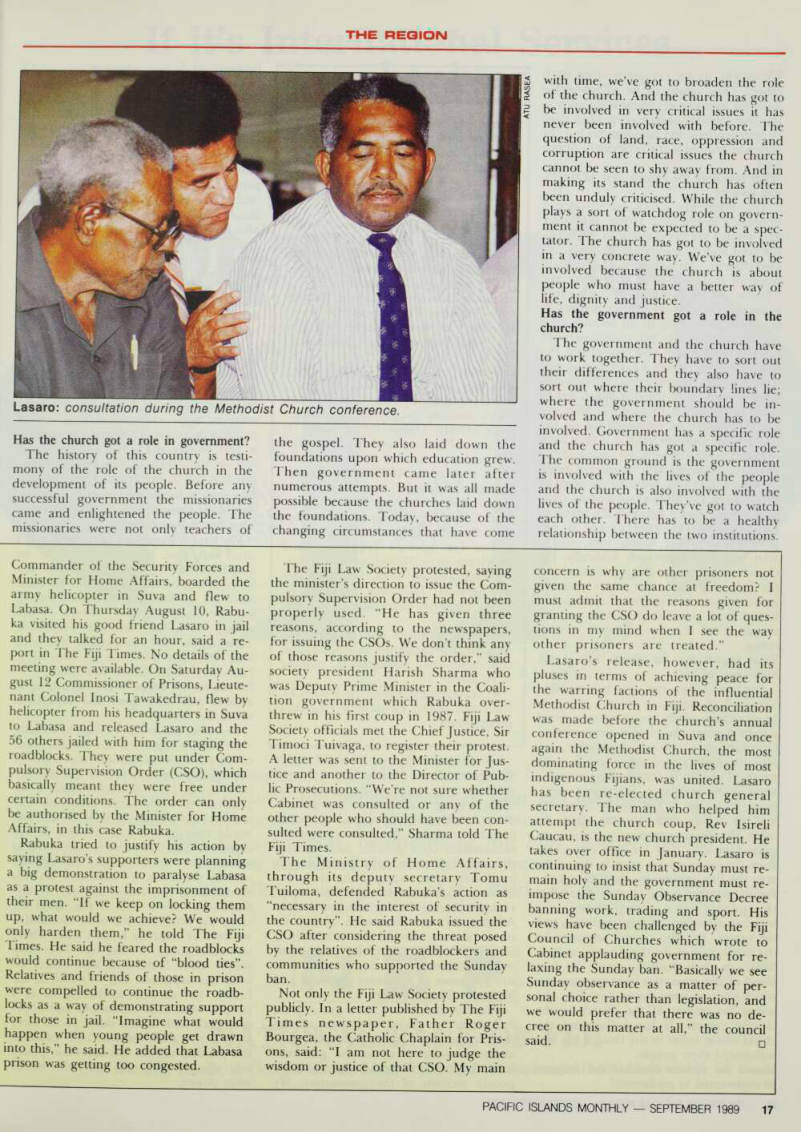
Lasaro: consultation during the Methodist Church conference.
Atu Rasea
We ought to be complementing each other. They ought to be afriad to be involved together in critical areas such as this one (Sunday observance). They must be independent and autonomous but the common ground is the betterment of our lives.
What role does the church play in the Fi jian society?
The Fijian life stands on three very important institutions. Firstly, the vanua and when I say the vanua it’s the people, the land and its traditions. Secondly, the government. And thirdly, the church.
None of these can work independently.
They’ve got to complement each other because their roles are complementary. It is not an easy thing to do because each institution has its own administrative machinery. Perhaps the vanua and the church have an easier job of liaising and working together whereas the govern ment is seen to be the one which has to come to the vanua or to the church. It’s a very peculiar set up which we do not see in other cultures yet it is a very heal thy machinery which we must draw strength from. Because there are times we will conflict and, sadly, to the point of antagonism. I’ve always said that we must maintain a balance between the three all the time. If the government is too powerful over the vanua well, you’ve seen what has happened. Biblically, the church ought to be the conscience and the light that guide the vanua and the government or the totality of society. But in the same way the church is not the overlord of the government or the vanua.
What impact has the church had in the Fijian way of life?
For most Fijians the church is our life.
You look at the Fijian villages, the only programmes which are continuous from day to day are the church programmes.
On Sunday we worship together, on
Monday most programmes are for the youth, Tuesday is for the women’s fel lowship, Wednesday is for prayer meet
ings, Thursday is for men’s fellowship
and on Friday and Saturday there are other church programmes going on. At grass root level they are well organised.
Even the newly set up areas in the urban area the first institution which brings the Fijians together is the church. After that the people then group themselves together according to their traditions and the vanua . But the church seems to be the binding force. So the church, or their belief, or their faith, is really the life blood of the grass root level communities which operate from day to day. You also notice the impact of the church in the chiefly system. It has influenced the chiefs whose belief in the church has also influenced their people.
Should the various churches and religions be represented in parliament?
Yes, I should think so. This will enable the voices of the various churches and religions to be heard at the top level de cision making machinery of our govern ment. I will not want these representa tives to be elected from the various de nominations on a political basis because that would tie them up in parliament or in cabinet. As an example, the Methodist Church might want to elect their repre sentative during their annual conference.
Additionally, the population of the de nominations should be taken into account in determining the number of
representatives.
Are you aware of the power you wield as a Methodist Church leader?
I understand that I have got a great influence over many members of the church and that’s simply because I have always been involved at the grassroot level, the most underpriviledged and the poorer sections of the community. My
background is one where I was raised from a very poor family. I have always been involved with the squatters, the un attached young people, ex-prisoners, the youth it has been my life. That is my calling and that it is my commitment. We had that fight with the government some years back over the resettlement of some people in Raiwaqa, Raiwai and the most recent case at the Jittu Estate. My stand has to do a lot with my background and also my training, and the nature of my work in the church. Although I’m the general secretary of the church, I do not see myself as a pen pusher behind a desk. I see myself as a catalyst, initiator, adviser and counsellor.
Do you believe in the Fijian chiefly system and its leadership?
Yes, I do believe in the chiefly system very very strongly. And I do believe in their role as traditional leaders of Fiji. At the same time I’m always critical about how the traditional leadership has been used in many cases in making critical
political decisions. Traditional leadership
is here to stay and it has a very specific role in the fabric of the Fijian society.
But it is not to be exploited and abused.
You seem to have a hold on army comman der Major-General Sitiveni Rabuka. How have you managed this?
We have always been very close and I don’t deny that. We argue, we fight, we also have our own battles to fight. But we’ve always been good friends. He came after me to Bucalevu Provincial School and he entered Queen Victoria School while I was at Ratu Kadavulevu School in Tailevu. So our relationship has been long standing and one of very close friendship and I cannot hide that.
Do you see his coups in 1987 as helping to achieve your own goals and aspirations within the church?
Yes, I see his military coups as helping some of my objectives but not all. Some of the goals, the aspirations and hopes of the Fijians were achieved by that particu lar event in 1987. But others have to be achieved through other processes. For me that was a clear-cut intervention that would have helped achieve some of our objectives but others we would have to
achieve quite democratically through the
normal processes. To elaborate on this more, what the coup did was to say: Stop, let’s have a look at this again be cause the whole life was a rat race and if we were to continue I don’t know where we were going to end up. The coup simply said: Stop, and let’s reflect on what has happened and let’s look to the future. Let us look at the Fijians as a
people, what their aspirations and hopes
are. Let’s look at the other races. Let’s look at the achievements. Let’s examine the political power, the economic power and who controls who and who wields what power.