Cornered by hunger strike
pp. 26-27 · Read in the full issue
French Polynesia
By Al Prince
THE first hunger strike to protest French nuclear tests in French Polynesia has produced a victory of sorts. That victory was a promise on July 7 by Territorial Government Presi dent Alexandre Leontieff to request a special session of the Territorial Assem bly starting August 17 to discuss the French nuclear tests, among other potentially explosive subjects (see box).
President Leontieff has yet to explain publicly why he promised the leaders of the hunger strike that he would convene the Territorial Assembly to debate the nuclear tests for the first time. However, there are at least three possible explana tions for that promise. First, the hunger strike was making almost daily headlines in the local French press, which may have been politically embarrassing to President Leontieff and his majority coalition government. The hunger strike may have been particularly embarrassing in view of the majority coalition’s recent refusal to approve a motion by its only
independence political party member
la Mana Te Nunaa that called for a Territorial Assembly debate on three aspects of the nuclear tests.
Second, with increasing demands from majority coalition as well as opposition political party leaders for a public de bate, as well as a public polling of voters on the nuclear tests, Leontieff may have concluded that the issue could not be postponed any longer without risking more protests against the nuclear tests.
Finally, Leontieff may have concluded that to continue postponing a public de bate would have only risked exposing his majority coalition to increasing political attacks from opposition party leaders.
Regardless of Leontieffs motives for promising the Territorial Assembly de bate, the nuclear testing issue has clearly been revived during the past month, making regular headlines in the local press. And the leaders of the hunger strike cleverly took advantage of every possible occasion to further their cause.
On July 4, a delegation of 15 persons out of the some 30 conducting the hun ger strike marched to the offices of French High Commissioner Jean Mont pezat and then to the Territorial Assem bly building nearby. At the High Com missioner’s office, the delegation de posed two letters, one addressed to Montpezat, the other addressed to French President Francois Mitterrand.
Both letters were accepted by an official
on behalf of the
High Commis
sioner’s secret ary-general, who was re ported busy.
The letter to Mitterrand asked the French Presi dent to approve the hunger strikers’ request for a democratic popular vote in Tahiti on whether the nuclear tests should continue or stop.
The letter noted that since the begin ning of the tests in 1966, the Maohi (the ancient name for Tahitian) people have never been consulted. However, the let ter did not note that the Territorial Assembly’s Permanent Commission, which meets behind closed doors when the assembly is not in regular session twice a year, approved the French nuc lear testing programme in 1964, two years before the tests began. The letter claimed that nearly all of Tahiti’s politic al, religious and union leaders have re peatedly called for a halt to the nuclear tests. Although the same claim was made in the letter to the High Commissioner, the public record would indicate this to be a slight exaggeration. Such a demand by “several” political, religious and union leaders would appear to be more correct than the hunger strikers’ claim of “near ly all” (“/a quasi-totalite”) such leaders.
The nex day, July 5, the hunger strik ers presented a similar letter to Jean- Michel Boucheron, president of the visit ing Defense Commission of the French National Assembly. This letter called on Boucheron to inform the National Assembly in Paris of a demand in Tahiti for a halt in the French nuclear tests and for using the money previously spent on the tests to repair the alleged economic, ecological and health damage that the testing program has allegedly produced.
On the eve of the National Defense Commission’s July 7 return to Paris, Boucheron held one of the most incredi ble, if not stupefying, press conferences ever held in Tahiti by an elected French politician on the nuclear testing issue.
Judging from the reports by Tahiti’s
two French daily newspapers, Boucheron salt-and-peppered his answers with re marks that at times were overly simplis tic, naive, erroneous or arrogant to the point of being demeaning if not insult
ing. Both newspapers suggested by im
plication that if Boucheron represents the type of elected French politician who claims to be informed about what is going on in French Polynesia, Tahiti does not stand much of a chance of ever
La Depeche De Tahiti
La Depeche De Tahiti
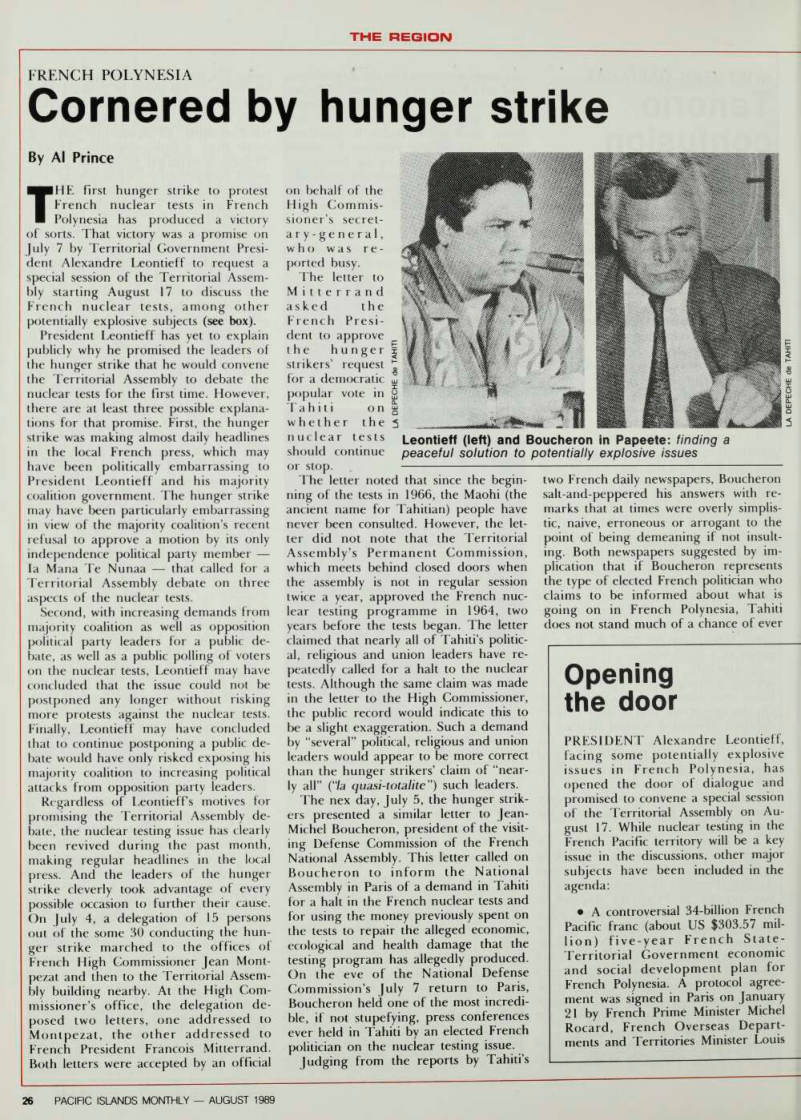
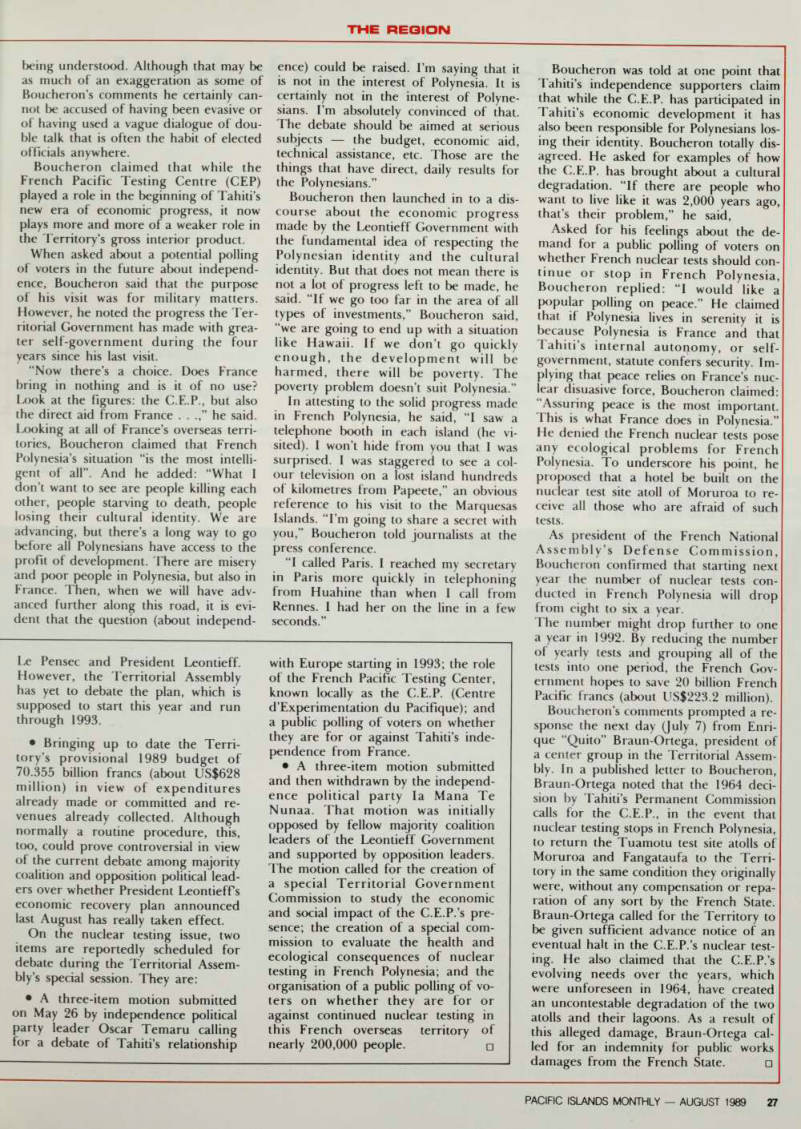
Leontieff (left) and Boucheron in Papeete: finding a peaceful solution to potentially explosive issues
being understood. Although that may be as much of an exaggeration as some of Boucheron’s comments he certainly can not be accused of having been evasive or of having used a vague dialogue of dou ble talk that is often the habit of elected
officials anywhere.
Boucheron claimed that while the French Pacific Testing Centre (CEP) played a role in the beginning of Tahiti’s new era of economic progress, it now plays more and more of a weaker role in the Territory’s gross interior product.
When asked about a potential polling of voters in the future about independ ence, Boucheron said that the purpose of his visit was for military matters.
However, he noted the progress the Ter ritorial Government has made with grea ter self-government during the four years since his last visit.
“Now there’s a choice. Does France bring in nothing and is it of no use?
Look at the figures: the C.E.P., but also the direct aid from France . . he said.
Looking at all of France’s overseas terri tories, Boucheron claimed that French Polynesia’s situation “is the most intelli gent of all”. And he added: “What I don’t want to see are people killing each
other, people starving to death, people
losing their cultural identity. We are advancing, but there’s a long way to go before all Polynesians have access to the
profit of development. There are misery
and poor people in Polynesia, but also in France. Then, when we will have adv anced further along this road, it is evi dent that the question (about independ
ence) could be raised. I’m saying that it is not in the interest of Polynesia. It is certainly not in the interest of Polyne sians. I’m absolutely convinced of that.
The debate should be aimed at serious subjects the budget, economic aid, technical assistance, etc. Those are the things that have direct, daily results for
the Polynesians.”
Boucheron then launched in to a dis course about the economic progress made by the Leontieff Government with the fundamental idea of respecting the Polynesian identity and the cultural identity. But that does not mean there is not a lot of progress left to be made, he said. “If we go too far in the area of all types of investments,” Boucheron said, “we are going to end up with a situation like Hawaii. If we don’t go quickly enough, the development will be harmed, there will be poverty. The poverty problem doesn’t suit Polynesia.”
In attesting to the solid progress made in French Polynesia, he said, “I saw a telephone booth in each island (he vi sited). I won’t hide from you that I was surprised. I was staggered to see a col our television on a lost island hundreds of kilometres from Papeete,” an obvious reference to his visit to the Marquesas Islands. “I’m going to share a secret with you,” Boucheron told journalists at the press conference.
“I called Paris. I reached my secretary in Paris more quickly in telephoning from Huahine than when I call from Rennes. I had her on the line in a few seconds.”
Boucheron was told at one point that Tahiti’s independence supporters claim that while the C.E.P. has participated in Tahiti’s economic development it has also been responsible for Polynesians los ing their identity. Boucheron totally dis agreed. He asked for examples of how the C.E.P. has brought about a cultural degradation. “If there are people who want to live like it was 2,000 years ago, that’s their problem,” he said, Asked for his feelings about the de mand for a public polling of voters on whether French nuclear tests should con tinue or stop in French Polynesia, Boucheron replied: “I would like a popular polling on peace.” He claimed that if Polynesia lives in serenity it is because Polynesia is France and that Tahiti’s internal autonomy, or self government, statute confers security. Im plying that peace relies on France’s nuc lear disuasive force, Boucheron claimed: “Assuring peace is the most important.
This is what France does in Polynesia.”
He denied the French nuclear tests pose any ecological problems for French Polynesia. To underscore his point, he proposed that a hotel be built on the nuclear test site atoll of Moruroa to re ceive all those who are afraid of such tests.
As president of the French National Assembly’s Defense Commission, Boucheron confirmed that starting next year the number of nuclear tests con ducted in French Polynesia will drop from eight to six a year.
The number might drop further to one a year in 1992. By reducing the number of yearly tests and grouping all of the tests into one period, the French Gov ernment hopes to save 20 billion French Pacific francs (about U 55223.2 million).
Boucheron’s comments prompted a re sponse the next day (July 7) from Enri que “Quito” Braun-Ortega, president of a center group in the Territorial Assem bly. In a published letter to Boucheron, Braun-Ortega noted that the 1964 deci sion by Tahiti’s Permanent Commission calls for the C.E.P., in the event that nuclear testing stops in French Polynesia, to return the Tuamotu test site atolls of Moruroa and Fangataufa to the Terri tory in the same condition they originally were, without any compensation or repa ration of any sort by the French State.
Braun-Ortega called for the Territory to be given sufficient advance notice of an eventual halt in the C.E.P.’s nuclear test ing. He also claimed that the C.E.P.’s evolving needs over the years, which were unforeseen in 1964, have created an uncontestable degradation of the two atolls and their lagoons. As a result of this alleged damage, Braun-Ortega cal led for an indemnity for public works damages from the French State. □