Tenorio
p. 25 · Read in the full issue
Northern Marianas
Tenorio confusion
By David North
IT is pretty safe to predict that after the Marianas’ November elections the Governor will be Tenorio but the question remains, which Tenorio? Will it be Pedro P. Tenorio, the popular Re publican incumbent Governor who may, or may not, seek a third term. Or will it be Pedro P’s Lt. Governor, Pedro A.
Tenorio, who is seeking the Republican nomination? Or will it be Froilan Tenorio, currently the elected Resident Representative in Washington of the Commonwealth of the Northern Mariana Islands? Froilan has the Demo cratic nomination, and appears to be the front runner at the moment.
To complicate matters, there is a con stitutional question, something like the one that bedeviled the American Samoan gubernatorial race of a few years back.
After Pedro P. won his first four-year term as Governor in 1981 the Common wealth adopted a new constitution, which like the Mainland constitution, prohibits more than two consecutive terms for the Governor. But did the Marianas con stitution make an exception (as the main land one does) for the Governor in office at the time the new rule was
adopted? Lawyers disagree, and Gov
ernor Tenorio has not ruled out the pos sibility of a third term.
Meanwhile the Democrats have selected their candidate, and the Repub licans were slated to do so in late July.
On the Democratic side Froilan Tenorio defeated Territorial Senator Herman P.
Guerrero and Tony Guerrero in the primary, while the Republicans faced their own Tenorio-Guerrero conflict, with the Lt. Governor, Pedro A., favoured to win the nomination over Larry Guerrero, former president of the Territorial Senate.
But Tenorios and Guerreros are not always in conflict; take the relationship between Froilan Tenorio and Herman T. (for Tenorio) Guerrero. The latter has served as Froilan’s deputy in Washington for the last half dozen years, and secured, with his boss’ help, the Democratic nomination for the job as re sident representative. The two men are also first cousins. Herman T. Guerrero’s Republican opponent will be Juan N.
Babauta, a freshman Territorial Senator from Saipan, the most populous of the Mariana islands.
Also up for grabs this November will be six of the nine seats in the Senate,
currently dominated by the Republicans, and all 15 seats in the House of Repre sentatives, which currently has a Demo cratic majority. The speaker of that body, incidentally, Pedro R. Guerrero, brother to Senator Herman R., almost was not renominated by the Democratic Party for another term in the legislature, but the party’s central committee changed its mind and put him back on the ticket.
The members of the House of Repre sentatives serve two-year terms, while the other offices up for election have four year terms.
Unlike the political melting pot of Guam, where candidates of Chamorro, Haole, Filipino and Japanese extraction win island-wide selections, every Marianas islands candidate mentioned above is all or part Chamorro, most of whom bear names reminiscent of the more than two centuries of Spanish rule.
This reflects the voting population if not the work force of the Marianas.
Most of the foreign-born workforce in the Commonwealth have not become citizens, and the island government is not pressing for a change in that situa tion.
In addition to a handful of Haoles and other foreign-born, the principal non- Chamorro citizen population consists of Carolinians. Senator Herman R. Guer rero is part Carolinian and his current dissatisfaction with Froilan Tenorio may complicate the latter’s campaign in the Carolinian community. As in many is land elections, Mariana islands citizens living elsewhere, notably on Hawaii and in Southern California, will play an im portant role with their absentee ballots.
The substance of the November cam
paign has not yet taken shape, but two sets of issues will surely be debated. One is the state of the island’s infrastructure its roads, its water, sewage and elec trical systems, all apparently needing more than a little attention. Froilan Tenorio is expected to use his profes sional background he is one of few islanders to hold a mainland degree in civil engineering when he discusses
the subject.
He will be expected to say that with booming tourism and access to federal dollars the islands should have better utility systems, and to be critical of the incumbent Republicans on that score. He may also talk about “privatisation” of one or more of the utilities apparently the only Marianas utility in private hands is the telephone system, which has a repu tation of working reasonably well.
The Republican candidates, on the other hand, will try to focus island dis content with Washington on the island’s representative in Washington, Froilan Tenorio. As the island and the Mainland have worked through the details of the Commonwealth relationship, established in the Covenant, many in the Marianas have become unhappy with the new rela tionship. Some feel that the mainland dollars come with too many strings (like federal control of immigration policy and the Interior Department’s Inspector General auditing the books of island agencies.) And, privately, there are some who are not sure that the award of Un ited States citizenship to many of the re sidents was important enough to com pensate for the continuing rocky rela tions with Washington.
The Governor has an option of plac ing a referendum on the ballot this November asking for the islanders’ opin ions on whether the Covenant should be re-negotiated, but it is unlikely that such a referendum will appear this year.
One item that might be expected to be discussed probably will not be. That is the question of the role of the Resident
Representative in Washington. Those
playing that role for Guam and Amer ican Samoa, Ben Blaz and Eni F.H.
Faleomavaega, sit as delegates in the Un ited States House of Representatives, where they have votes in committee, and in party caucuses, but not on the Floor.
The US Government, not the island gov ernments, pay their salaries and office expenses.
The Marianas representative, at Com monwealth expense, plays a quasi ambassadorial role which some think gives the Commonwealth more inde pendence. None of the candidates appear to be in any rush to get closer to
Washington by seeking to place the
Marianas’ representative in the Congress of the United States. □
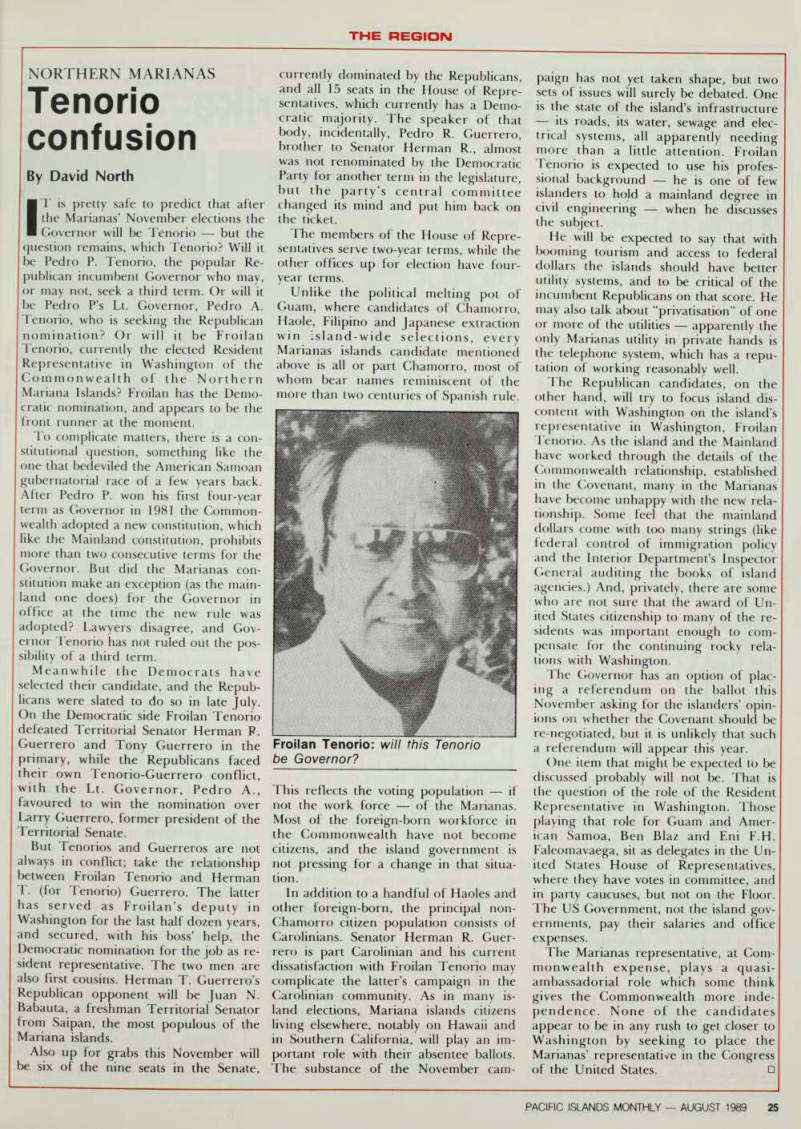
Froilan Tenorio: will this Tenorio be Governor?