Garments war enters new phase
pp. 32-35 · Read in the full issue
Business
ECONOMIC relations between Fiji
and New Zealand have entered a new phase with New Zealand manufacturers complaining they face un fair competition while Fiji is concerned new tax laws will negate some of the advantages of its tax-free zone system.
The issue of Fiji’s tax-free zones, and their effect on the New Zealand clothing industry, has been one which has roused strong feelings. Early in 1988 there were street marches in Christchurch as clo thing workers protested the loss of their jobs because of cheap imports from Fiji under the SPARFECA agreement. Since
then, not only have clothing companies
closed their doors but some of them have shifted their factories to Fiji. At the latest report, the Fiji Trade and Invest ment Board has already approved 40 proposals while another 30 companies
have applications pending; the majority
are in the clothing and textile industry.
I he investments so far approved but not begun are expected to total about SF3OO million, and included clothing, footwear and furniture manufacturers. An invest ment board spokesman has been re ported as saying that one New Zealand garment manufacturer plans to invest about SF6O million to set up 20 small factories.
The tax-free schemes provide for a
13-year tax holiday, no withholding tax
on interest and dividends paid abroad,
freedom to repatriate capital and profits,
and duty-free imports of equipment and
raw materials.
While Fiji has been singled out as the major cause of New Zealand factory clo sures, the government in Wellington has embarked on a programme of deregula tion which, over the next three years, will affect imports from all countries.
The latest factory to close is that of Lich field (NZ) Ltd, which has been making shirts since the time of World War I and is one of New Zealand’s most familiar brand names.
Lichfield is to close its factory in Christchurch and become solely an im porter of men’s clothing. Seventy-seven
people are to lose their jobs not many in a national picture, although garment industry labour figures due out in July are expected to reveal a substantial loss of jobs in the last year. In fact, Lichfield
managing director, John Rogers, cited
China not Fiji as typical of the competition faced by New Zealand fac tories. He quoted labour costs in Christ church of NZ$lO per hour inclusive of bonuses compared with labour costs in China amounting to NZ$3O a month. A recent letter in The Fiji Times claimed that rates in Fiji ranged from SF2O to $6O a week, with most workers in the range of $25-$3O a week, still a major edge on New Zealand labour costs.
Commenting on the fact that Fijian made garments were coming into New Zealand free of quota and duty, Rogers said he was sad to see long-serving em ployees made redundant but it was hard to see any alternative to the govern ment’s policy of deregulation. “The wider benefits to the economy resulting from the removal of trade protection, and the reduction in inflation resulting from lower clothing prices cannot be ignored,” he said. “While the Fiji situa tion is receiving a great deal of publicity at present, deregulation policy over the next three years will affect imports from all countries, not just Fiji.”
The president of the New Zealand Textile and Garment Manufacturers’
Federation, Chris Pickrill, told PaciTic Is lands Monthly that garment imports from Fiji were now running at the rate of SNZ3O million a year while Australia had imposed some restrictions on Fiji garments. He said the flood of imports had far exceeded the government’s ex pectations when it opened the door to clothing from Fiji. He said the New Zea land government had no regard for the New Zealand clothing industry, and the import flood had only exacerbated the effects of the depressed internal market which had resulted from New Zealand’s economic recession.
Pickrill said it was not too late to im pose a quantitative control on imports.
“We have no wish to impose difficulties on Fiji, but New Zealand could help Fiji develop in a more balanced way,” he said. His federation would keep lobbying the administration in Wellington for a
change.
The secretary of the Fiji Garment Manufacturers’ Association, Manharlal Hari, said Fiji still had only a small share of the New Zealand market, that the country’s trade liberalisation had benefit ted all clothing manufacturers exporting there regardless of country of origin. He added that 50 per cent of clothing con tent had to come in the form of raw materials from either Australia or New Zealand, and that much knitted fabric was being imported from New Zealand factories.
But there is no question that the gar ment industry has benefitted from in creased access to the New Zealand mar ket in the last two years, the Fiji industry’s workforce has grown from less than 5000 to more than 7000 people, although the devaluation of the Fiji dollar was a contributing factor to higher exports.
But the issue has now been compli cated by the New Zealand introduction of what it describes as the International Tax Regime which requires New Zea land residents to pay tax on income de rived from offshore investments. The Fi ji Ministry of Trade and Investment has warned the changes will effectively inhibit New Zealand investment in Fiji.
The Director of Trade and Commerce, Ratu Isoa Gavidi, said there would be discussions between the two taxation de partments to try and find an acceptable solution. They will be joined by the New Zealand-Fiji Business Council which will
make representations in Wellington.
Council president, Harold Titter, said the news could force a number of New Zealand firms to establish companies in Fiji independent of any New Zealand en tity and for the owners to live in Fiji.
“There are ways to get around a prob lem,” he said. □
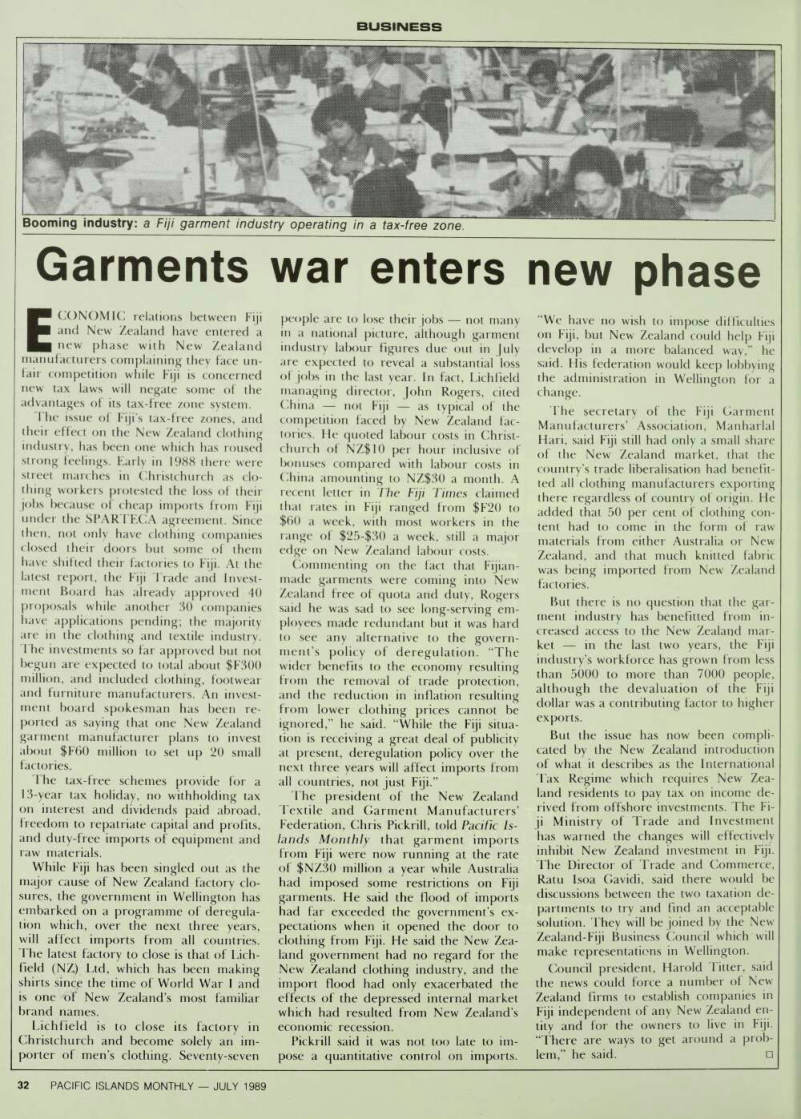
Booming industry: a Fiji garment industry operating in a tax-free zone.
Tourists make
some richer
WHILE both Western Samoa and Fiji have recently reported in creases in tourism earnings, a senior Cook Islands businessman has questioned the way his country is hand ling its visitor promotion and Vanuatu’s new promotion has been hurt by the de cision by Ansett to withdraw from that country. The continuing discussion of
tourism problems signifies the import
ance of the industry to the smaller island states.
It was the sharp increase in tourism, plus an increase in official transfers, which resulted in an overall balance of payments surplus in Western Samoa for 1988. The surplus totalled SWS3I.7 mil lion, up $6 million on the 1987 surplus.
I here was a rise in travel earnings of $12.9 million to $33 million, while offi cial transfers rose from $7.5 million to $43.2 million. Tourism and transfer in come helped overcome the merchandise deficit which widened further in 1988 by $20.1 million to $125.2 million.
In Fiji, tourism is estimated to have brought in $F 180.6 million last year, and provisional figures from the Bureau of Statistics show a 24 per cent increase over the 1987 earnings of $145.7 mil lion; after inflation, there was a real in crease of 10.8 per cent.
Total tourist arrivals in 1988 were 208,155, compared with 189,000 in 1987. An indication of the recovery in
Fiji’s tourist industry could be gleaned
from the comparative January figures
January 1988 having 40.9 per cent more visitor arrivals than the same month the previous year. Visitors from New Zea land during 1988 were up 37.6 per cent, from Australia 17.1 per cent, although Australia is still by far the major point of origin of tourists to Fiji.
Meanwhile, Cook Islands Chamber of
Commerce president, Hugh Henry, has
called for a reassessment of his nation’s policies in a recent article in the Cook Islands News. He says that, faced with a downturn, the Cook Islands should build on its strengths of being a peaceful,
friendly refuge from the concrete jung
les of the large nations. He said that while New Zealand provided 40 per cent of the country’s visitor business, the Cook Islands had been ignoring that im portant market in recent years.
Henry questioned the need for another international hotel on Raroton ga, arguing that the current Rarotongan Hotel, the Edgewater Resort and the once active Tamure could cater for that market. But the Cooks needed to main tain its strength which he sees as the motel-style accommodation which lets
visitors live among the people. “Most visitors are from the concrete jungles of the cities of the world. They find that our way of life and our quality of life is what they have lost,” he wrote.
When the Cook Islands entered the tourism race in 1967 it faced several ma jor development hurdles: no internation al airport, no international hotel, prob lems with water reticulation and power generation. All these had been over come. “As we reach the limitations of these infrastructural services, we face the same hurdles again,” said Henry. “The
only difference being they are twice
the cost.”
Vanuatu has launched a major adver tising and promotion campaign in Au stralia and will buy a Boeing 727 jet from Australian Airlines so that Air Vanuatu once again has an aircraft of its own, a purchase which enable the intro duction of direct Melbourne-Port Vila flights, followed by a service to Auck land. Ihe campaign launched coincided with the decision by Ansett to withdraw from the Sydney-Port Vila run because it
was insufficiently profitable. Vanuatu’s
response was that the new Melbourne service would replace the people lost due to Ansett’s withdrawal.
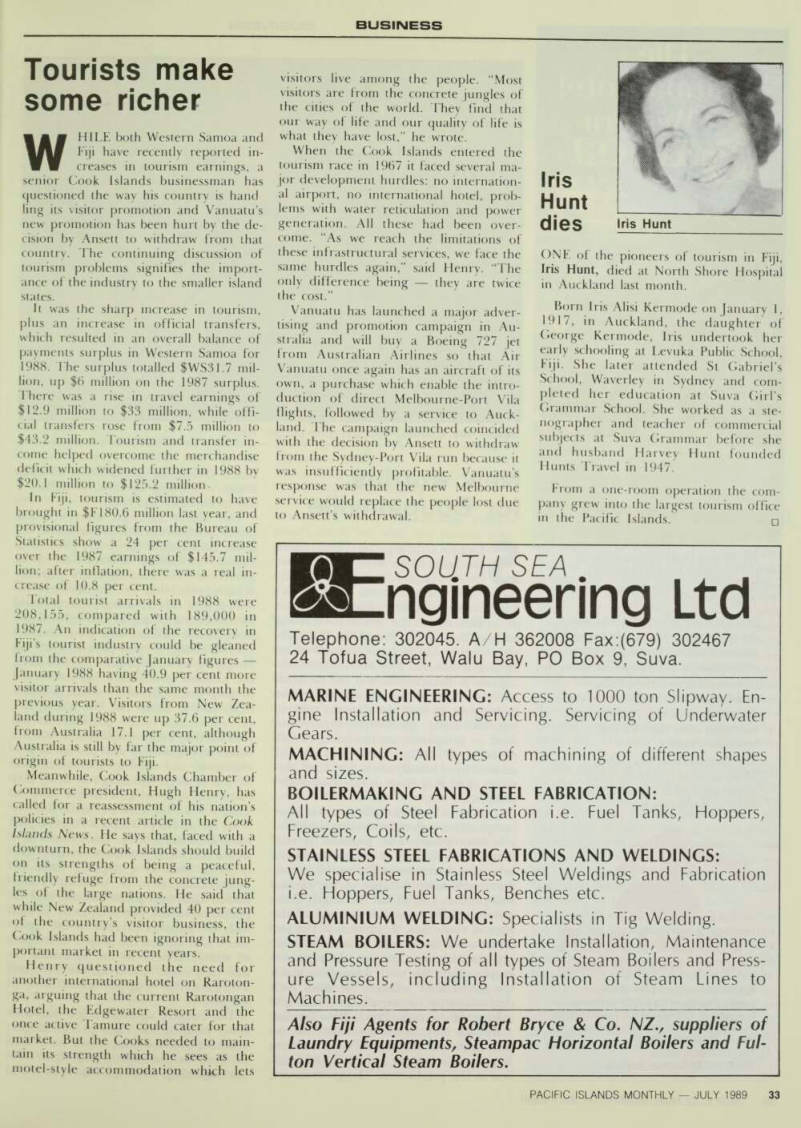
ONE of the pioneers of tourism in Fiji, Iris Hunt, died at North Shore Hospital in Auckland last month.
Bo™ Iris A,isi Kermode on January 1, ‘ ’ ln Auckland, the daughter of (,eor g e Kermode, Iris undertook her ar V schooling at Levuka Public School, ¥*•{*• l aler attended St Gabriel’s School Waverley in Sydney and com- J? etec her education at Suva Girl’s Grammar Sch °ol. She worked as a ste nograPher and teacher of commercial sub J ects at Su va Grammar before she and husband Harvey Hunt founded Hunts I ravel in 1947.
From a one-room operation the corn pany grew into the largest tourism office in the Pacific Islands. n
Iris Hunt dies
Iris Hunt
New worries
for Bougainville
SEVERAL prospecting companies
are believed to have scaled down their plans for exploration in Papua New Guinea in the wake of the Bougainville troubles. The appearance of headlines in the press forecasting multi-million dollar losses for Bougain ville Copper Ltd is having an effect on mining sentiment. The violence and dis ruption at Bougainville will not so much hamper mine projects which are either in progress or have the deposits proven, but will deter speculative exploration work companies are not going to sink millions of dollars into looking for minerals and oils if, when they find any thing, then they have to face landholder
problems.
Sources in Port Moresby say that some companies are already winding down ex
ploration plans. The problem is that
Papua New Guinea is one of the most expensive countries in the world to con duct exploration because of the terrain and climate, and all but the largest finds are marginally economic because of the costs of extraction. Regardless of the jus tification of landowner claims, the min ing corporations can see their profits evaporating. “We won’t know how much the landholders will ask for until each deal comes up for negotiation,” said one mining executive in Papua New Guinea.
By late May, it was estimated the re cent closure of the copper mine had cost Bougainville Copper Ltd (BCL) K 52 mil lion in lost production. The government,
too, is feeling the pinch the national treasury is losing about K 1.5 million a day in royalties and taxes.
The alarm amongst miners is not much at BCL’s current predicament, but at the implications for future projects in Papua New Guinea. Sources close to the government in Port Moresby privately acknowledge that the landholders in volved with other mining projects would increase their claims in the light of the Bougainville violence and the recent de cisions about royalty payments at the Porgera gold mine project. In both cases, the national government has intervened to help the landholders obtain a better deal, and it seems this will establish a precedent that future governments will find hard to break: landholders, when it comes to negotiating with provincial gov ernments and mining companies, will have a strategic advantage in being able to call on national government support.
That will up the stakes considerably.
As far as Placer Pacific’s Porgera gold mine is concerned, the landholders have won a real victory, and one which is like ly to be seen as a stepping stone for other claims. Even so, landowners asso ciation chairman Jolson Kutato said his
people were still not completely pleased
with the benefits covered in the agree ment, and warned the project developers to strictly adhere to the agreement so that they could “avoid the Ok Tedi and
Bougainville Copper situations in
Porgera”.
The Porgera agreement is a standard setter because the Enga provincial gov ernment and the landowners have been involved in the negotiations right from the beginning, although that itself led to
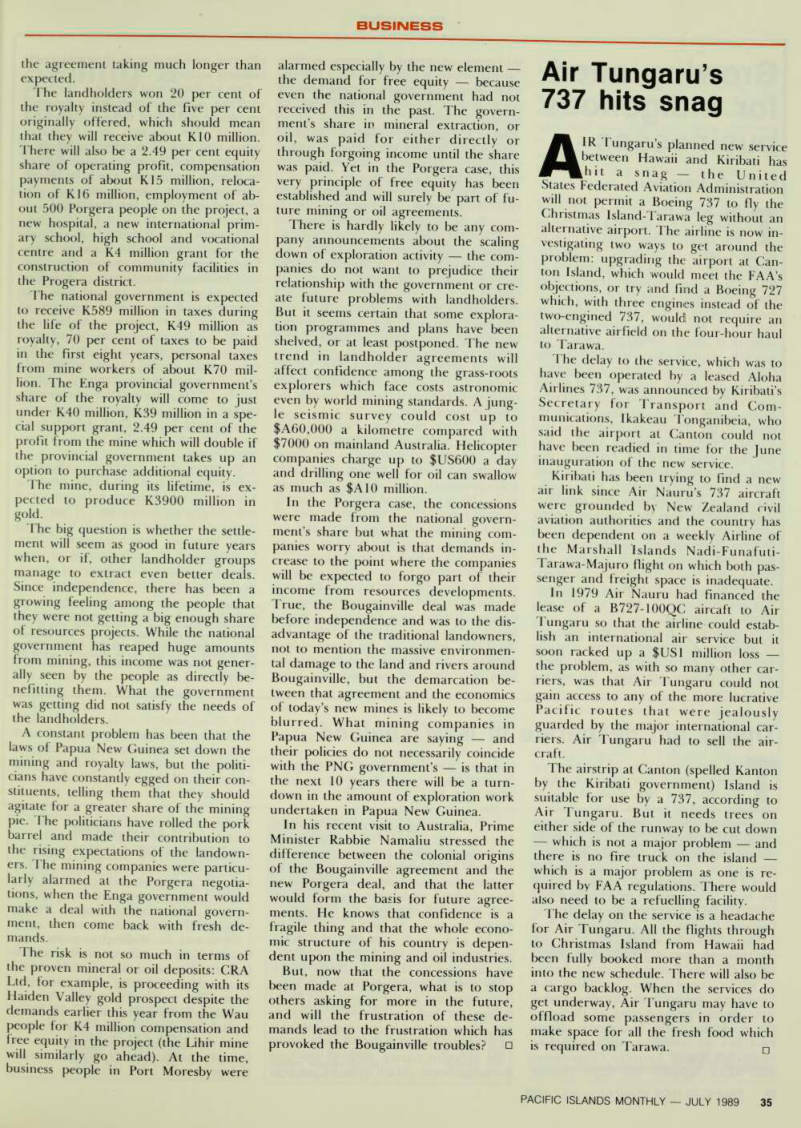
Before the trouble: Bougainville copper mine.
the agreement taking much longer than expected.
The landholders won 20 per cent of the royalty instead of the five per cent originally offered, which should mean that they will receive about KlO million, There will also be a 2.49 per cent equity share of operating profit, compensation payments of about Kl 5 million, relocation of Kl 6 million, employment of about 500 Porgera people on the project, a new hospital, a new international primary school, high school and vocational centre and a K 4 million grant for the construction of community facilities in the Progera district.
The national government is expected to receive K 589 million in taxes during the life of the project, K 49 million as royalty, 70 per cent of taxes to be paid in the first eight years, personal taxes from mine workers of about K7O milhon. The Enga provincial government’s share of the royalty will come to just under K4O million, K 39 million in a special support grant, 2.49 per cent of the profit from the mine which will double if the provincial government takes up an option to purchase additional equity.
The mine, during its lifetime, is expected to produce K 3900 million in gold.
The big question is whether the settlement will seem as good in future years when, or if, other landholder groups manage to extract even better deals, Since independence, there has been a growing feeling among the people that they were not getting a big enough share of resources projects. While the national government has reaped huge amounts from mining, this income was not generally seen by the people as directly benefiting them. What the government was getting did not satisfy the needs of the landholders.
A constant problem has been that the laws of Papua New Guinea set down the mining and royalty laws, but the politicians have constantly egged on their constituents, telling them that they should agitate for a greater share of the mining pie. The politicians have rolled the pork barrel and made their contribution to the rising expectations of the landowners. The mining companies were particularly alarmed at the Porgera negotialions, when the Enga government would make a deal with the national government, then come back with fresh demands.
I he risk is not so much in terms of the proven mineral or oil deposits: CRA Ltd, for example, is proceeding with its
Haiden Valley gold prospect despite the
demands earlier this year from the Wau people for K 4 million compensation and free equity in the project (the Lihir mine will similarly go ahead). At the time, business people in Port Moresby were
alarmed especially by the new element the demand for free equity because even the national government had not received this in the past. The govern ment’s share in mineral extraction, or oil, was paid for either directly or through forgoing income until the share was paid. Yet in the Porgera case, this very principle of free equity has been established and will surely be part of fu ture mining or oil agreements, There is hardly likely to be any com pany announcements about the scaling down of exploration activity the corn panics do not want to prejudice their relationship with the government or cre ate future problems with landholders, But it seems certain that some explora tion programmes and plans have been shelved, or at least postponed. The new trend in landholder agreements will affect confidence among the grass-roots explorers which face costs astronomic even by world mining standards. A jung le seismic survey could cost up to $A60,000 a kilometre compared with $7OOO on mainland Australia. Helicopter companies charge up to SUS6OO a day and drilling one well for oil can swallow as much as SAIO million, In the Porgera case, the concessions were made from the national govern menfs share but what the mining com panics worry about is that demands in crease to the point where the companies will be expected to forgo part of their income from resources developments, True, the Bougainville deal was made before independence and was to the dis advantage of the traditional landowners, not to mention the massive environmen tal damage to the land and rivers around Bougainville, but the demarcation be tween that agreement and the economics of today’s new mines is likely to become blurred. What mining companies in Papua New Guinea are saying and their policies do not necessarily coincide with the PNG government’s is that in the next 10 years there will be a turn down in the amount of exploration work undertaken in Papua New Guinea, In his recent visit to Australia, Prime Minister Rabbie Namaliu stressed the difference between the colonial origins of the Bougainville agreement and the new Porgera deal, and that the latter would form the basis for future agree ments. He knows that confidence is a fragile thing and that the whole econo mic structure of his country is depen dent upon the mining and oil industries, But, now that the concessions have been made at Porgera, what is to stop others asking for more in the future, and will the frustration of these de mands lead to the frustration which has provoked the Bougainville troubles? □
Air Tungaru’s
737 hits snag
AIR 1 ungaru s planned new service between Hawaii and Kiribati has hit a snag the United States Federated Aviation Administration will not permit a Boeing 737 to fly the Christmas Island-Tarawa leg without an alternative airport. The airline is now in vestigating two ways to get around the problem: upgrading the airport at Can ton Island, which would meet the FAA’s objections, or try and find a Boeing 727 which, with three engines instead of the two-engined 737, would not require an alternative airfield on the four-hour haul to Tarawa.
The delay to the service, which was to have been operated by a leased Aloha Airlines 737, was announced by Kiribati’s Secretary for Transport and Com munications, Ikakeau Tonganibeia, who said the airport at Canton could not have been readied in time for the June inauguration of the new service.
Kiribati has been trying to find a new air link since Air Nauru’s 737 aircraft were grounded by New Zealand civil aviation authorities and the country has been dependent on a weekly Airline of the Marshall Islands Nadi-Funafuti- Tarawa-Majuro flight on which both pas senger and freight space is inadequate.
In 1979 Air Nauru had financed the lease of a 8727-100 QC aircaft to Air Tungaru so that the airline could estab lish an international air service but it soon racked up a SUSI million loss the problem, as with so many other car riers, was that Air Tungaru could not gain access to any of the more lucrative Pacific routes that were jealously guarded by the major international car riers. Air Tungaru had to sell the air craft.
The airstrip at Canton (spelled Kanton by the Kiribati government) Island is suitable for use by a 737, according to Air Tungaru. But it needs trees on either side of the runway to be cut down which is not a major problem and there is no fire truck on the island which is a major problem as one is re quired by FAA regulations. There would also need to be a refuelling facility.
The delay on the service is a headache for Air Tungaru. All the flights through to Christmas Island from Hawaii had been fully booked more than a month into the new schedule. There will also be a cargo backlog. When the services do get underway, Air Tungaru may have to offload some passengers in order to make space for all the fresh food which is required on Tarawa. □