Who will turn out the lights?
pp. 11-15 · Read in the full issue
The Region
Niue
By Karen Mangnall
LEGISLATORS on the tiny island of Niue drew a collective deep breath recently and took a tenta tive step towards loosening ties with New Zealand. Niue’s 2000 or so residents now face the prospect of a January referen dum on up to 37 changes to the con stitution first drawn up in 1974 when the island became self-governing in free association with New Zealand.
Changes include dumping New Zea land’s Governor-General as head of state and installing instead a Niuean Gov ernor-General, tipped to be 80-year-old Sir Robert Rex who may retire early from his post as Premier. The legislators also voted for dual Niuean and New Zealand citizenship, for localising the New Zealand-dominated Public Service Commission and for reducing the num ber of MPs from 20 to 18. The changes are now being drafted into law although at the time of writing no comment has come from New Zealand.
The three-day debate centred on giv ing Niue greater freedom for indepen dent economic and political develop ment. Niue hasn’t shown much of a taste for independence since it was annexed to New Zealand in 1901. After the Second World War, wlien the United Nations was stoking the fires of self determination amongst the world’s col onies, Niue said hands off. New Zealand aid has kept Niueans in a fashion to
which they’d already become quietly
addicted by the time of self-government in 1974. Last year, New Zealand put Niue on an intravenous drip-feed of $lO million a year for three years in a last ditch effort to revive the island (see box, pl 3). So far the Niue Concerted Action Plan (NCAP) hasn’t worked. New Zea land is threatening to cut off Niue’s supply and the constitutional debate is one of the withdrawal symptoms.
AH the money hasn’t turned the tide of Niueans departing at such a rate that while 10,000 now live in New Zealand, probably fewer than 2000 live back on the island. And while it’s a standing joke that by the turn of the century nobody will be living on Niue, it’s less of a joke that the last person to turn out the lights is likely to be a public servant. Two thirds of New Zealand’s aid goes to Niue’s overstuffed public service and at the moment the bureaucrats are feeling raw.
In April, the New Zealand Auditor General released an “unusually blunt” report calling Niue’s Cabinet negligent with aid money and criticising the gov
eminent for failing to protect the in terests of taxpayers. A few days later, Foreign Affairs Minister Russell Marshall flew over to warn that Niue must halve its public service in the next two years or face aid cuts. Marshall says he wasn’t “explicitly holding a stick” at the Niue Government but he made it clear it
wasn’t easy to get $lO million from his Cabinet colleagues when New Zealand’s tightening its belt and when Niue wasn’t making any inroads into its public ser vice as promised under the NCAP.
Marshall told Sir Robert Rex and his three ministers that he’d need to see “substantial progress made in the next
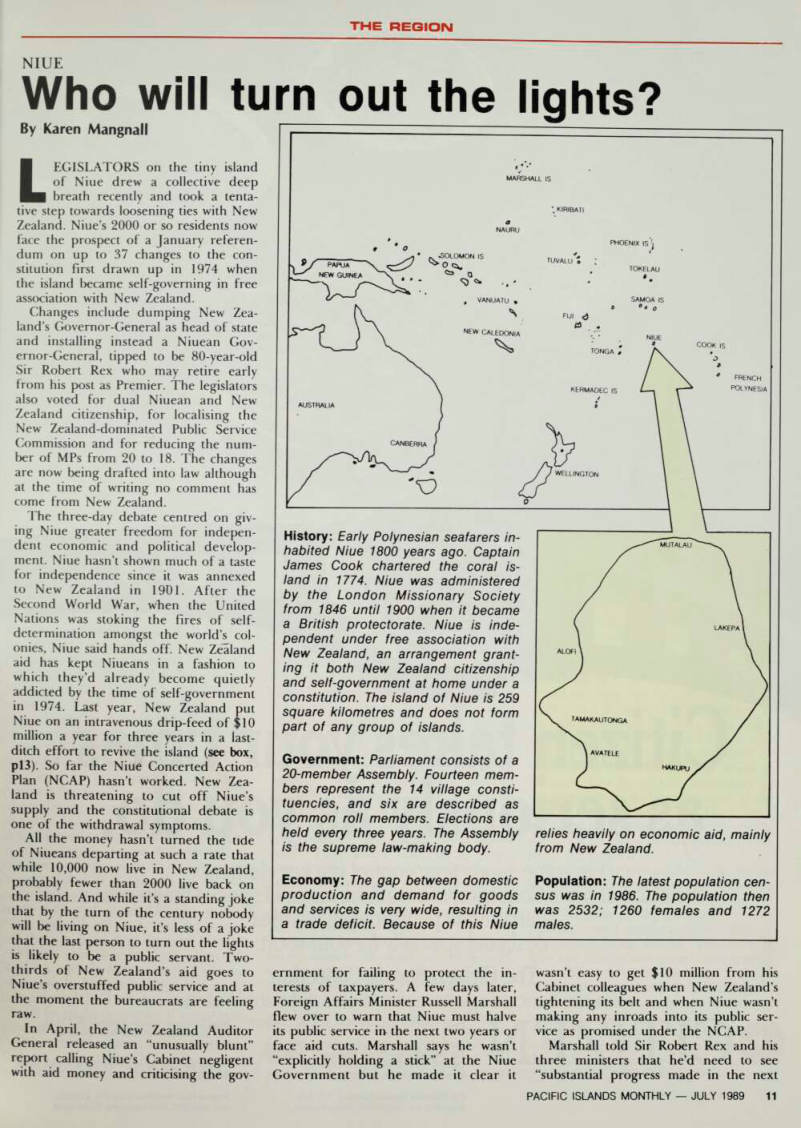
History: Early Polynesian seafarers in habited Niue 1800 years ago. Captain James Cook chartered the coral is land in 1774. Niue was administered by the London Missionary Society from 1846 until 1900 when it became a British protectorate. Niue is inde pendent under free association with New Zealand, an arrangement grant ing it both New Zealand citizenship and self-government at home under a constitution. The island of Niue is 259 square kilometres and does not form part of any group of islands.
Government: Parliament consists of a 20-member Assembly. Fourteen mem bers represent the 14 village consti tuencies, and six are described as common roll members. Elections are held every three years. The Assembly is the supreme law-making body.
Economy: The gap between domestic production and demand for goods and services is very wide, resulting in a trade deficit. Because of this Niue
relies heavily on economic aid, mainly from New Zealand.
Population: The latest population cen sus was in 1986. The population then was 2532; 1260 females and 1272 males.
-12 months, in fact frankly rather more progress than weve seen in the last 12 months’’. Marshall hopes he’s treading the right side of the hne between talking tough and neo-colomal paternalism, but neither the messenger nor the message please Sir Robert. New Zealand has a constitutional obligation to give Niue financial and administrative support, but the Premier says after that it’s up to Nme how it deploys that aid. “It’s very, very hard or rather sad to hear (them keep) reminding us that it’s New Zealand taxpayers money. I mean this sort of thing doesn’t go down very well with me or my people here.
Robert may have misread the tide of Niuean public opinion. In the irst week of June, three Niuean MPs crossed the floor to join the unofficial opposition in a vote of no confidence in the Rex Cabinet, sparked by the New Zealand audit report. The no confidence vote was unprecedented and although it was lost by seven votes to 13, proposer Voung Vivian is claiming a moral vietory. Vivian believes Niueans are now more educated about efficient use of New Zealand aid and Rex supporters will have a hard time in next March’s elections. Another indicator that Sir Robert’s support may be waning was the admission by his number two, Frank Lui, that although he d not cross the floor for Vivian he might reconsider if the opposition asked him to take over as Premier.
Other omens seem set against Sir Robert. The seven MPs who voted against Sir Robert represent more than
half of Niue’s remaining population, in
eluding the island’s three largest villages,
And observers believe Sir Robert may even lose his own Alofi South village seat
if he’s challenged by sitting independent
opposition MP Tauveve Jacobsen, who’s currently holding a common roll seat.
While some Niuean politicians may wish for more sugar coating from New Zealand, the bitter pill is that the aid
millions are actually helping to destroy
the Niuean economic revival they’re sup posed to encourage. The aid has created a new social class of well-paid and sine cured bureaucrats while Niue’s private enterprises languish. The private sector’s deep hurt surfaced during Marshall’s visit to Niue, when farmer after tourism operator after businessperson poured out their frustrations. They accuse the Rex government of victimising them as
political rivals for complaining that pub
lie servants get preferential development loans. They asked Marshall to direct some of the annual aid straight into a private incorporation set up by the pri vate sector aiming to buy the defunct coconut cream factory to process fruit and vegetables for export.
Marshall himself professes to be un sure whether it’ll make any difference cutting Niue’s public service by up to two-thirds and shifting the money to pri vate enterprises. “But the one thing which we’re all clear about is that we have in Niue vastly more people em ployed by the government than the pre sent size of the population warrants,” he says. “They previously had schools in vir
tually every village and as of the begin ning of this year they’ve rationalised the whole primary system into one good sized primary school. Now that’s a good model I think for what they need to be
doing elsewhere.”
Nor can Niue justify having 20 MPs for a population generally accepted to have fallen well below the official figure of 2000, especially with one MP being elected from a village of 17 men, women and children.
“If we kept the aid at the present level, and I think we’d be encouraged to do that if we knew that they were doing something constructive and creative with it, then it would free up rather more of that limited amount of money which is available now to explore possibilities to get agriculture and horticulture going better,” says Marshall. “You know there are signs of life there and what people need is a bit more encouragement, a bit more competition.”
Marshall asks how a Niuean can set up in business as a plumber or electrician when potential customers can get the job done for free by the government. And farmers aren’t encouraged to make a commercial living out of agriculture if they can borrow the government tractor or bulldozer for a few days free of charge. He says these “little kindnesses” are a disincentive to private enterprise and need to go.
But Sir Robert says New Zealand charges the Niue Government with trying to keep Niueans on the island and giving them public service jobs is one of
the only ways of doing so. His misgivings are shared by Niue’s director of econo mic planning, Toke Talagi, who says Niue doesn’t have the population base to allow it the luxury of laying off public sector employees without enough private sector jobs to take up the slack. “In New Zealand at the present moment, the dole is so much easier, the benefits are so much easier to get that what they would be normally getting out here. So there’s always that expectation that if things are tough here things are easier out there and in fact it is easier in New Zealand.”
Fifty years ago Niue was a prosperous, self-reliant island. Only three per cent of its population was in fulltime paid em ployment; the rest working as smallhold farmers. Today, thanks to aid money, Niue’s Government provides most of the remuneration for cash crops and hand icrafts. It employs more than half of the active workforce and controls most of the island’s assets including government farms and development blocks. But ex ports cover only a fifth of imports. A significant proportion of imports is food stuffs. In many villages half the aid-built houses are empty. Abandoned lime and passionfruit plantations give mute testi mony to the repeated failures of govern
ment-sponsored development projects.
Niue’s tendency to go big on single cash crops limes, passionfruit and soon apparently pineapples was inau gurated by the New Zealand post-war colonial administration which would make inflated predictions for the success of the latest flavour-of-the-month pro duct which would soon collapse. In the
meantime, imports kept rising and the
trade deficit grew. In the 19605, as New Zealand espoused self-determination, it started a large capital works programme and stressed social welfare at the ex pense of economic development. In the five years to self-government in 1974, three-quarters of Niue’s aid went on the public service. The stagnant economy, raised expectations and the inequalities created with the new, richer class of pub lic servants meant Niueans began to flood to New Zealand when the island’s airport opened in 1971.
Niue’s isn’t an idyllic tropical island paradise. Less than one-third of its sur face is suitable for cultivation, its soils are shallow and deficient, its marine re sources are relatively scarce and its rain fall variable. Niue’s physical environment offers little yet for the past 40 years New Zealand has invested large sums on a primary-product export economy in the belief the island could become a viable trading nation. And all the evidence points to the fact that aid spending on “social welfare” to maintain Niue’s living standard merely encourages young Niueans to debunk for New Zealand.
Talagi favours the Niue government
establishing certain industries then sell ing or leasing them to the private sector.
He concedes the government doesn’t favour his approach because of its past
record of backing development projects
which have gone bust. The recent audit report criticised the Niue Government’s persistent failure to enforce contracts with local and foreign organisations, a failure which has cost jobs and hundreds of thousands of dollars in lost revenue and written-off loans. The audit report has sent many of Niue’s politicians and bureaucrats into a defensive crouch.
“I don’t think that it’s right or fair to expect Cabinet to go and stand over each department and watch over them,” says Sir Robert. “That’s political interfer
ence. We make the policies and (there are) different departments to carry (them) out and if there’s any squander ing I don’t see why the auditor should point an accusing finger at us.”
I alagi says Niueans are justified in feeling unfairly blamed for all of Niue’s economic failings. It’s taken the Niue government 15 years to try to wean Niueans off expecting to be “spoon fed” by a New Zealand administration which once had been only too happy to give the islanders anything they wanted. The Niue Government must change that atti tude, Talagi says, so that the next gen eration is taught that “there’s nothing free in this world and there’s no expecta tion that people will continue doing things for you just because you happen to exist”.
Independent opposition MP Tauveve Jacobsen is a vocal critic of aid spending which she blames for creating a welfare mentality amongst Niueans. Jacobsen says the emphasis on the public service means there are no promotions, no motivation and little incentive to excell.
“Whereas if you put a lot of these people out into working for themselves it’s amazing what they’ll come up with,” she says. “They’re very talented, they’re bril liant.”
Jacobsen says the “work ethic” is im portant in restoring a nation’s pride but Niue must act immediately to spend its aid money more effectively and entice young Niueans to return home or the island will be lost. “They’ll probably turn the lights out on us and say goodnight.
And that would be it for us. We’d prob ably be left to crawl with the crabs. This place isn’t going to get better with peo
ple just sitting waiting for handouts,”
Jacobsen says. “This place is going to get better when everybody gets out, pick and shovel, and they’re just gonna have to work.” Q
Nz Embassy
Russell Marshall: signs of life in Niue.