Earthrust
pp. 8-9 · Read in the full issue

Cover
Trying to stop the slaughter
The Pacific Islands are uniting like never before to eliminate the use of the destructive driftnets from the southern albacore fisheries. The issue will feature in discussions at the Forum meeting in Tarawa this month.
IMAGINE if the Pacific fishing fleets of Taiwan and Japan dropped their driftnets end-to-end in one night from west to east. They would stretch
from Sydney past Papeete, providing a
15-metre deep curtain that would hook fish, whales, turtles, ships’ propellers, and even birds. Such is the frightening ability of the driftnets to “strip-mine” the sea and empty it of its stock,hook line and sinker. This is why the nations of the Pacific are uniting like never before against its use in the rich southern alba core fishery and the Tasman Sea.
Now commonly known as the “wall of death”, driftnets or gillnets are made of fine mono-multifilament nylon mesh de ployed in straight lines to hang in the water like large curtains. They can be eight to 15 metres deep and are up to 60 kilometres long. Small floats keep them perpendicular to the surface and lead
weights keep the bottom edge hanging
straight down in the water.
Marine environmentalists say this is the most damaging method of fishing and causes irreversible ecological dam age. “It’s like dropping a bomb in the ocean, killing everything within reach and people come in, take what they want and throw the rest back into the sea,” said research biologist Samuel Laßudde, of the international environmental orga nisation Earthtrust. “Few people can im agine how damaging this technology is to
the resources of the sea. It’s like strip mining the ocean.
The issue, now so sensitive it has over shadowed French nuclear testing in French Polynesia, will be the focus of the South Pacific Forum meeting in Tarawa this month. Consensus will be sought for a regional treaty backed by all member countries banning the use of driftnets in their economic zones and putting a black ban on all driftnet vessels needing har bour facilities for transhipment, refuell ing and other services. Regional canner ies will also be asked to stop buying alba core tuna from driftnet vessels.
The islands are getting the full back ing of New Zealand and Australia. Both have imposed territorial restrictions in cluding the banning of driftnets from economic zones, the denial of access to foreign driftnet vessels and a ban on transhipment. New Zealand warned that ships could be confiscated if they carried driftnets in New Zealand waters. And the Auckland Harbour Board has voted unanimously to ban driftnet vessels.
In Nairobi on May 29 New Zealand environmental expert John Gilbert told a United Nations environmental panel that driftnet fishing is fast depleting Pacific Islands marine resources and threaten ing the diversity of life in the sea. “With its large by-catch of unwanted fish marine mammals and birds, drift gill netting is devastating marine resources,”
he said. He called for it to be outlawed, and immediately won the support of Au stralia and the international environmen tal organisation, Greenpeace. A month later Taiwan succumbed to an American ultimatum and agreed to sign a North Pacific driftnet agreement with the Un ited States. The agreement, among other things, will allow for “high seas board ing” of Taiwanese driftnet vessels and
requires satellite transponders placed on
all Taiwanese ships so the US can keep track of fishing vessels.
While the United States was able to flex its muscles and force Taiwan to an agreement, the tiny, aid-dependent Paci fic Island nations are finding the battle tougher without the same political and economic advantages. A conference in Suva on June 26-28 between Pacific Is land countries, Taiwan, South Korea and Japan magnified the weakness of the small states to stand alone. South Korea agreed in that meeting to withdraw us driftnet research vessel from the South Pacific. But Taiwan and Japan bluntly refused to compromise and forced an
impasse in the negotiation.
Both these Asian economic powers en joy a lot of influence in the region.
Japan, for example has become one of the bigger aid donors to the Pacific Is lands, providing financial assistance for a
variety of project with particular atten
tion to the development of the fishing
Earthrust
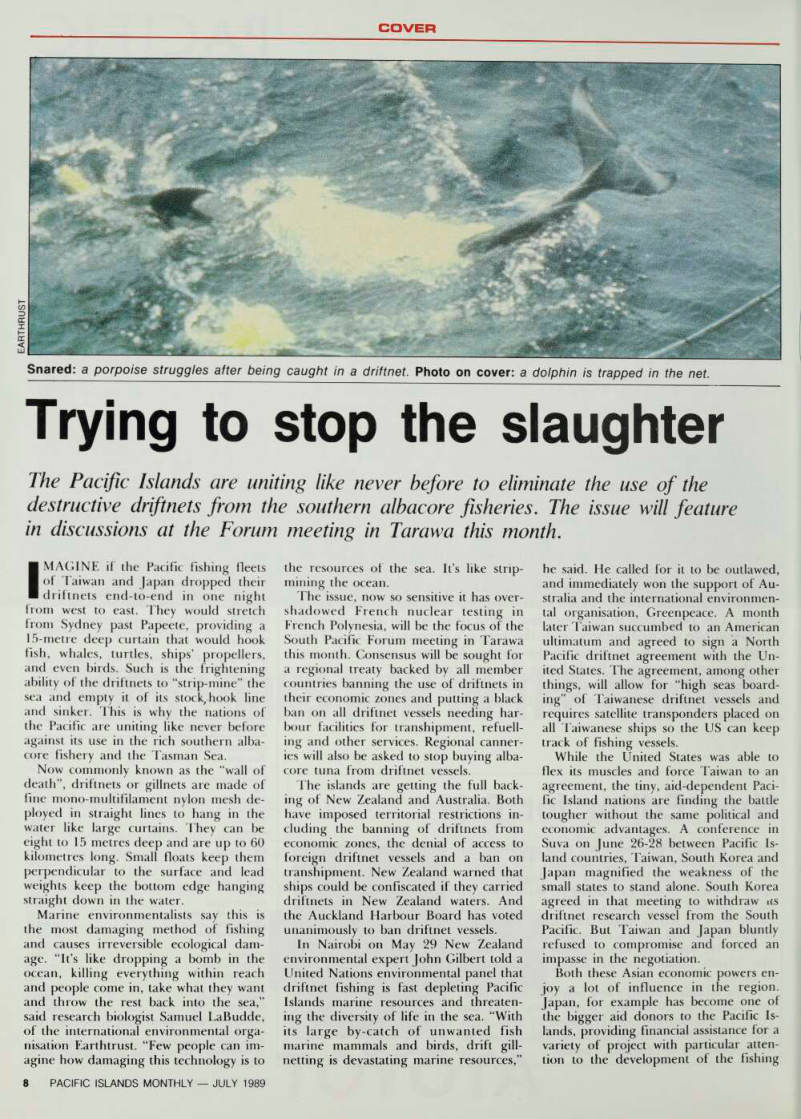
Snared: a porpoise struggles after being caught in a driftnet. Photo on cover: a dolphin is trapped in the net.
industry. Within hours of Japan telling the Suva conference it would not stop the use of driftnets in the South Pacific, Western Samoa announced it was accept ing nearly US$ll.4 million from Japan to pay for the second phase of the Apia port development. (Japan provides near ly 50 percent of Western Samoa’s total aid programme). The Same day Japan and the Solomon Islands signed an agreement in Honiara for the Japanese government to provide US$7.4 million to pay for the construction of a fishing pro ject at Noro. The facilities include a cold
storage, a wharf, ice-making plant and workshop. It will be the new base for an expanded cannery owned jointly by the Solomons government and a Japanese company. In Tonga, Taiwan is spending US$l.B million for the construction of an indoor stadium in Nukualofa to be used for the Mini South Pacific Games next month.
The list doesn’t end there. Last month Taiwan shipped into Suva the first of the Hyundai Sonatas it’s giving Fiji for use by government ministers. Japan at about the same time agreed to provide a furth
er grant of US$l.7 million to buy fishing equipment for the rural areas. Fiji’s fisheries department is seeking another
US$l.6 million, again to buy fishing
equipment. Japanese and Taiwanese aid
funds are financing projects throughout
the Pacific Islands. It was noted at the Suva conference, for example, that Fiji, which usually provides a pivotal role in regional decisions, was non-committal on the driftnet issue.
I he albacore fishery between latitude 30 and 40 south, is one of the richest in the world having been newly-discovered by the Asian driftnetters who once con centrated in the North Pacific. The num ber of driftnet vessels has grown from 10 Japanese and seven Taiwanese in the 1987/88 season to at least 50 Japanese and 130 Taiwanese ships this year. The attraction is the highly-priced albacore tuna whose white flesh is fetching US$lOOO a tonne in the United States.
Forum Fisheries Agency estimates, however, predict a collapse of the fishery within five years if driftnetting is allowed to continue at its current rate.
Such a situation would be disastrous for the longline industries in Fiji, Tonga, french Polynesia, Solomon Islands, the Cook Islands and Vanuatu.
Japan argues that the Forum Fisheries Agency does not have concrete evidence to back its argument on the albacore stock available and the sustainable level of exploitation. The agency admits such a lack of data and points only at the history of driftnet fishing in the North Pacific to draw parallels in the south. It also accuses Taiwanese and Japanese fleets in the south of not providing com plete information on the amount of catch being taken- For Asians, driftnets are essential.
They are economical. Ships do not re quire the large crews needed by the longliners. Japan pointed out that a workshop on South Pacific Albacore Re source (SPAR) in Suva in June deter mined that the damage to the albacore fisheries caused by driftnets was “un clear”. It is therefore necessary to do an
indepth study, which Japan is prepared
to help, into “all kinds of fisheries”. This was supported by Taiwan which said that while it was “very much concerned about the possibility of over-exploitation of the southern albacore stock” they had very little information on the available stock.
“We shall very much like to realise the exact stock status of this species before something on the conservation can be done,” a Taiwan statement said. It offered to provide scientists to help in a study to determine the Maximum Sus tainable Yield of the stock. Based only on such a scientific evaluation will it go into a conservation and management agreement concerning the southern alba core stock. □