The healers of Tonga
pp. 18-19 · Read in the full issue
Tonga
by Robert Simms
era of high-tech medicine is 1 well advanced in Australia and I New Zealand. Facilities and spe cialists are available to perform the most intricate surgery and treatment to correct problems that, until a few years ago, were considered terminal.
However, the reality in some of the Pacific island nations, only a short flight away, is quite different. A lack of funds that can be devoted to medi cine, has led to a critical shortage of doctors, surgeons and specialists and has led to facilities that are inadequate
by today’s standards.
The situation in the Kingdom of Tonga is as acute as any in the Pacific.
Although approximately 13% of the national budget is spent on health, this represents only $l2B per head of population. With fewer than 100,000 people living in the country, it means there is little money to spend on any thing more than basic health and spe cialist care. There are less than forty doctors in Tonga to attend to a
population that is spread throughout
the island chain.
Consequently, a shortage of special
ists has occurred because of the diffi culty in releasing these doctors from
duty to study overseas for perhaps
four or five years. There is only one general surgeon fully trained to deal
with all major operations ranging
from motor trauma to peptic ulcer perforations and “diabetes foot”. A second surgeon, who recently gradu ated, will return shortly, but tne work load is unlikely to diminish.
Elective surgery and operations that the Tongan doctors are unable to handle, are referred to Australian or New Zealand hospitals, or are post poned until an appropriate group of overseas specialists visits the country.
Interplast, a plastic surgery team, ASPE f, an opthamology group, and the Seventh Day Adventist neart team go to Tonga from Australia. An American eye specialist group and in dividual specialists also visit regularly.
Dr lan Stratton, an orthopaedic surgeon from Australia who worked in the Kingdom between 1978 and 1980, returns for two weeks each year to operate on children with talipes (club feet). He has performed surgery on over one hundred and eighty five children, correcting deformaties known locally as “hape”, i.e. laugh at.
Dr Stratton said that talipes has been in Polynesian society for centuries.
The incidence of approximately 1% is
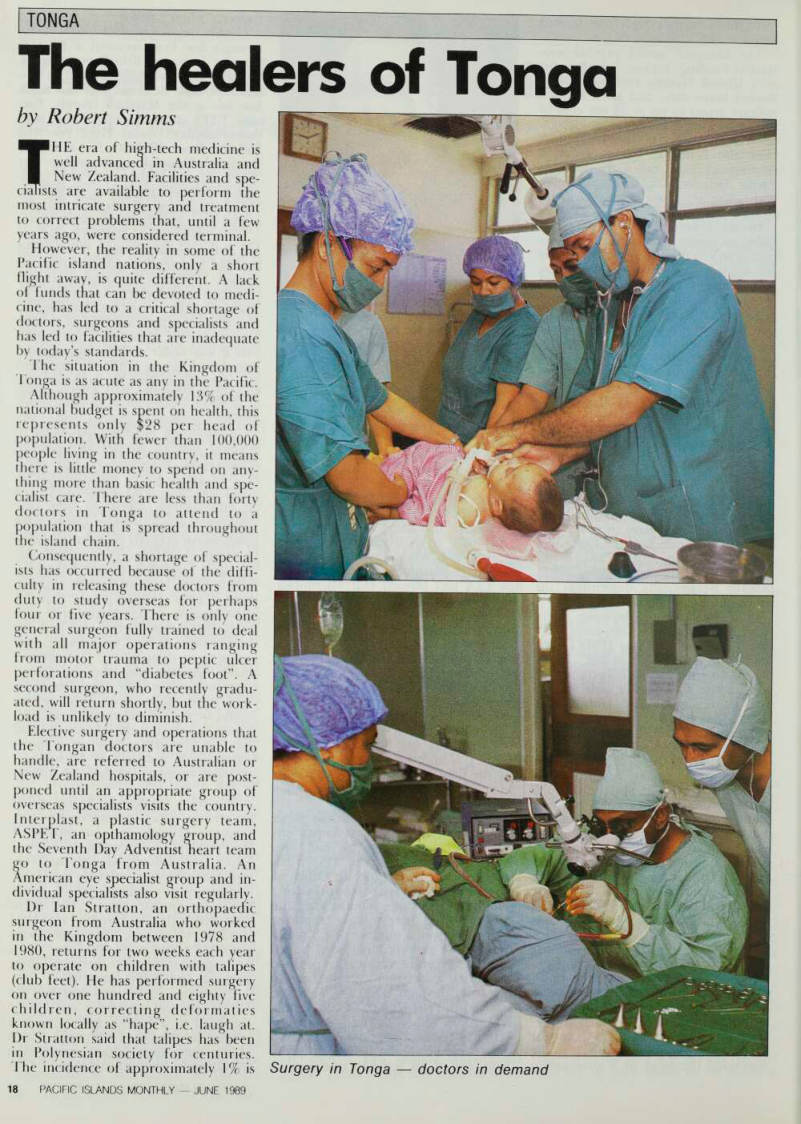
Surgery in Tonga - doctors in demand
ten times higher than in western cul tures. He attributes this to most prob ably a genetic trait, similar to that evi dent in the Navajo Indian which pro duces hair lip and cleft palate defor mities.
Dr Malik Vitharana, a Sri Lankan ENT surgeon who is now resident in Australia, has been visiting Tonga with Dr Stratton since 1986. Tonga has a resident ENT specialist who has completed a six month basic course in New Zealand, but as Dr Vitharana ex plained, it would take far longer to learn the techniques of micro-surgery.
“To be able to operate successfully on an ear complaint like chronic mas toiditis, for example, would reouire training of at least four years/ he said.
It is this degree of specialised train ing that is lacking in most areas of medicine in Tonga.
Dr Supilio Fofiaki, the Director of Health in the Kingdom, said that many of the doctors would like to im prove their knowledge overseas but cannot be spared.
“Their skills must be used to help the most people in a realistic way,” he said.
Dr Foliaki has been considering va rious possibilities for improving the provision of specialist care. An ex
change system has been tried, whereby
New Zealand RMO’s worked in Tonga and a local doctor was freed to gam experience in New Zealand. This program ran into problems because of the inequitable rates of pay. The Ton gan Health Ministry could not afford to pay the New Zealand salary, which is more than five times higher than the Tongan equivalent. Moreover, the Tongan doctor working at the over seas income rate in New Zealand, re sented returning home to work for much less.
Another program that Dr Foliaki prefers is one where overseas special ists travel to Tonga for short periods to train the doctors there.
New Zealand provides funding each year specifically for visits by their spe cialists and for the supply of equip ment that will help improve the quali ty of medical care.
Australian medical aid is generally used in other health related areas, in cluding the provision of water and sewerage facilities on the island of Ha’apai. However, Mr Arthur Birch, the aid development officer at the Au stralian High Commission in Nukualofa, said that if a proposal was submitted to the Commission that was designed to bring Australian medical specialists to Tonga to help to improve the knowledge and capabilities of the local doctors, funding would be favourably considered under the Small Grants Scheme. This scheme provides up to $50,000 for worthwhile projects
and is in addition to previously determined aid levels.
Dr Bill Tangi, the general surgeon at Vaiola Hospital in Nuku’aiofa, agreed that a program like this would be very useful.
“There is a pressing need for the
training of physicians, a radiologist
and a pathologist,” he said.
Other programs being considered include one proposed by Dr Robert North of the Provincial Surgeons Association in Australia. This would involve the six week rotation of surgeons over a period of two or three years.
Dr Foliaki sees this as a practical way to ameliorate the present chronic shortage of surgeons and is awaiting comment from staff doctors before agreeing to proceed with the proposal, He said that it is far better for specialists to go to Tonga rather than padents going to Australia or New Zealand. ‘lf specialists come here,” he said, “they can not only treat a greater number of patients, but can also teach the staff some of their knowledge.”
“I don’t think that we will ever become fully self-sufficient in all aspects of medicine,” he said. “But within ten years, I think that we will have the necessary expertise from a cost/benefit point of view, as far as specialised services go.”
To help acnieve this goal, the Australian Anaesthetists Association’s South Pacific Aid Committee is endeavouring to co-ordinate the various medical organisations that operate in the Pacific. In the past, a number of services have tended to overlap, so they are trying to rationalize the sys
tern and compile a database that would list the equipment and person nel available in each country. In this way, more effective assistance could be
provided and vital equipment supplied
to the hospitals that need it most. Dr Michael Logan, the anaesthetist who travels with Dr Stratton and Dr Vitharana to Tonga each year, said that often equipment is sent to Pacific Island countries by benevolent orga nisations, without consideration of its suitability and without the necessary technical backup to install it properly, “Through a co-ordinated body, Au stralia and New Zealand would share
responsibility for providing and
paying for a technician to service all the medical equipment at the hospit als,” he said. New equipment could be installed by him and the staff in structed on its use.
He added that a locum service would be established to allow local doctors to go on study leave or so that they will have time to learn from visit ing specialists. Dr Logan said that, fol lowing discussion with Dr Foliaki, it is hopea that the service will be operat ing within twelve months, As these medical assistance schemes are implemented, the burden of pro viding specialist services in the Pacific will lessen. The islands may never be come totally self-reliant, but the quali ty of health care will definitely im prove.
Dr Foliaki said that in Tonga, every discipline of medicine is covered by someone who has at least some train ing in those areas. The call now is for full specialist training, he said,
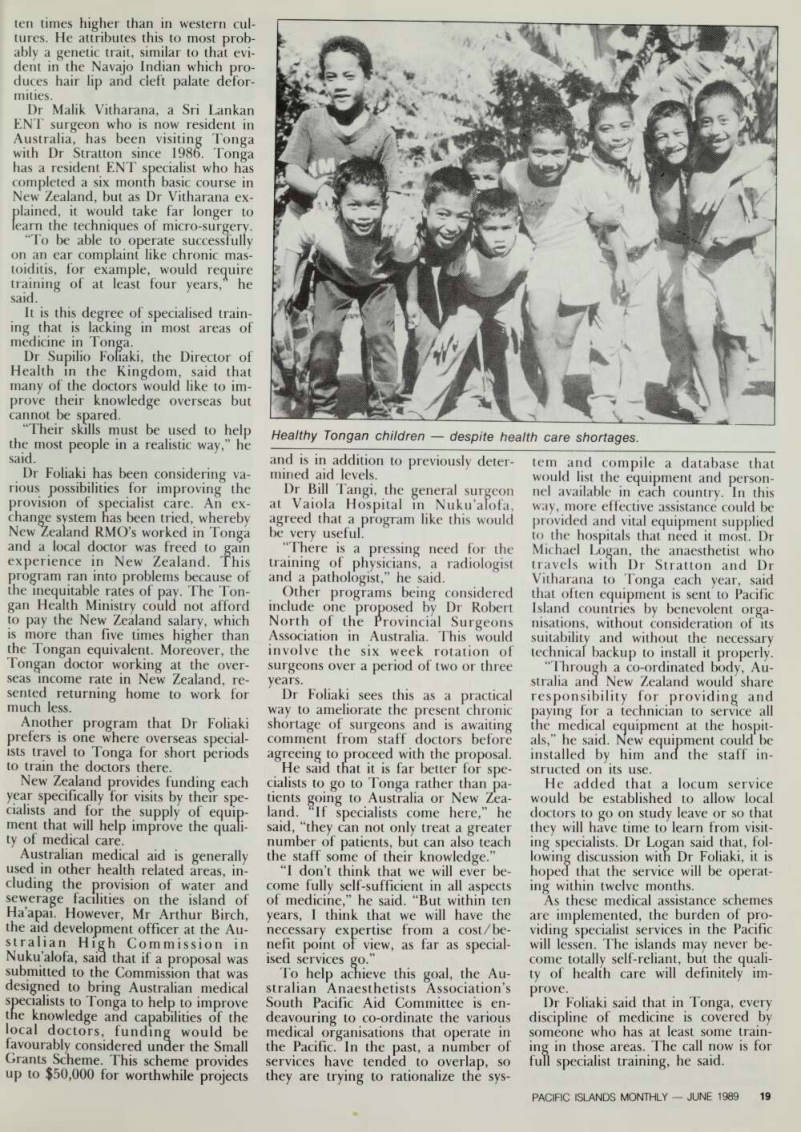
Healthy Tongan children - despite health care shortages.