Zeder under the spotlight
pp. 16-17 · Read in the full issue
The Region
Allegations of impropriety dog the US President’s old friend.
By Ed Rampell
Newly Elected Us Presi
dent George Bush has nomin ated former United States Ambassador to Micronesia Fred Zeder to head a federal development agency
though the ex-diplomat played a key
role in a power deal in Palau that is
currently under investigation by the
US Congress’ watchdog agency. Senate
confirmation hearings are currently
under way regarding Zeder’s nomina tion as chairman and chief executive of the Overseas Private Investment
Corporation.
OPIC is a well-sustaining govern ment agency that facilitates American investment m development projects in the Third World, including Oceania.
It assists US investors primarily by in
suring investments against political
risks and by financing such invest ments through direct loans and/or loan guarantees. OPIC also aids inves tors with investment information on development countries, via a compute rised data system called the Opportun
ity Bank. Another service provided by
OPIC is feasibility studies of proposer!
projects; according to William Paupe,
the former Suva-based regional direc tor for USAID,OPIC has country agreements with Tonga, Kiribati and
Fiji and projects already established in
Papua New Guinea. £eder has an impressive career re sume that parallels that of his old friend and longtime political associate, George Bush. Like Bush, Zeder was a Pilot m the Pacific during World War I, serving in the Aluetians, and flew in the first air strikes launched against Japan. In the Postwar era, Zedar Rico, the Virgin Islands and Japan, worked with Chrysler and his Hydrometals firm was listed on the New York Stock Exchange.
Friends with Bush since the 19505, Zeder hails from Connecticut but moved to Texas. He served during the Ford administration as the Interior Department’s director of Territorial Affairs, while Bush was director of the Central Intelligence Agency. More re cently, he was one of the Bush cam paign’s top 10 fund raisers and one of the highest paid membrs of the presi dent’s transition team thougn he reportedly took less than was allocated to him under budgetary restraints.
In 1982, Bush was instrumental in arranging the appointment of his old friend as the President’s Personal Rep resentative to Micronesia. As the US
ambassador to Micronesia, Zeder pres ided over the disputed termination of the Trust Territory of the Pacific Is lands (TTPI): his gruff demeanour stirred controversy and Palau’s former Senate President, Isidore Rudimch, was quoted as saying that Zeder was “a pain in the ass'’ whose “cowboy di plomacy” led eventually to involve ment in one of the Pacific’s biggest fiscal fiascoes one that has me potential to cause severe embarrass ment to him during the OPIC Senate
confirmation hearings.
In 1983, during a crucial moment in the negotiations of a power project for the Republic of Palau, Zeder inter vened m the discussion with the result that, while Palauan representa tives negotiated with financiers in London over the terms for a 16 mega watt IPSECO power plant and 24million-litre fuel storage facility, Zeder and US Interior Department officers dispatched an official cable to the Un itea Kingdom that deliberately or un
internationally misrepresented a prop
osed Compact of Free Association be tween Palau and the US as having
been “approved by the people of
Palau in a February 10, 1983 plebis cite”. The cable goes on to contend
that the proposed Compact’s funding
could be used as collateral for
Ipseco.
The multinational banking cartel that financed IPSECO later told the
American Broadcasting Corporation’s
20/20 news program that Zeder’s cable played a pivotal role in convinc ing the financiers to back IPSECO. On the strength of the cable, Her Majes
ty’s Government guaranteed, the
IPSECO loans with Export Credit Guarantee Department (ECGD) funds.
Hence, the micro-nation of 15,000 people with limited resources and assets, totally dependent on US gov ernment aia of about $2O million a year received more than SUS 24 million in loans from the consortium.
IPSECO proved to be a debacle, and the over-sized, over-priced project has bankrupted Palau. In early 1985 the Republic defaulted on its national debt for IPSECO, in late 1985, IPSE CO’s financiers countered by suing Palau in a New York federal court. In early 1986 IPSECO itself, a British Eower firm, declared bankruptcy in ondon and last year IPSECO’s bank ers won a $44 million judgement against Palau ... one that remains to be
paid. The Republic s political ‘reign of terror’, which includes the gunshot deaths of two presidents has been spe culatively linked to the IPSECO scandal.
Despite Zeder’s assertions that the Palauans electorate has passed the Compact (with a 61 per cent vote), the ROP Supreme Court ruled twice in 1986 that the Compact required 75 per cent approval to override Palau’s anti-nuclear constitution. The Palauan people have so far refused to pass the Compact and the treaty has not been implemented six years after Zeder’s fateful cable. (There is even dispute, should the Compact ever be passed, over whether or not the accord s funds can be used for the staggering IPSECO debt. For mer Palau Vice President Alfonso Aiterong claims that though the Re public asked Zeder to assist it in obtaining IPSECO loans, the then
ambassador was specificallv requested
not to indicate that Compact funds could be used to pay for the plant.) IPSECO proved to be such a major controversy that the General Account ing Office, the investigative arm of the US Congress, has already sent two missions to Palau to probe the power project. The GAO has charged that top Palauan politicians, including late President Lazarus Salii, former Speak er of the House Carlos Salii and Palau National Development Bank chairman Polycarp Basilius received about $1 million in kickbacks. IPSECO critics including former Speaker of the House Santos Olikong and the Amer ican Civil Liberties Union have charged that in addition to being a poor business deal, IPSECO was in fact designed to destroy Palau’s nuc lear-free constitution.
The conspiracy scenario is as fol
lows: the Repuolic’s representatives
were ‘deceived’ into believing that the power plant and fuel storage facility could pay for themselves by selling fuel and electricity. Trust Territory
High Commissioner Janet McCoy
approved a special law allowing IPSE
CO exemption from most business norms, including a feasibility study, despite protests from Palauan leaders and the US Interior Department’s au ditor. The facility created a devastat ing debt burden for Palau, which was faced with an enormous economic dilemma: the only way it culd possibly pay off its debt would be by entering
into the Compact with the United States.
The Compact would provide sub stantial funding, replace Palau’s status as a United Nations trusteeship with limited home rule, and grant tne US military access to up to 3o per cent of
the strategically located archipelago.
Should U§ bases in the Philippines close the Pentagon has prepared a contingency plan, called tne Western Pacific Defence Arc, that has Tinian and Guam as its northern angles and Palau at the south.
In six referenda the treaty has failed to garner the mandated 75 per cent vote required to overrule Palau’s anti-nuclear constitutional stipulations, and according to the conspiracy thesis IPSECO was intended to create such economic distress for the Republic that Palauans would vote for the Com pact under duress. Once 75 per cent
of the people approved the Compact
(or an appropriate constitutional amendment was passed) and the treaty ratification process was completed, the US could transit nuclear craft within Palau and build military bases there.
And that would be waiting for the Pentagon? A brand new power plant and fuel facility, already constructed ... and conveniently too large for the miniscule Republic’s needs. It would also represent a facility for which the military would not have to pay a cent and with so much of the Compact’s funds used to pay off IPSECO and other outstanding debts, Palau could
remain perpetually dependent on
America.
In a Washington telephone inter view, Zeder dismissed the conspiracy theory and asserted that IPSECO cri tics “follow an old Marxist line”. Point ing out that the facility is currently on line (thanks to Japanese aid) and in
operation, Zeder contended that
‘TPSECO is not a scandal at all” and that a smiliar IPSECO plant in the Re public of the Marshall Islands (which did not approve the Compact), is cur
rently running without any problems.
Nevertheless, the situation could cause Zeder’s nomination serious harm. It raises important questions ab out the business acumen of the man who would head OPIC. As the agen cy’s key function is risk insurance and loan guarantees for overseas investors in developing countries, it is curious that somebody so closely associated with the IPSECO fiasco would be con sidered to head OPIC (especially since Zeder asked the UK to use ECGD funds, earmarked for supporting de velopment projects, to back the IPSE CO bankers loans with what is basical ly a loan guarantee or risk insurance).
Is it appropriate for somebody re sponsible for arranging a loan for such a development project to be appointed the head of a government
agency in charge of making loans, loan guarantees and risk insurance for US investments?
It is also curious that Zeder would be nominated to head an agency in volved with feasibility studies when IPSECO lacked such a study as well as other normal business practices. But
purely economic bungling aspects
aside, it has yet to be demonstrated whether or not ISPECO was a politi cally motivated action and, if so, whether or not Zeder knew this.
In 1976, fresh from his Watergate exposes, Bob Woodward revealed in a front-page Washington Post scoop that the CIA had bugged that Micronesia status negotiations for four years.
Then-Secretary of State and National Security Adviser Henry Kissinger had ordereo the surveillance of America’s United Nations wards during the Nix on administration in order “to assist the possibility of exerting convert in fluence on key elements of the Mic ronesian”.
President Bush recently named Scowcroft as his National Security Adviser and the agency’s chief dur ing the final year of the ClA’s surveill ance of Mirconesia was none other than George Bush himself.
In 1985, then Vice-President Bush returned after 40 years to Saipan en route to China, where he had pre viously represented the US. Bush travelled with Zeder and his Office of Micronesian Status Negotiations (OSMN) about three months after the still unsolved investigative reporter Jack Anderson, a number of US politi cans whose careers have been linked with the Trust Territory have profited from their association with the Islands, primarily through IPSECO. “First you start with Fred Zeder,” Ohio Demo crat John Seiberling told Anderson.
“He had business interests in Hawaii. 1 didn’t feel he should be able to profit from any of his activities in the nego
tiations.’' OMSN legal counsel John Arm strong’s law firm received a $20,000 retainer from the British power com fany and was paid more than 135,000 for defending IPSEC in a law suit at the Marshall Islands. For mer TTPI attorney general and high commissioner Daniel High received $50,000 from IPSECO for acting as the firm’s Honolulu agent and former TTPI director Governor Peter Cole man of American Samoa served on IPSECO’s board of directors and re ceived payments from the power firm.
Zeder denies that IPSECO paid for his airfare from London to Scotland in 1984 to attend a golf tournament,
though IPSECO’s bankruptcy records
indicate otherwise. According to Anderson, the ex-ambassador also de nies that he supported IPSECO’s busi ness venture ... [Daniel] High recalls that it was Zeder and Armstrong who introduced him to IPSECO’s president and convinced him to work for the firm, a decision High says he now re grets.
Allegations of purported improprie
ty do not end with IPSECO. Zeder’s son Howard heads the Marshall Is lands Maritime Authority, which regis
ters foreign ships: Seilberling and
other Congressmen have expressed
concern over what Anderson calls Mic ronesia’s “revolving door” policy of US government officials going on to enjoy personal gain from their island ser vice, and Seiberling sought unsuccess fully to block Howard Zeder’s appoint ment. Zeder Junior insists that his appointment is legitimate and con tends that he is highly qualified for the position, saying v ‘my whole career has been in shipping ... I resent and
totally disagree with the charges of
neoptism and profiteering. The Mari time head claims that the registry “could be one of the single largest re venue makers for the Marshalls” and that it is “the first private sector initia tive showing a return in Micronesia” albeit earning less than $1 million so far.
The irony is that Bush has called for stricter ethics legislations for gov ernment officials and has instituted the President’s Commission on Federal Ethics Law Reform, saying that “cur rent federal ethics rules do not serve adequately to eliminate use of public
funds for private gains.” The Presi
dent added that he favours “a code of conduct to ensure that those who serve the public trust avoid any actual or apparent conflict between their
personal and public interests”.
It remains to be seen whether the US Senate will appoint a man to be the head of a federal agency while a project he promoted with such zeal is at the same time under investigation by Congress own investigations. □
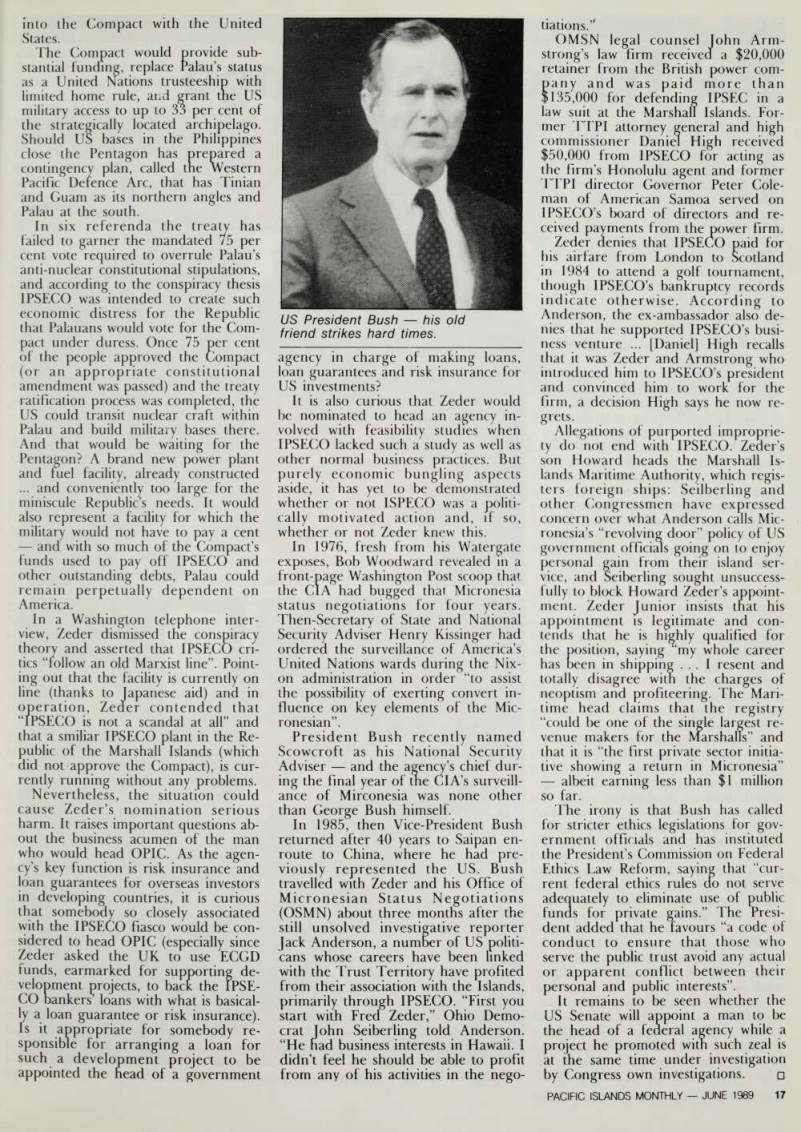
US President Bush - his old friend strikes hard times.