Oceania on show in Hungary
pp. 20-21 · Read in the full issue
Pacific Art
Examples of Papua New Guinea’s tribal art can be found all over the world. Nicholas Rothwell found some treasures in Budapest.
IN THE stately shell of Budapest’s
old Palace of Justice, across a grassy square from the echoing Hunga rian Parliament, reposes one of the world’s greatest, and least known, col lections of Oceanian art, the jewel in the crown of the Neprajzi Museum,
Hungary’s Ethnographic Museum.
Here, in a permanent exhibition of treasures from around the world, lurk some of the purest and best-preserved examples of the tribal art of Papua New Guinea. Everything in this museum is on the grand scale, from the size of its collection more than 150,000 objects to the number of volumes in its library 130,000 and the identity of some of its past researchers they include the com posers Bela Bartok and Zoltan Kodaly.
The Museum’s director. Dr Tamas Hoffman, presides over his charges with a country enthusiasm. Both a testament to nineteenth century Hun gary’s desire for matchless museum holdings, and a tribute to the zeal of its first generations of scientists, the ethnographic collection contains a wel ter of fine works from every region Mexico to Indonesia, the Congo to the Australian outback especially well represented, thanks to the efforts of a
pioneering Hungarian anthropological
theorist, Geza Roheim. But the high
point of the tribal art section, which is grouped in a permanent exhibition, New Ireland, S>epik and Huon Gulf masterpieces, remarkable both for their perfect preservation and their aesthetic originalities work in the museum’s display cases and cellars and scientists who made forays into New Guinea when the area was a German colony. He points out that the Museum of Mankind in London has holdings from a similar overall region, but dating from a later period of Brit ish control. ‘All the collections here were
gathered by Hungarians, who were
doctors, merchants, or natural scien tists, in the period up to the 19305, Dr Hoffman recalls; The ethnographic museum itself was not up in 1872 was part of the National Museum, based on a humble collection of 92 pieces assembled by an enthusiast whose tastes focused on artefacts left by speakers of Finno-Ugric, the distinc tive language group of which Hunga rian is a member. The museum soon became a vast enterprise, fueled by
the interest of the Budapest public in ethnography, a discipline which, it was once hoped, would shed light on the origins of the Hungarian nation. Folk songs were a special focus of attention and Bartok left thousands of record ing cylinders of his work in the arc hives here. Inevitably, the collection broadened to include pieces from all round the world, and two great Hungarian collectors of New Guinea art, Samuel Fenichel 1868-93 and Lajos Biro 1856-1931 both donated their treasures to the museum. ‘These collections are a mirror of the interests of the nineteenth century and the first years of the twentieth, contends Dr Hoffmann in his caver nous offices, dwarfed by piles of academic texts. ‘We see here not only pieces of primitive art, but also objects used in everyday life; they are very well documented, and we have the ori ginal photos it is rare to find field work of this quality from that time.’
Not only were Hungarian pioneer
anthropologists and natural scientists voracious collectors they were also possessed of a streak of generosity
peculiar to the fast-changing society of
turn-of-the century Buaapest. It was the custom in those days to donate one’s collections to the great museums of the city, as a fine, nationalist gestur e; ‘Hungarians, as you know, are great patriots,’ says Dr Hoffmann with a wry smile; The collectors would give to the National Museum, and they rarely sold their works it was a question of a certain style, a way of behaving, to make a donation and then reap the benefits of the public attention such a geasture would se cure.’
Some of the Papua New Guinea
pieces on display are undoubtedly
well-known to connoisseurs of the field, but nothing can prepare one for the experience of coming face to face with such a profusion of the most in tense art-worlcs of Melanesian culture, secreted in such distant, such insistent ly central European surrounds. The Hungarians who visited the remote shores of New Ireland, the Huon and the Sepik brought with them western eyes, and each of the objects on view in Budapest exemplifies the converg ence of ritual significance in tribal
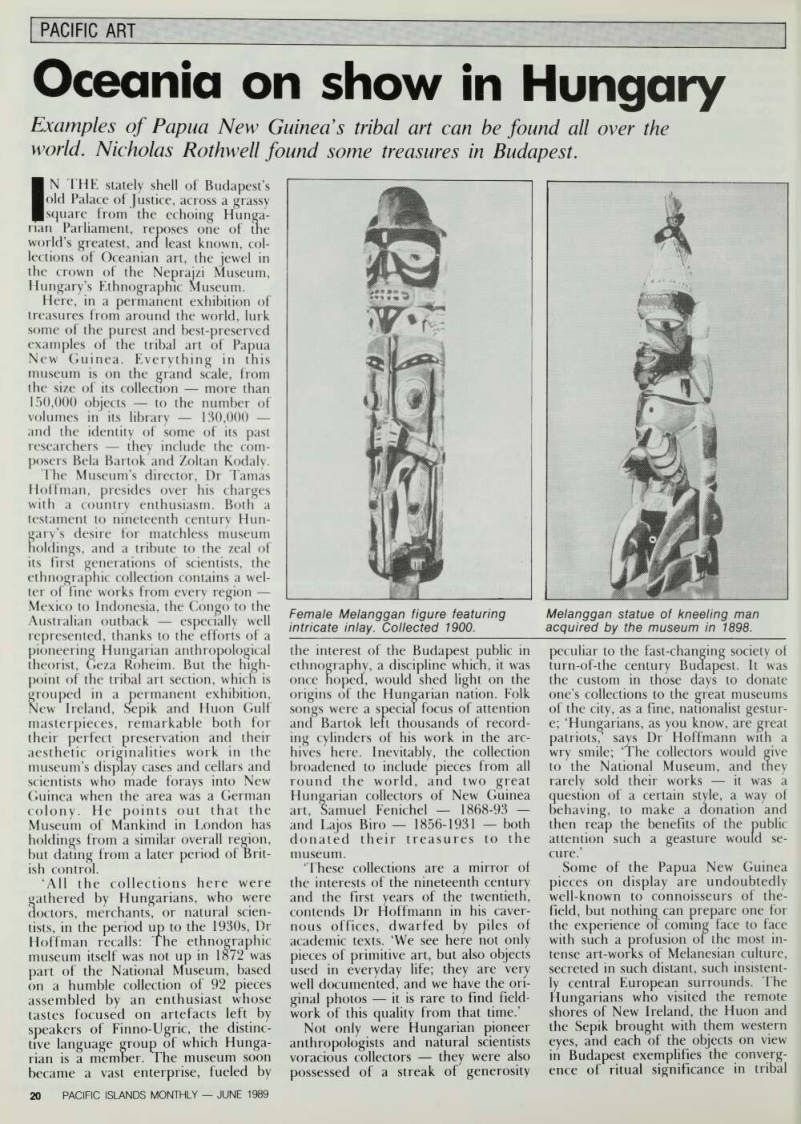
Female Melanggan figure featuring intricate inlay. Collected 1900.
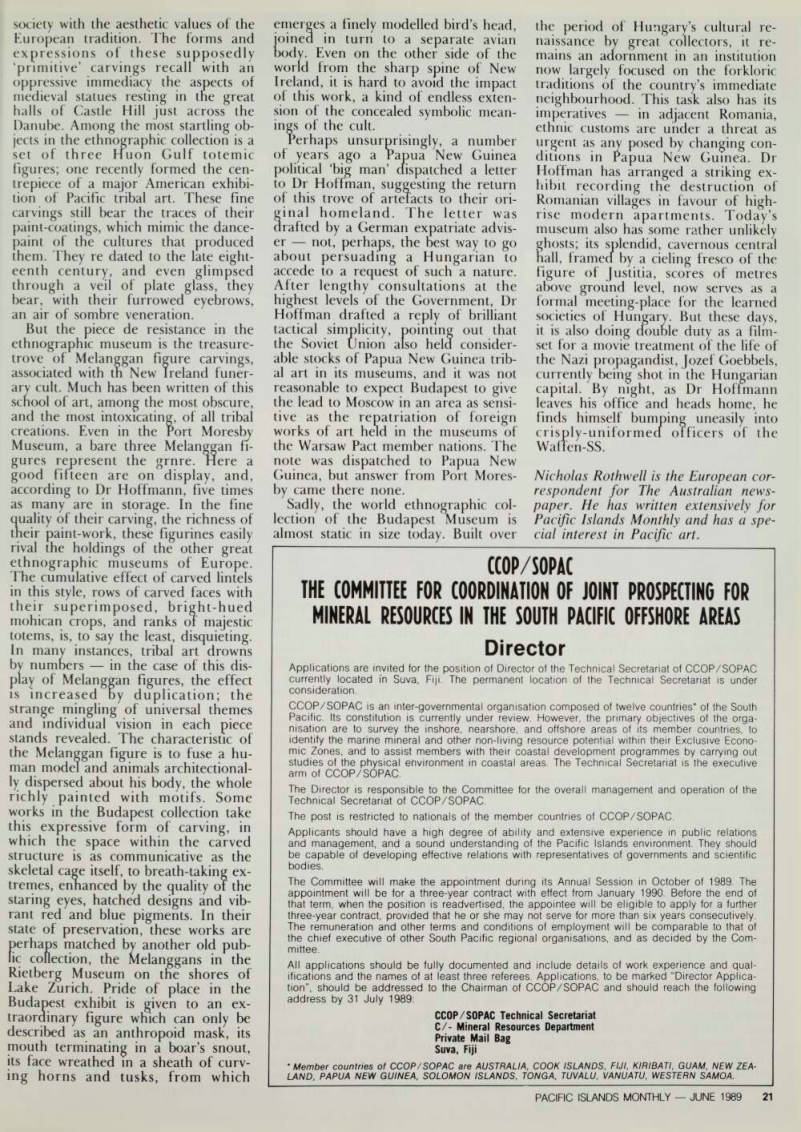
Melanggan statue of kneeling man acquired by the museum in 1898.
society with the aesthetic values of the European tradition. The forms and
expressions of these supposedly
primitive’ carvings recall with an
oppressive immediacy the aspects of
medieval statues resting in the great halls of Castle Hill just across the Danube. Among the most startling ob jects in the ethnographic collection is a set of three Huon Gulf totemic figures; one recently formed the cen trepiece of a major American exhibi tion of Pacific tribal art. These fine carvings still bear the traces of their paint-coatings, which mimic the dance paint of the cultures that produced them. They re dated to the late eight eenth century, and even glimpsed through a veil of plate glass, they bear, with their furrowed eyebrows, an air of sombre veneration.
But the piece de resistance in the ethnographic museum is the treasure trove of Melanggan figure carvings, associated with tn New Ireland funer ary cult. Much has been written of this scnool of art, among the most obscure, and the most intoxicating, of all tribal creations. Even in the Port Moresby Museum, a bare three Melanggan fi gures represent the grnre. Here a good fifteen are on display, and, according to Dr Hoffmann, five times as many are in storage. In the fine Quality of their carving, the richness of
tneir paint-work, these figurines easily
rival the holdings of the other great
ethnographic museums of Europe.
The cumulative effect of carved lintels in this style, rows of carved faces with their superimposed, bright-hued mohican crops, and ranks of majestic totems, is, to say the least, disquieting.
In many instances, tribal art drowns by numbers in the case of this dis
play of Melanggan figures, the effect
is increased by duplication; the strange mingling of universal themes and individual vision in each piece stands revealed. The characteristic of the Melanggan figure is to fuse a hu man model and animals architectional ly dispersed about his body, the whole richly painted with motifs. Some works in the Budapest collection take this expressive form of carving, in which the space within the carved structure is as communicative as the skeletal cage itself, to breath-taking ex tremes, ennanced by the quality of the staring eyes, hatched designs and vib rant red and blue pigments. In their state of preservation, these works are
perhaps matched by another old pub
lic collection, the Melanggans in the Rietberg Museum on the shores of Lake Zurich. Pride of place in the Budapest exhibit is given to an ex
traordinary figure which can only be
described as an anthropoid mask, its mouth terminating in a boar’s snout, its face wreathed in a sheath of curv ing horns and tusks, from which
emerges a finely modelled bird’s head, joined in turn to a separate avian body. Even on the other side of the world from the sharp spine of New Ireland, it is hard to avoid the impact of this work, a kind of endless exten sion of the concealed symbolic mean ings of the cult.
Perhaps unsurprisingly, a number
of years ago a Papua New Guinea
political ‘big man’ dispatched a letter
to Dr Hoffman, suggesting the return of this trove of artefacts to their ori ginal homeland. The letter was drafted by a German expatriate advis er not, perhaps, the best way to go about persuading a Hungarian to accede to a request of such a nature.
After lengthy consultations at the highest levels of the Government, Dr Hoffman drafted a reply of brilliant tactical simplicity, pointing out that the Soviet Union also held consider able stocks of Papua New Guinea trib al art in its museums, and it was not reasonable to expect Budapest to give the lead to Moscow in an area as sensi tive as the repatriation of foreign works of art held in the museums of the Warsaw Pact member nations. The note was dispatched to Papua New Guinea, but answer from Port Mores by came there none.
Sadly, the world ethnographic col lection of the Budapest Museum is almost static in size today. Built over
the period of Hungary’s cultural re naissance by great collectors, it re mains an adornment in an institution now largely focused on the forkloric traditions of the country’s immediate neighbourhood. This task also has its
imperatives in adjacent Romania,
ethnic customs are under a threat as urgent as any posed by changing con ditions in Papua New Guinea. Dr Hoffman has arranged a striking ex hibit recording the destruction of Romanian villages in favour of high rise modern apartments. Today’s museum also has some rather unlikely ghosts; its splendid, cavernous central hall, framed by a cieling fresco of the figure of Justitia, scores of metres above ground level, now serves as a formal meeting-place for the learned societies of Hungary. But these days, it is also doing double duty as a film set for a movie treatment of the life of the Nazi propagandist, Jozef Goebbels, currently being shot in the Hungarian
capital. By night, as Dr Hoffmann
leaves his office and heads home, he finds himself bumping uneasily into crisply-uniformed officers of the Waffen-SS.
Nicholas Rothwell is the European cor respondent for The Australian news paper. He has written extensively for Pacific Islands Monthly and has a spe cial interest in Pacific art.