Natural Heritage under threat
pp. 34-35 · Read in the full issue

Cook Islands
From Rarotonga, Cheryl Lilly reports on two major conservation issues one the legacy of past ignorance, the other a bitter lesson in exploitation.
ONE OF THE world’s rarest birds, the kakerori or Raro
tongan flycatcher, is fighting
tor survival in the Cook Islands. Ex tensive searches in 1988 located 35 birds, but following the 1988/89 breeding season (wnich ended in February), only 28 birds remain.
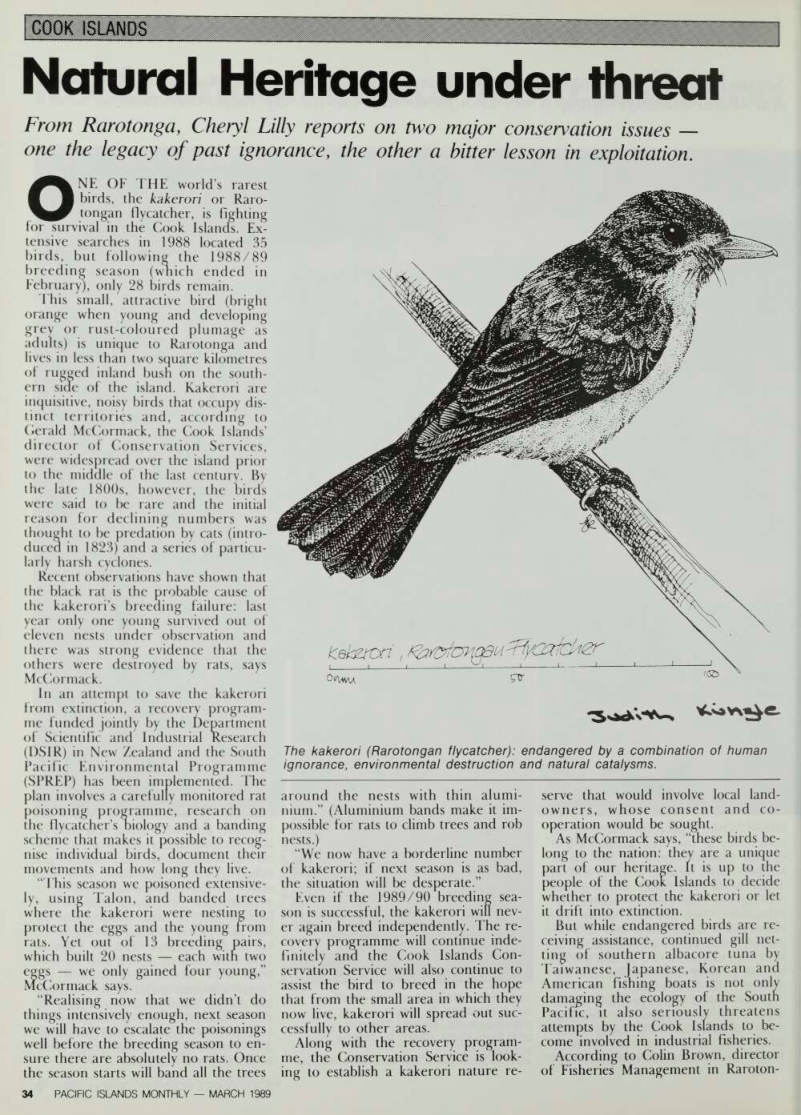
This small, attractive bird (bright orange when young and developing grey or rust-coloured plumage as adults) is unique to Rarotonga and lives in less than two square kilometres of rugged inland bush on the south ern siae of the island. Kakerori are inquisitive, noisy birds that occupy dis tinct territories and, according to Gerald McCormack, the Cook Islands’ director of Conservation Services, were widespread over the island prior to the middle of the last century. By the late 1800 s, however, the birds were said to be rare and the initial reason for declining numbers was thought to be predation by cats (intro duced in 1823) and a series of particu
larly harsh cyclones.
Recent observations have shown that the black rat is the probable cause of the kakerori’s breeding failure: last year only one young survived out of eleven nests under observation and there was strong evidence that the others were destroyed by rats, says McCormack.
In an attempt to save the kakerori from extinction, a recovery program
me funded jointly by the Department
of Scientific and Industrial Research (DSIR) in New Zealand and the South Pacific Environmental Programme (SPREP) has been implemented. The plan involves a carefully monitored rat poisoning programme, research on
the flycatcher’s biology and a banding
scheme that makes it possible to recog nise individual birds, document their movements and how long they live.
“This season we poisoned extensive ly, using Talon, and banded trees where the kakerori were nesting to protect the eggs and the young from rats. Yet out of 13 breeding pairs, which built 20 nests each with two
eggs we only gained four young,”
McCormack says.
“Realising now that we didn’t do
things intensively enough, next season
we will have to escalate the poisonings well before the breeding season to en sure there are absolutely no rats. Once the season starts will band all the trees
around the nests with thin aluminium.” (Aluminium bands make it impossible for rats to climb trees and rob nests.) “We now have a borderline number of kakerori; if next season is as bad, the situation will be desperate.”
Even if the 1989/90 breeding season is successful, the kakerori will never again breed independently. The recovery programme will continue indefmitely and the Cook Islands Conservation Service will also continue to assist the bird to breed in the hope that from the small area in which they now live, kakerori will spread out suecessfully to other areas.
Along with the recovery programme, the Conservation Service is looking to establish a kakerori nature re-
serve that would involve local land owners, whose consent and co
operation would be sought,
As McCormack says, “these birds be long to the nation: they are a unique part of our heritage. It is up to the people of the Cook Islands to decide whether to protect the kakerori or let it drift into extinction, But while endangered birds are re ceiving assistance, continued gill net ting of southern albacore tuna by Taiwanese, Japanese, Korean and American fishing boats is not onlv damaging the ecology of the South Pacific, it also senouslv threatens attempts by the Cook Islands to be come involved in industrial fisheries, According to Colin Brown, director of Fisheries Management in Raroton
The kakerori (Rarotongan flycatcher): endangered by a combination of human ignorance, environmental destruction and natural catalysms.
ga, the Cook Islands has always wanted to participate in such an in dustry. “The Cook Islands are in fact the most practicable location for boats fishing this albacore stock,” he says, “Ideally we would like to see a trans hipping base set up on Rarotonga, but our most realistic option is a joint ven ture with United States boats fishing this albacore ground.”
However, any hope of establishing industrial fisheries are likely to be overshadowed by the activities of the S’ll netters. “There are currently more an 150 boats, all with 15 to 20 nets, fishing this area,” says Brown. “At this level tne southern albacore stocks will be wiped out in two years.”
Cohn Brown’s concern for the fu ture of southern albacore stocks is shared by many South Pacific nations.
Late last year reprsentatives from the South Pacific Commission, Forum Fisheries Agency and regional orga nisations from the Cook Islands, Ton ga, Fiji, Tahiti, American Samoa and New Zealand, met in Suva to discuss
the implications and problems posed
by the gill netters.
It was recognised that the region faced a major threat from the num bers of gill netters entering this fisher y; and because the fishing is mainly in International waters, national fisheries laws cannot be applied to prevent the
anticipated over-exploitation or ban
the gill netters.
The consultative committee at the Suva meeting recommended that the use of gill nets for catching pelagic fish be condemned at all levels. Colin Brown explains: “Gill nets sweep the ocean floor, taking everything includ ing marine mammals and sea turtles.
They also represent a navigational hazard to other boats, and when they break or are lost, the nets drift ancl continue to catch fish, small whales and other marine animals.”
The consultative group called for regional governments to ban albacore gill net boats from using port facilities, for regional canneries not to purchase gill netted albacore and for the imple mentation of a ban on the tranship ment of gill netted albacore within the region. It was requested that the Au stralian and New Zealand Govern ments be approached to raise the gill net issue during southern bluefin tuna trilateral talks with Japan.
It was also recommended that those governments having bilateral access arrangements with Japan, Taiwan and Korea stress their countries’ concern
regarding gill netting activities in the
South Pacific.
For its part, the Cook Islands gives high priority to the conservation of albacore stocks and hopes regional co operation will achieve sound manage ment measures to protect this econo
mically vital fishery. □