Australia’S Tourism
pp. 32-33 · Read in the full issue
The Environment
Reefs under threat from pollution
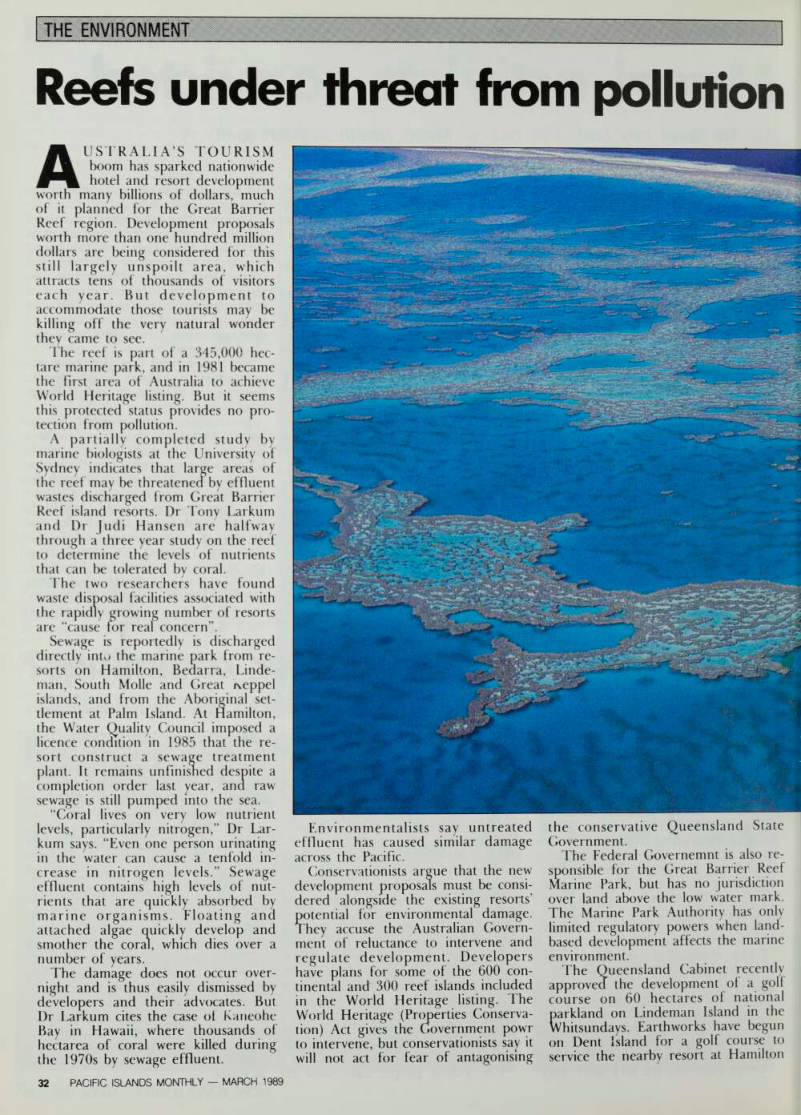
boom has sparked nationwide hotel and resort development worth many billions of dollars, much of it planned for the Great Barrier
Reef region. Development proposals
worth more than one hundred million dollars are being considered for this still largely unspoilt area, which attracts tens of thousands of visitors each year. But development to accommodate those tourists may be killing off the very natural wonder they came to see.
The reef is part of a 345,000 hec tare marine park, and in 1981 became the first area of Australia to achieve World Heritage listing. But it seems this protected status provides no pro tection from pollution.
A partially completed study by
marine biologists at the University of Sydney indicates that large areas of the reef may be threatened by effluent wastes discharged from Great Barrier Reef island resorts. Dr Tony Larkum and Dr Judi Hansen are halfway through a three year study on the reef to determine the levels of nutrients that can be tolerated by coral.
The two researchers have found waste disposal facilities associated with the rapidly growing number of resorts are “cause (or real concern”.
Sewage is reportedly is discharged
directly into the marine park from re sorts on Hamilton, Bedarra, Linde man, South Molle and Great irveppel islands, and from the Aboriginal set tlement at Palm Island. At Hamilton, the Water Quality Council imposed a licence condition in 1985 that the re sort construct a sewage treatment plant. It remains unfmisned despite a completion order last year, ana raw sewage is still pumped into the sea.
“Coral lives on very low nutrient levels, particularly nitrogen,” Dr Lar kum says. “Even one person urinating in the water can cause a tenfold in crease in nitrogen levels.” Sewage effluent contains high levels of nut rients that are quickly absorbed by
marine organisms. Floating and
attached algae Quickly develop and
smother the coral, which dies over a number of years.
The damage does not occur over night and is thus easily dismissed by developers and their advocates. But Dr Larkum cites the case of Kaneohe Bay in Hawaii, where thousands of hectarea of coral were killed during
the 1970 s by sewage effluent.
Environmentalists say untreated effluent has caused similar damage across the Pacific.
Conservationists argue that the new development proposals must be consi dered alongside the existing resorts’
potential for environmental damage.
They accuse the Australian Govern ment of reluctance to intervene and
regulate development. Developers
have plans for some of the 600 con tinental and 300 reef islands included in the World Heritage listing. The
World Heritage (Properties Conserva
tion) Act gives the Government powr to intervene, but conservationists say it will not act for fear of antagonising
the conservative Queensland State Government.
The Federal Governemnt is also re sponsible for the Great Barrier Reef Marine Park, but has no jurisdiction over land above the low water mark.
The Marine Park Authority has only limited regulatory powers when land based development affects the marine environment.
The Queensland Cabinet recently
approve? the development of a golf
course on 60 hectares of national parkland on Lindeman Island in the
Whitsundays. Earthworks have begun
on Dent Island for a golf course to service the nearby resort at Hamilton
Sewage effluent threatens large areas of coral on the Great Barrier Reef
and World Heritage listing is not enough to stop the rot.
By Richard Dinnen
Island. Other projects planned or under way in the area include a $lO million redevelopment of the Great Keppel Island resort, a $lOO million dollar hotel and resort development on Magnetic Island off Townsville (de velopment that has met major en vironmental opposition) and a $125 million dollar resort on Wild Duck Is land that threatens one of the world’s largest nesting colonies for the en dangered flat-back turtle.
Other World Heritage-listed islands
reportedly earmarked for develop
ment include Keswick, Long Hum mock Hill, Daydream and St Bees.
While an environmental impact study
has been ordered for the Magnetic Is land project, conservationists and con cerned residents say such studies are token gestures and have little real effect on the eventual outcome.
In the face of growing concern and protest, the Federal Government in sists that World Heritage listing is “no bar to development” and the Queens land Government asserts that its con trols over island development are
“quite adequate”. But environmental
ists do not agree, and have called for close monitoring and development of effective sewage disposal methods.
The University of Sydney study tends
to justify their concern.
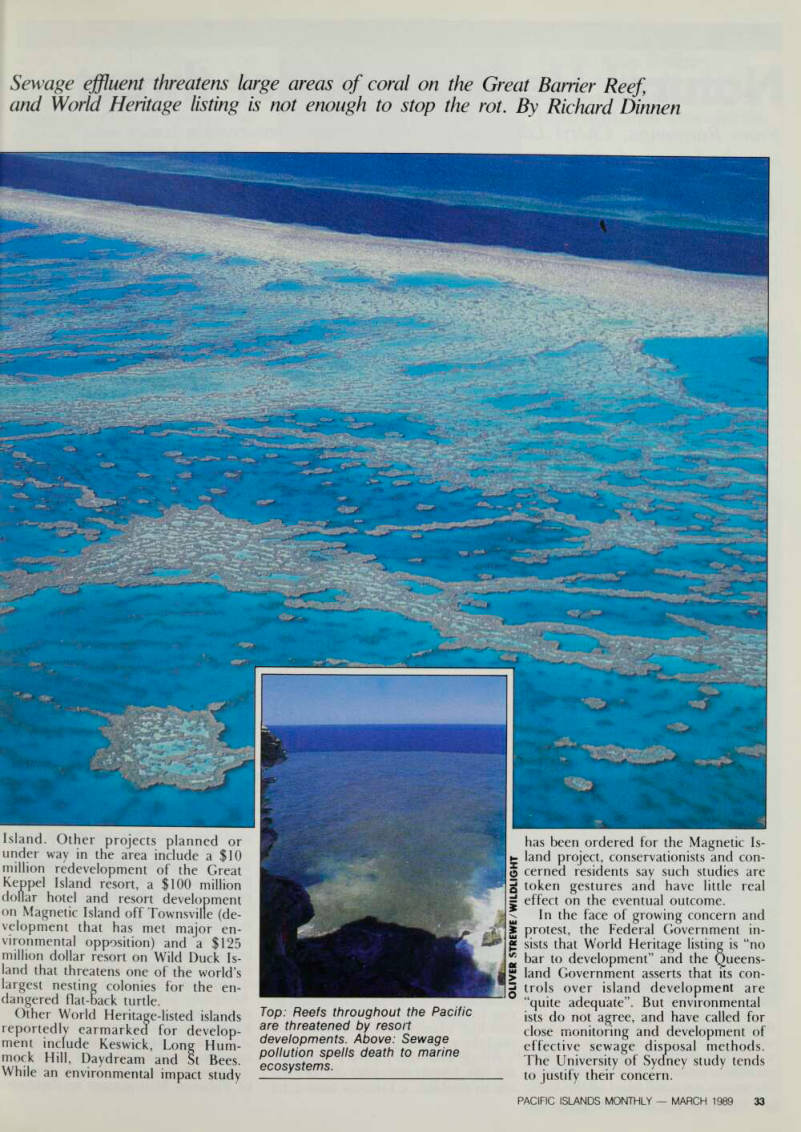
Top: Reefs throughout the Pacific are threatened by resort developments. Above: Sewage pollution spells death to marine ecosystems.