Sope, Sokomanu guilty
pp. 10-13 · Read in the full issue

Vanuatu
Sope, Sokomanu guilty of mutiny and sedition
John Dunn reports from Port Vila on the trial that saw a President and a former Ambassador to the United Nations behind bars for treason.
ATI GEORGE Sokomanu, 52, should have been in Japan last month as President of Vanuatu, representing his country at the funeral of Emperor Hirohito.
Instead, he spent his days on a hard wooden courtroom bench and his nights in the near suffocating heat of Port Vila’s steamy, concrete goal.
Sokomanu had been arrested last De cember, following his attempt to dis solve Parliament and to install his nephew and friend, Barak Sope, 38, as nead of an interim Government.
He appeared in the capital’s red roofed colonial Court House charged with incitement to mutiny a crime that carriers a life sentence. With him were Sope and five others, also charged with mutiny and additional
( charges, including sedition, for which
the maximum sentence is three years.
Two blocks away their former friend and colleague, the country’s Prime Minister, Walter Lini tne man they tried to depose worked on in his office. Sokomanu, Sope and Lini had been freedom-fighting com rades under the slogan Sen Hoo (Let’s Pull Together) and leaders of the self government push in the 19705.
Father Lini, a former Anglican priest, became the Re pub fie of Vanuatu’s first Prime Minister, Soko manu became its first President and Sope, a wealthy businessman, was
Secretary-General of the ruling
Vanua’aku Pati, Ambassador to the United Nations and later Minister for Public Works. For seven years the triumvirate ruled peacefully and well over this chain of 83 islands and its population of 146,000. Among the newly emerging nations of the South Pacific, Vanuatu was something of a model. Tourism, based on uncluttered
beaches, reef-protected lagoons and
newly built resort hotels, began attracting travellers from Australia, New Zealand and Japan.
But things began to sour. Sope be gan to flirt with Libya, which upset Lini. Then in January 1987, Lini in Washington to visit President Reagan suffered a severe stroke and there were doubts he would be able to stay on as leader. Sope saw his chance and began to bid for power but Lini reco-
vered (though partial paralysis re
mains) and retained his position.
Sope continued to manoeuvre, and last May staged an anti-Government demonstration after Lini had transfer red land leases around Port Vila from VULCAN, a semi-Government au thority, to a Government Department.
Police and the Government’s 550man paramilitary mobile force res tored order, but not until one man had been killed and damage estimated at close to SAI million was caused to
shops and office buildings.
An angry Lini expelled Sope from the Vanuaaku Pati and declared this
meant he also ceased to be a Member of Parliament: under the constitution an MP expelled from his party must immediately vacate his seat.
Lini pusned this move through the 46-seat Parliament in July, expelling
Sope together with four supporting
MPs plus the 18-member UMP (Union of Moderate Parties) Opposition, which had boycotted Parliament and which was thus deprived of its seats on the technicality that its members had
forfeited Parliamentary membership
by not attending sittings.
By-elections in December to fill the
seats were boycotted by Sope’s newly
formed Melanesian Progressive Party
and the UMP, and when only 40 per cent of voters (compared with a usual average of 80 per cent) participated in the poll, Sope called on Sokomanu to dissolve Parliament on the grounds that Lini had lost popular support.
The result was that Vanuatu now had virtually a one-party legislature, and tensions were beginning to rise.
Then, on December 17, Sokomanu acted. Using his ceremonial address to open Parliament, Sokomanu
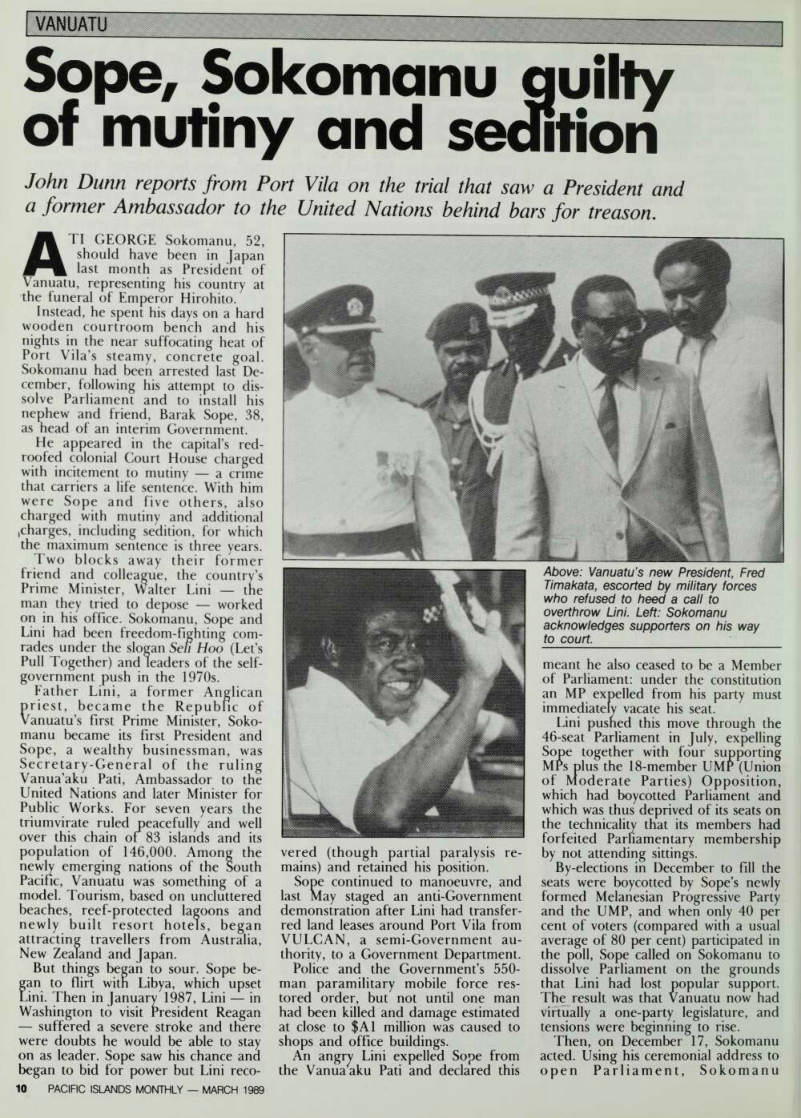
Above: Vanuatu’s new President, Fred Timakata, escorted by military forces who refused to heed a call to overthrow Uni. Left: Sokomanu acknowledges supporters on his way to court.
announced instead that he was dissolv ing it. Maintaining that he had a duty to act in the national interest, he said: “I do not only abide by the Constitu tion but my fear of what is happening to the country. The people will follow me. I am the last person who would want to see blood flow in this
country.”
Sokomanu immediately ‘swore in’
Sope as interim Prime Minister and four others as ministers, pending new elections in February. He called on the police and the paramilitary force to back him and threatened to seek out side military aid if they did not.
But the police and the military
moved equally swiftly, arresting Soko
manu, Sope, the four ‘ministers’ and Sokomanu’s secretary.
Said Lini: “I am totally disappointed with [Sokomanu]. He does not have the legal power, the constitutional power or even the political power to declare Parliament dissolved. He has made a mockery of the democratic system and a political fool of himself.”
Lini applied to the Supreme Court for a ruling; it declared illegal Sokoma nu’s dissolution of Parliament and ordered him to keep out of politics.
Lini made sure of that, and last month the country’s Electoral College dismissed Sokomanu and replaced him as President with Fred Timakata, a Presbvterian pastor.
Judge Ward presided over the trial assisted by two local assessors Krovet Ailuba Obed, a gardener and Charles Smith, a council clerk.
All seven defendants pleaded not guilty to the charges, with Sokomanu testifying that he had been “bluffing” when he threatened the country’s security forces with foreign interven tion if they did not drop their alle giance to Lini.
When Sokomanu and his six co defendants appeared before Chief
Justice Frederick Cooke just prior to
Christmas, the judge declared: “This is indeed a sad day to have to deal with a case against the President of the country, but I have to do my duty.”
He refused bail “because of the seriousness of the charges” and the seven were taken to Port Vila Prison, where they were placed apart from the other inmates 54 petty thieves and two rapists in the female sec tion, where no women were being held at the dme.
Sope immediately began a hunger
strike, refusing the twice-daily meal of boiled beef and rice until he had his
companions were given legal repre
sentation. “Lawyers in Vanuatu are afraid to act for us because they fear
they will be expelled,” he charged.
Sope began eating after six days
when a French lawyer, Jean Louzier from New Caledonia, was appointed.
Louzier and two assistants waited in the Vanuatu Supreme Court as the seven prisoners stepped out of a blue
police van.
Police, fearing demonstrations by
supporters of Sokomanu and Sope, had set up roadblocks manned by armed troops who admitted only rela tives of the accused.
An angry Sokomanu loudly pro
tested this restriction. “Even in colo nial times people were allowed to come to court, he shouted as he climbed the steps to the courthouse.
Waving his hand around the small courtroom packed with relatives, a handful of diplomatic corps repre sentatives and Australian and French media, Sokomanu continued: “They allow foreigners to come but not our
people. They are fascists. What’s hap
pened to democracy.”
Judge Gordon Ward, Chief Justice of the nearby Solomon Islands, who had flown in from Honiara as a neut ral official, quickly upheld a submis sion by Louzier that the hearing be open to all and on the second day several hundred people crammed into
the courtroom and its precincts or waited in the shade of the trees in the
surrounding grounds.
Sokomanu told the court the events that led to the arrests had been his idea alone, but he believed he had dis cretionary powers under the Constitu tion to dissolve Parliament and to in stall an interim administration. He had felt he had the support of the security forces and though he had no plans to call in overseas troops, he wanted to test their loyalty.
Sope denied he had any part in Sokomanu’s attempted dissolution of Parliament or plans to set up an in terim Government, or the writing of the circular threatening the formation of another armed force.
In response to the introduction of
highly unusual questions by the pro
secution, Barak Sope told the court about an aborted arms deal, saying that in 1983 Lini had sent him on a secret mission to China to conduct an arms purchase worth SA2I million.
Even though documents were signed, no money had been paid, no arms had
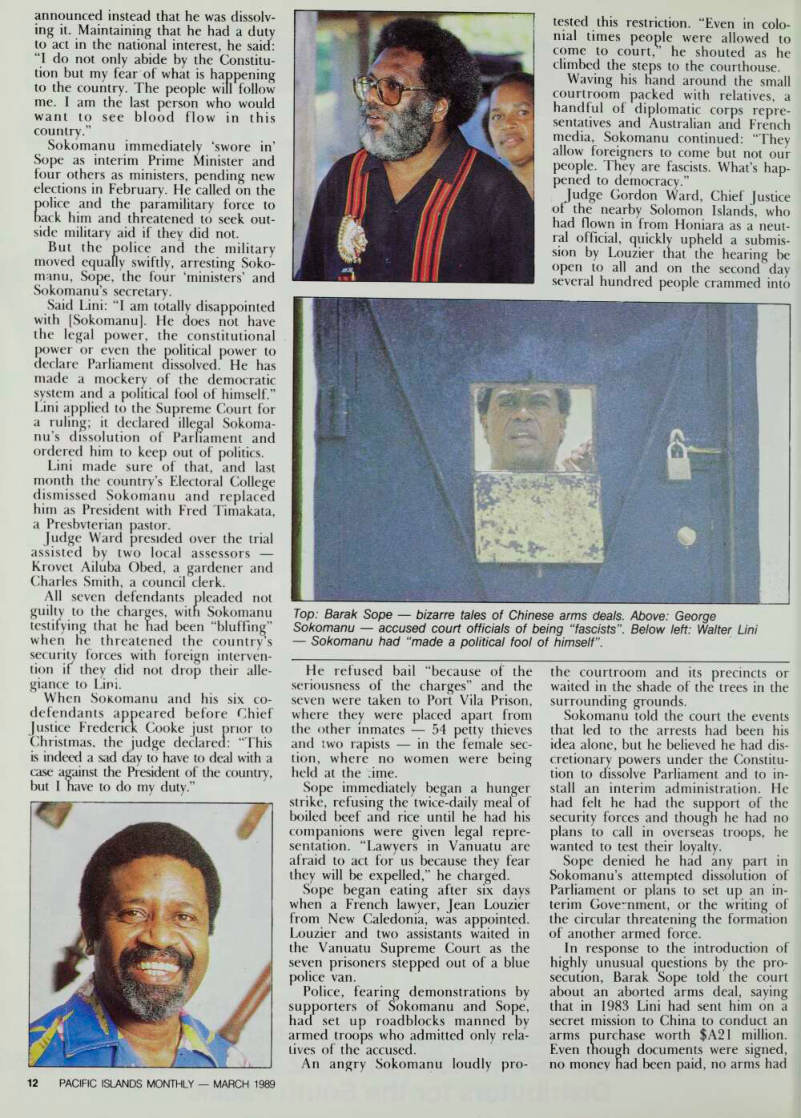
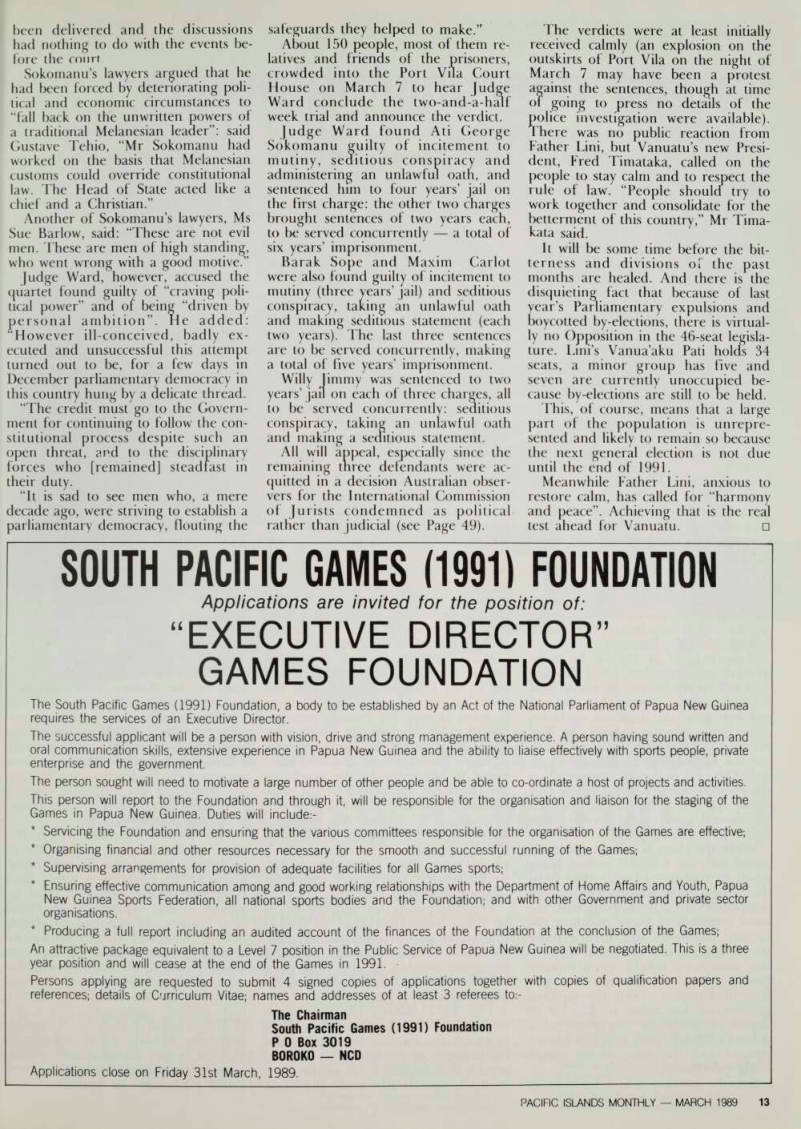
fop; Barak Sope - bizarre tales of Chinese arms deals. Above: George Sokomanu - accused court officials of being "fascists”. Below left: Walter Lini - Sokomanu had “made a political fool of himself”.
been delivered and the discussions had nothing to do with the events be fore the court Sokomanu’s lawyers argued that he
had been forced by deteriorating poli
tical and economic circumstances to “fall back on the unwritten powers of a traditional Melanesian leader”: said Gustave Tehio, “Mr Sokomanu had worked on the basis that Melanesian customs could override constitutional law. The Head of State acted like a chief and a Christian.”
Another of Sokomanu’s lawyers, Ms Sue Barlow, said: “These are not evil men. These are men of high standing, who went wrong with a good motive.”
Judge Ward, however, accused the
quartet found guilty of “craving poli
tical power” and of being “driven by personal ambition”, fie added: ill-conceived, badly ex ecuted and unsuccessful this attempt turned out to be, for a few days in
December parliamentary democracy in
this country hung by a delicate thread.
“The credit must go to the Govern ment for continuing to follow the con stitutional process despite such an open threat, and to the disciplinary forces who [remained] steadfast in
their duty.
“It is sad to see men who, a mere decade ago, were striving to establish a
parliamentary democracy, flouting the
safeguards they helped to make.”
About 150 people, most of them re latives and friends of the prisoners, crowded into the Port Vila Court House on March 7 to hear Judge Ward conclude the two-and-a-half week trial and announce the verdict.
Judge Ward found Ati George Sokomanu guilty of incitement to
mutiny, seditious conspiracy and
administering an unlawful oatn, and sentenced him to four years’ jail on the first charge: the other two charges brought sentences of two years each, to be served concurrently a total of
six years’ imprisonment.
Barak Sope and Maxim Carlot were also found guilty of incitement to
mutiny (three years’ jail) and seditious
conspiracy, taxing an unlawful oath and making seditious statement (each two years). The last three sentences are to be served concurrently, making a total of five years’ imprisonment.
Willy Jimmy was sentenced to two years’ jail on each of three charges, all to be served concurrently: seditious conspiracy, taking an unlawful oath and making a seditious statement.
All will appeal, especially since the remaining three defendants were ac quitted in a decision Australian obser vers for the International Commission of Jurists condemned as political rather than Judicial (see Page 49).
The verdicts were at least initially received calmly (an explosion on the outskirts of Port Vila on the night of March 7 may have been a protest against the sentences, though at time of going to press no details of the
police investigation were available),
There was no public reaction from Father Lini, but Vanuatu’s new Presi dent, Fred Timataka, called on the people to stay calm and to respect the rule of law. “People should try to work together and consolidate for the betterment of this country,” Mr Tima kata said.
It will be some time before the bit terness and divisions of the past months are healed. And there is the disquieting fact that because of last
year’s Parliamentary expulsions and
boycotted by-elections, there is virtual ly no Opposition in the 46-seat legisla ture. Lim’s Vanua’aku Pad holds 34 seats, a minor group has five and seven are currently unoccupied be cause by-elections are still to be held.
Phis, of course, means that a large part of the population is unrepre sented and likely to remain so because the next general election is not due until the end of 1991.
Meanwhile Father Lini, anxious to restore calm, has called for “harmony and peace”. Achieving that is the real test ahead for Vanuatu. □