stop no-confidence vote
pp. 8-9 · Read in the full issue
Papua New Guinea
Parliament suspended to stop no-confidence vote
Waigani seems condemned to repeat its recent history of rule by defection rather than election, writes Frank Senge
STUDENTS OF Papua New
Guinea’s tangled politics would
be amazed to read a report that began with the words; “Parliament sat the full three-week session without the mention of the now infamous vote of no confidence . .
Those not too familiar with the Byzantine character of life in Waiga m’s corridors of power might ask why: the answer is, quite simply, that the unusual frequent motions of no
confidence and equally frequent
changes of government is absolute
ly ordinary.
The novelty of this provision in the PNG Constitution has died down with its regular invocation, so that people now want to see a return to boring, down-to-earth democratic governing.
For this report, however, the routine sentence must suffice: In the wake of persistent rumours of military coups and continuing industrial dis putes, another motion of no confi dence PNG’s 15th in 11 years was moved on the eight-month-old Government of Prime Minister Rabbie Namaliu on March 2.
Former student leader and Morobe Provincial Premier Utula Samana
sponsored the motion, naming
Opposition Leader Paias Wingti as alternative Prime Minister.
The next day the Government em ployed the very tactic used by Mr Wingti’s government last April wnen it was facing a vote of no confidence.
Leader of Government business John Giheno moved that the house adjourn
to July 4, catching the Opposition
totally unaware and unable to muster enough votes to defeat the motion.
The Government survived the division by 53 votes to the Opposition’s 46.
The only difference between last April’s move and this was that this time Parliament convened for two full weeks: last year, the House adjourned after only two hours and wnen the vote was finally taken, on July 4, the Government was defeated and Mr Namaliu became Papua New Guinea’s fourth Prime Minister since Independ ence in 1975. Not a bad record in
comparison with some parliamentary
democracies, but one that reflects a
nation increasingly dependent on
votes of no confidence rather than elections as a tool of government.
Ironically, on March 1 the Govern ment had tabled a series of proposed amendments to Section 145 of the Constitution ... the very section that provides for no confidence motions.
The Government is proposing to in crease the minimum period between votes of no confidence from six months to between 18 and 30 months; alternatively, after each successful vote the Prime Minister or Governor General will, it is proposed, be given the power to dissolve Parliament and schedule elections.
Constitutional amendments have to be passed by an absolute majority of 73 members (out of 109) in three separate sittings of Parliament.
As has become usual, the motion of no confidence in the Government of Mr Namaliu was tabled after weeks of
speculation, negotiations and defec
tions. But it would appear that Mr Wingti was reluctant to move the vote: his idea was to act in the July sitting, by which time people would judge Mr Namaliu to have been in Government long enough for them to be able to assess his fitness for the position.
The majority of Opposition mem bers, however, were determined to push ahead with the vote. Mr Wingti’s former chief adviser Gabriel Ramoi
said: “I am sorry tor Wingti. He is cautious, but he is a reluctant com
mander leading a willing army.”
At the same time, it appears the Opposition was still trying to decide which commander to follow. The choice was between Mr Wingti, Peo
ple’s Progress Party leader Sir Julius
Chan and Melanesian United Front leader Utula Samana.
The problem was only resolved on the evening before the motion was tabled: Paias Wingti was to be alter nate Prime Minister, Utula Samana was to be his deputy.
The decision to put up Mr Wingti again cost the Opposition the support of Gabriel Ramoi, who claimed he would not support anybody in whom Parliament has already shown it had no confidence.
Five members defected from the Government to the Opposition during the negotiations. The National Party, led by Mount Hagen businessman Michael Mel, pulled out of the coali tion Government and chose the mid dle benches, with Mel declaring that he would offer the support of nis 10 members to whichever side gave them the greatest number of ministries.
Mel had apparently became frus trated by Mr Namaliu’s repeated fai lures to assign a promised ministerial portfolio to the ambitious Highlander or his group.
Michael Mel’s negotiations were thwarted by the presence in Cabinet of Finance and Planning Minister Paul Pora, who leads a faction of five National Party members and who voted with Mr Namaliu in the last mo tion of no confidence while the Mel faction voted with Mr Wingti (Mr Mel later brought his party across to the Government benches).
The present estrangement was Mr Mel’s punishment for not voting for Mr Namaliu when he took Govern ment last year. And when Mel announced the withdrawal of his group this time, Government ministers commented that the National Party had never in any case been considered part of the Government. “[The Mel faction] never voted with us. We don’t need their numbers,” one spokesman
is reported as saying.
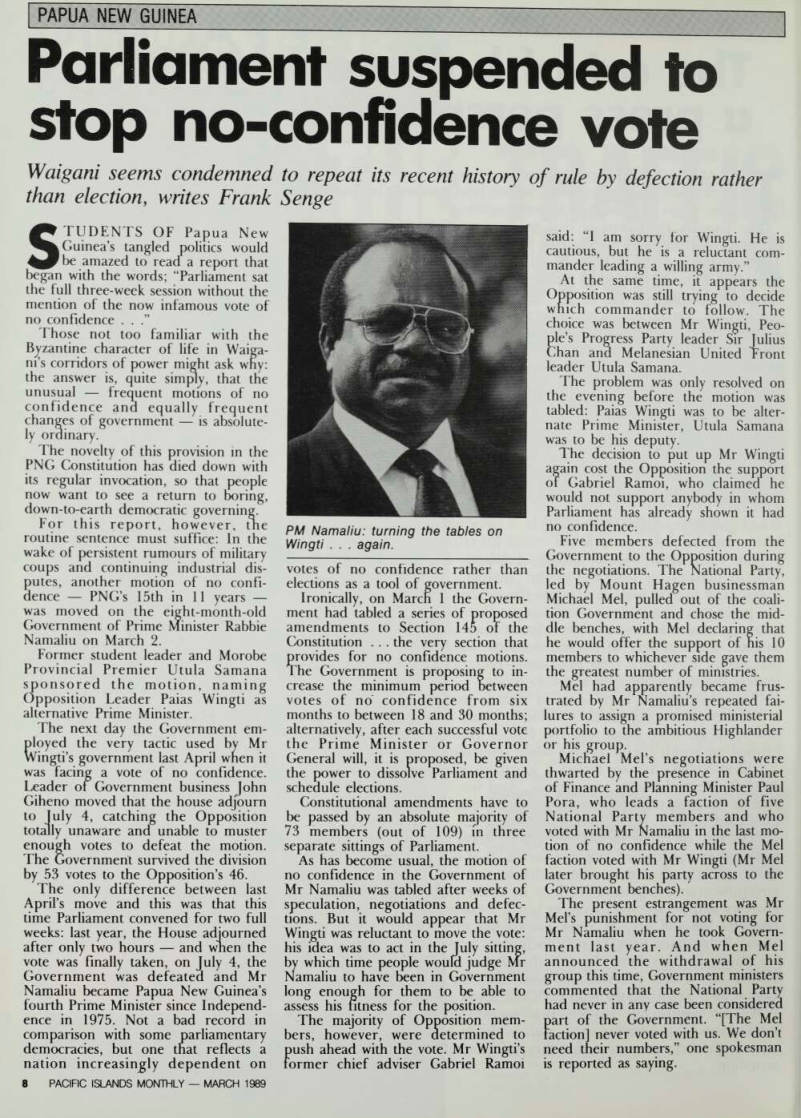
PM Namaliu: turning the tables on Wingti ... again.
Michael Mel has given Paul Pora’s group an ultimatum to follow the majority decision or be sacked from the party. The Government’s fate would be sealed should this group move out, but is highly unlikely: and Mr Pora has told a special meeting of the National Party that he would nev er vote for Mr Wingti the two have bitter grudges that date back to the 1982 elections. er vote for Mr Wingti the two have bitter grudges that date back to the 1982 elections.
The Melanesian Alliance, led by Father John Momis and human rights lawyer and Minister for Justice Ber nard Narakobi, will not leave the Gov ernment benches, if only because the Melanesian Alliance has never before enjoyed the privilege and power it currently holds. With four of its eight members holding ministries, the Melanesian Alliance has the enviable position of having a set of policies that is agreed to readily by the Prime Minister. The mining forum, which for the first time enabled direct nego tiations between landowners and de velopers; the involvement of provin cial governments in decision-making; and heavy emphasis on law and order are Melanesian Alliance ideas.
That leaves Ted Diro’s People’s Ac tion Party as the only other potential power broker with any real capacity.
And again as usual, Diro’s is the un predictable party in any coalition. Diro is as frustrated as Michael Mel at not securing a portfolio for himself (he lays claim to the deputy Prime Minis ter, currently held by fellow PAP par ty member Akoka Doi.) Diro’s problem, however, is that there is no guarantee he will get any better deal with the Opposition.
Though Paias Wingti is snowing in
terest in Mr Diro, it was he who initi ated the Forestry Inquiry and who
thereby started Diro’s problems.
With parties thus entrenched, the
Opposition is working on securing the
Parliamentary support of individual,
unaligned members.
During the two weeks prior to the March 2 motion, Minerals and Energy Minister Patterson Lowa was told by the Opposition that he could keep his ministry if he would cross the floor.
The same message was passed on to Housing Minister Gerald Sigulogo. It is reported that third MP had flown to Rabaul and, when he returned, had already switched sides.
Trade and Industry Minister Galeva Kwarara and Forests Minister Karl Stack were said to be talking to the Opposition, but the tide was stemmed
suddenly by former Communications
Minister Gabriel Ramoi, who announced that he was crossing to the Government with eight fellow Opposi tion members.
He did not, it seems, actually have the eight MPs, but the announcement was enough to cause reflection among Government members who were
thinking of defecting.
Mr Ramoi is adamant that he would not support his former boss again.
“There was a vote of no confidence in the leadership of Wingti. Parliament had no confidence in his leadership.
“How can we put the same man up and ask the same Parliament to change its decision and have confi dence in him again?” Mr Ramoi won dered to reporters.
The vote to which Mr Ramoi refers was taken in July 1988, and was fol lowed by a vote of no confidence in Paias Wmgti’s leadership of the Peo ple’s Democratic Movement . . . by Gabriel Ramoi. When the party reaf firmed Wingti’s leadership, Ramoi left with fellow PDM member Peter Ku man. They now hold independent
positions in the Opposition.
The main reason for the vote of no confidence is what the Opposition re fers to as a “lack of leadership” on the 3art of Rabbie Namaliu. The Opposi-
tion blames recent industrial disputes
in the mining industry and military
demonstrations in Port Moresby on the Government and on the Namaliu style of administration. It is commonly acknowledged that Mr Namaliu is a committee man, one who is uncom fortable with the prospect of tough ac tion. This has been displayed both on Bougainville and in the soldiers’ ‘ram page , when he delegated his deputy, Akoka Doi, to sort out the problems.
But the overriding feeling in the community is that Mr Namaliu must be given time. One Opposition MP who crossed to the Government, Theo Tuya, summed it up thus: “Whether Rabbie is the right Prime Minister or not, I want him to be given sufficient time to prove himself.” Mr Tuva said the continuous votes of no confidence had undermined the credibility of PNG and had effectively made it a “laughing stock” in the eyes of coun tries that practised the same or similar systems of government.
After adjourning Parliament Mr Namaliu admitted that his Govern ment was “spending too much time and resources looking over its shoul der” for votes of no confidence.
“We have to get back to govern ment,” he declared.
But governing with a motion of no confidence on Parliament’s agenda has always been an impossible task. And Opposition leader Paias Wingti has vowed to get rid of the Government, saying it lacks the support of the majority of members.
Government can be changed with a simple majority of 55 members, and Mr Wingti says the adjournment vote of 53-4 o shows the Government still lacks the required majority in the 109member Parliament (one seat is cur rently vacant after a member’s death) and that he has the support of 57 members, some of whom were not present in the house when the ad journment vote was taken.
“We now have a minority govern ment,” he says, “a situation in which in any other country, the Prime Minister
would resign. Knowing PNG politics I
would not expect that, but we will eventually take over Government. The
[present] Government,” Mr Wingti
claims, “is as good as dead.”
Mr Namaliu said his Government was intact, accused the Opposition of
being “frivolous and irresponsible”
and at the same time put part of the blame on the development of the poli tical system in PNG and the public’s lack of familiarity with the Westmins ter system and its workings.
Said Mr Namaliu: “The PNG poli tical situation is volatile. Political party discipline is not really entrenched.
“We are going through a period of experimenting. It takes time for our leaders to get used to it.” □
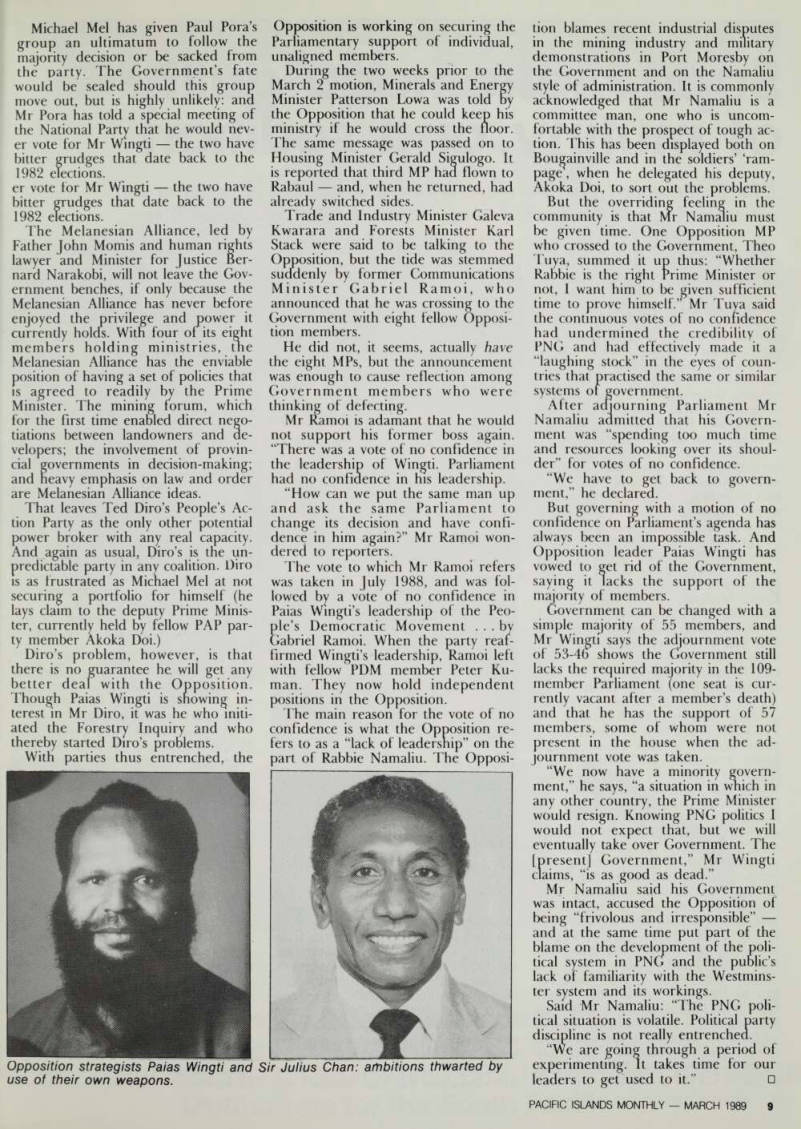
Opposition strategists Paias Wingti and Sir Julius Chan: ambitions thwarted by use of their own weapons.